Rails Framework Deep Dive: The Full-Stack Development Philosophy Behind 58k Stars
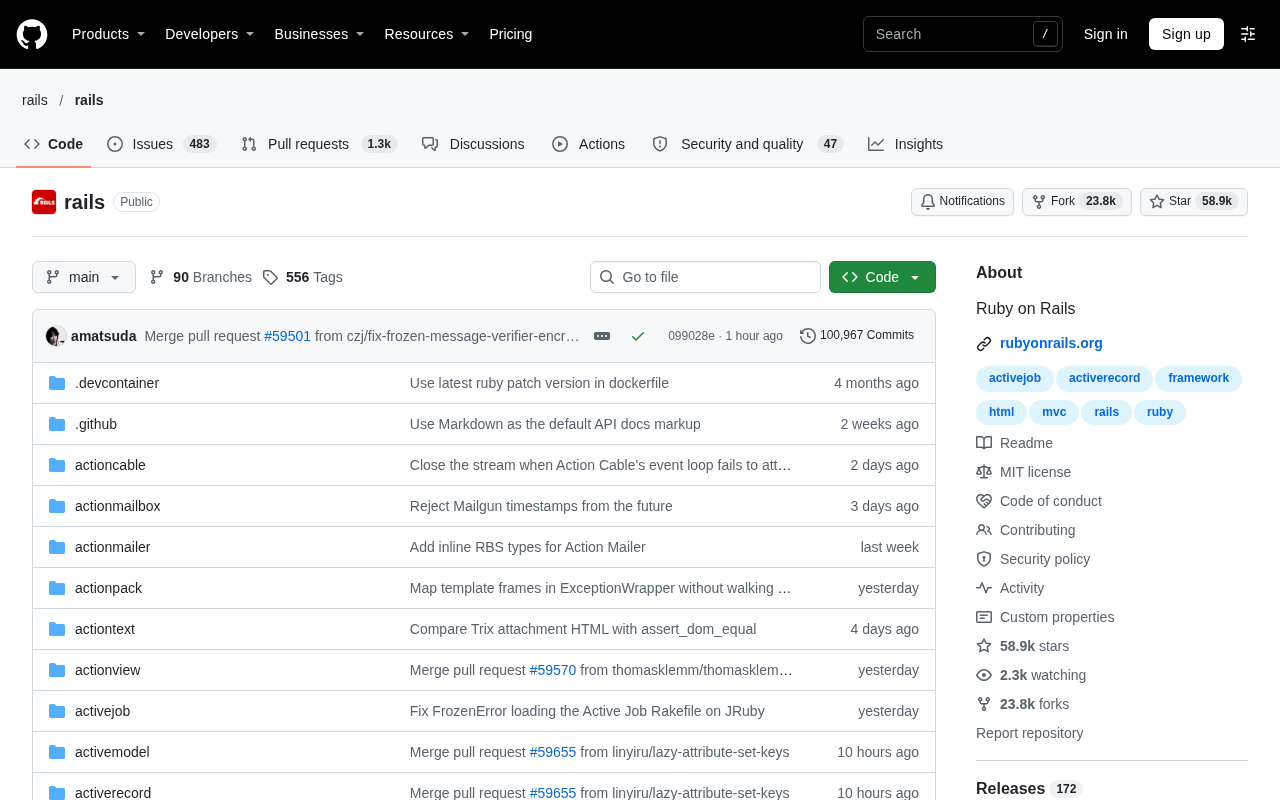
Rails centers on Convention over Configuration and DRY, using a full-stack integrated approach to trade for development efficiency.
The article introduces the rails/rails project with 58,889 stars on GitHub, noting that Rails is a Ruby web framework built on "Convention over Configuration" and "Don't Repeat Yourself." It offers an out-of-the-box full-stack solution, with official defaults for routing, controllers, models, views, migrations, and caching, letting developers go straight to business logic. Strict MVC separation lowers collaboration costs and suits small teams and rapid validation, but constrains highly customized systems. The Gem ecosystem and CLI toolchain add competitiveness beyond the framework, and the many forks reflect ongoing community collaboration. The article cautions that Rails' efficiency comes at a cost: developers must understand its internals, and its restrained pace suits stability-focused teams but may not fit those chasing the latest stack.
What Rails Is: A Framework That Defines a Development Paradigm
With 58,889 stars and 23,822 forks on GitHub, rails/rails is the most representative open-source project in the Ruby ecosystem. The project description is just a concise single line—Ruby on Rails. This web application framework, written in Ruby, has practiced the principles of "Convention over Configuration" and "Don't Repeat Yourself" (DRY) in an almost obsessive way since its inception.
Looking at the numbers, nearly 60,000 stars and over 20,000 forks indicate that this is not just a bookmarked project, but a technical foundation that has been repeatedly read, modified, and built upon by a large number of developers. The daily increase of 44 stars today also shows that even in an era of endless new frameworks, Rails still maintains steady attention.
Convention over Configuration is a software design paradigm whose core idea is that the framework presets reasonable default behaviors for common scenarios, and developers only need to explicitly configure the parts that deviate from the norm. In Rails, this means that if a model is named User, the framework automatically infers the corresponding database table as users, the controller as UsersController, and the view directory as app/views/users. This convention greatly reduces the number of configuration files and boilerplate code, making project structures highly consistent, but it also requires developers to understand and follow the framework's naming and organization rules.
DRY (Don't Repeat Yourself) emphasizes that every piece of knowledge in a system should have a single, unambiguous representation to avoid logic duplication. Rails implements this principle through features such as Active Record associations, the concern mechanism, partial templates, and helper methods, encouraging developers to extract shared logic and reduce maintenance costs.
Design Trade-offs of Full-Stack Integration
Complete by Default
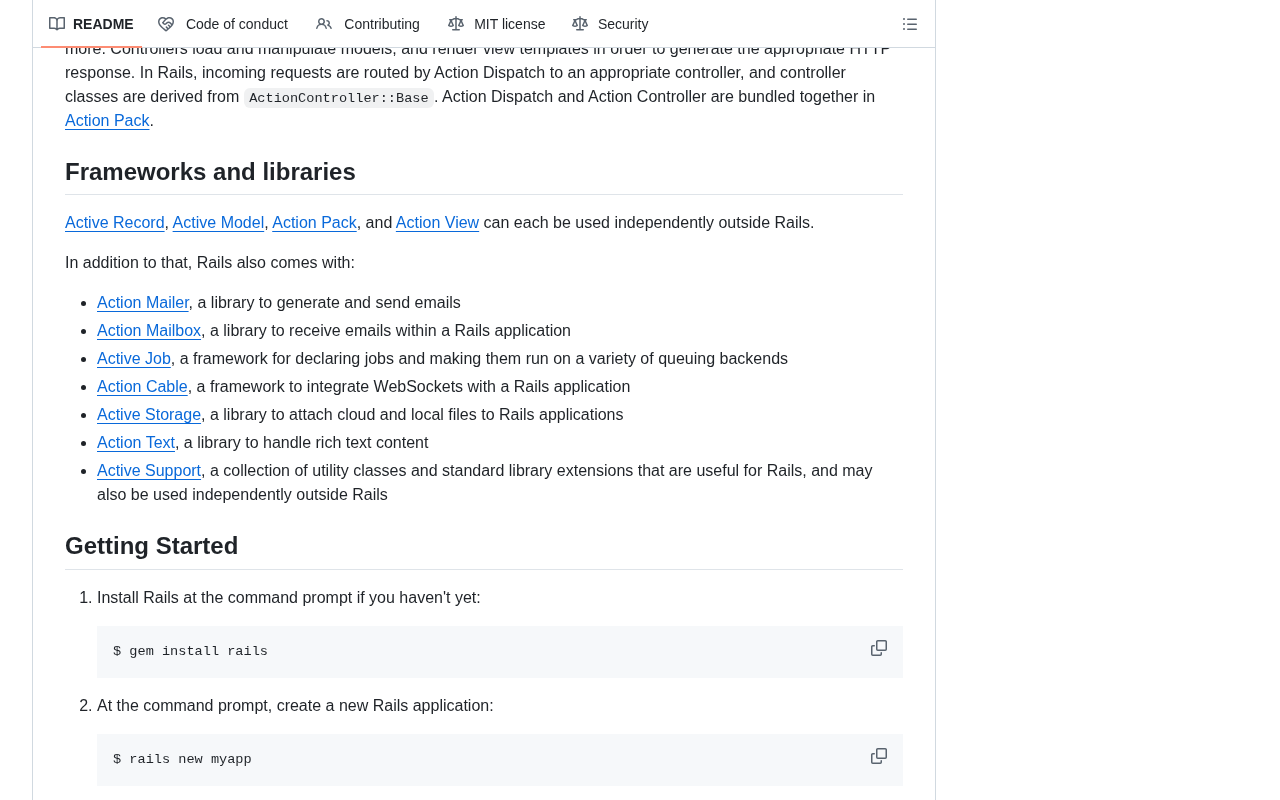
The most distinctive feature of Rails is that it provides a full-stack solution that works out of the box. Routing, controllers, models, views, database migrations, background jobs, caching, and email sending—these are all steps that require individual selection in most tech stacks, but in Rails, they all have official default implementations. Developers don't have to spend a lot of time comparing middleware at the project startup stage, but can go directly into writing business logic.
This design brings a clear advantage in development speed, at the cost of flexibility constraints. The framework assumes a structure it considers correct, and while enjoying the convenience, developers also need to accept how this structure shapes the project organization.
Strong Constraints of MVC
Rails is quite strict about implementing MVC. The model layer uses Active Record to handle data persistence and business logic, the controller is responsible for request dispatch, and the view layer completes rendering through the template system. The responsibility boundaries between the three are clarified by the framework, which reduces communication costs during team collaboration and allows new members to understand the project structure quickly.
For small and medium-sized teams or products that need rapid validation, these strong constraints often do more good than harm; for systems with highly customized architectures, however, design outside the framework boundaries may be necessary.
Active Record is Rails' ORM (Object-Relational Mapping) layer, which maps database tables to Ruby classes, rows in tables to object instances, and columns to object attributes. Beyond basic data persistence, Active Record also includes built-in associations (has_many, belongs_to, etc.), validations, callbacks, transactions, and query interfaces, enabling the model layer to handle both data access and some business logic. This "fat model" design is a typical Rails style, but it also requires developers to be careful to avoid models becoming overly bloated.
MVC (Model-View-Controller) is an architectural pattern that divides an application into three parts: data models, presentation views, and request-dispatching controllers. Rails' implementation of MVC is "strongly constrained" because it fixes the location and interaction of the three through directory structure and base classes (such as ApplicationController and ApplicationRecord), while the routes file centrally defines the mapping from URLs to controller actions, making request flow clear and predictable.
Support from the Ecosystem and Toolchain
Rails' competitiveness comes not only from the framework itself but also from the toolchain formed around it. The Rails command-line tools cover common operations from project initialization and code generation to database migrations, reducing the amount of boilerplate code to write. The Gem ecosystem provides mature third-party implementations for common needs such as authentication, payments, file uploads, and search.
This accumulated ecosystem is the result of time. Behind the more than 20,000 forks are both developers contributing code and enterprise teams building on Rails and pushing the framework's evolution in turn. Open-source collaboration here manifests as a continuous feedback loop: problems from real projects flow back into the framework, and the framework's iterations in turn serve more projects.
Gem is Ruby's package management unit, declaring project dependencies through the Bundler tool and Gemfile, similar to JavaScript's npm packages or Python's pip packages. The RubyGems repository hosts hundreds of thousands of Gems, and Rails itself is distributed as a Gem. Well-known Gems around Rails include Devise (authentication), Pundit (authorization), Sidekiq (background jobs), CarrierWave (file uploads), and others, covering high-frequency needs in web development and forming an important part of the Rails ecosystem.
Rails command-line tools center on the rails command and provide subcommands such as rails new (initialize a project), rails generate (generate skeleton code for models, controllers, migrations, etc.), rails db:migrate (run database migrations), and rails console (interactive debugging). These tools standardize common development operations, reduce the work of manually writing boilerplate code, and are also an extension of Rails' "Convention over Configuration" philosophy at the tooling level.
A Calm Judgment on Technology Selection
Rails is often labeled as "high development efficiency," but efficiency has never been a single-dimensional comparison. Its investment in convention and automation means developers need sufficient understanding of the framework's internal mechanisms to make correct judgments when encountering non-standard requirements. Using Rails as a black box brings obvious short-term benefits, but in the long run it may cost more when troubleshooting and extending functionality.
It should also be noted that Rails evolves at a relatively restrained pace. It does not chase every new architectural trend but continuously polishes around its existing paradigm. For teams pursuing stability and long-term maintenance costs, this pace is a plus; for scenarios that need to keep up with the latest tech stack, it may not be the optimal solution.
Who Should Pay Attention to This Project
Developers evaluating web backend tech stacks can use the rails/rails repository to understand how a mature framework organizes code, manages dependencies, and designs extension points. Teams already using Rails can understand the framework's decision logic through the source code and commit history, thereby writing code that better fits the framework's conventions.
The 58,889 stars are a result, not a reason. What is truly worth paying attention to is the project's sustained investment in the same design philosophy over more than a decade, and the engineering practices accumulated as a result.
One-line Summary
Rails centers on Convention over Configuration and DRY, trading a full-stack integrated solution for development efficiency.
Paragraph Summary
The article introduces the rails/rails project with 58,889 stars on GitHub, pointing out that Rails is a web application framework written in Ruby whose core philosophy is "Convention over Configuration" and "Don't Repeat Yourself." It provides an out-of-the-box full-stack solution, with routing, controllers, models, views, migrations, caching, and more all having official default implementations, allowing developers to go directly into business logic. Strict MVC responsibility division reduces team collaboration costs and suits small and medium-sized teams and rapid-validation products, but it constrains highly customized systems. The Gem ecosystem and command-line toolchain form competitiveness beyond the framework itself, and the large number of forks reflects continuous community collaboration and feedback loops. The article concludes by reminding readers that Rails' high efficiency is not without cost: developers need to understand the framework's internal mechanisms, and its restrained evolution pace suits teams pursuing stability but may not fit scenarios chasing the latest tech stack.
Related articles
 Tech Frontiers
Stylome Bot Slammed as Useless Junk: Why Do AI Detection Tools Keep Failing?
Reddit users test the Stylome AI detection bot: Gemini-rewritten text judged human-written, consistently low confidence. An analysis of AI text detection's technical dilemmas, privacy concerns, and credibility crisis in community governance.
 Tech Frontiers
When AI Becomes a Productivity Divide: Clarity or "AI Psychosis"?
A civil engineer's deep use of agentic AI boosted efficiency but bred contempt for peers who refuse to learn. Is this clarity or AI psychosis? An analysis of the cognitive and psychological challenges behind the AI productivity divide.
 Tech Frontiers
Opus 5.5 Benchmark Scores Climb, Community Says Its "Weights Are Blessed"
Reddit community discusses Opus 5.5's rising scores on the Benchmaxxing Bench, with users describing its performance as "weights are blessed." This article interprets the community reaction and cautions against conflating benchmark scores with real capability.