Rankfender 3.0: An All-in-One Operating System for AI Agents and SEO Teams

Rankfender v3.0 integrates SEO tools and adds AI assistant brand monitoring and agent operations.
Rankfender v3.0 launched on Product Hunt as an all-in-one SEO workspace combining keyword research, rank tracking (including AI Overviews), competitor and backlink analysis, site audits, traffic monitoring, and content and social strategy. Its differentiation is a built-in GEO module that tracks how 8 AI assistants including ChatGPT, Claude, Gemini, and Perplexity describe brands, plus support for Claude or ChatGPT AI agents to execute tasks. It received 76 upvotes and 6 comments, ranking 4th on the day. The article finds its positioning clear but notes that feature breadth versus execution depth, GEO monitoring reproducibility, and AI agent reliability still need practical verification.
Traditional SEO tools often leave marketing teams scrambling between multiple platforms, and the rise of AI assistants has introduced new challenges around brand visibility. Rankfender v3.0 presents an ambitious solution on Product Hunt: integrating keyword research, rank tracking (including AI Overviews), competitor and backlink analysis, site audits, traffic monitoring, and content and social strategy into a single platform—while filling a gap that older tools have missed: monitoring how 8 AI assistants, including ChatGPT, Claude, Gemini, and Perplexity, talk about your brand.
According to the Product Hunt page, the project has received 76 upvotes and 6 comments, ranking 4th on the day's leaderboard and categorized under Marketing, SEO, and Artificial Intelligence.
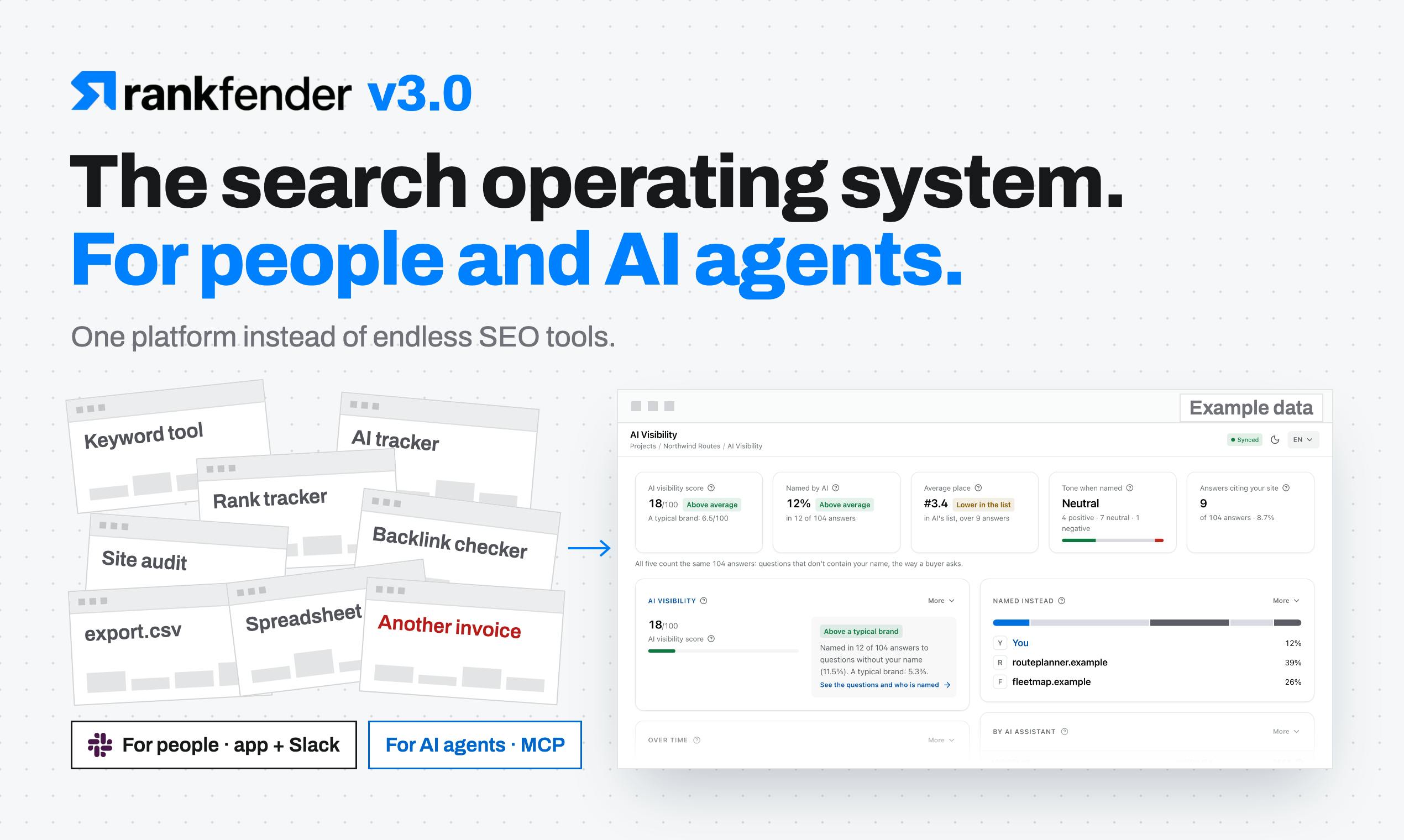
An all-in-one workspace: say goodbye to tool-switching fatigue
Rankfender 3.0's core selling point is straightforward: a single entry point for marketers, founders, and agencies tired of bouncing between multiple SEO tools. Its feature list covers most of the classic SEO workflow—keyword research, rank tracking, competitor analysis, backlink analysis, site audits, traffic data, and content and social modules.
The value of this "everything-in-one" integration lies in connected data. When ranking changes, competitor moves, and content performance appear in the same view, teams no longer need to manually stitch together reports from different tools. For small and mid-sized teams and startups with limited resources, reducing the number of tool subscriptions is itself a cost optimization.
You may not have noticed that the official description explicitly labels rank tracking as "including AI Overviews," meaning AI-generated summaries in traditional search results pages are now within the monitoring scope, rather than focusing solely on blue-link rankings.
GEO: monitoring how AI assistants talk about your brand
Rankfender 3.0's most distinctive capability is building "Generative Engine Optimization" (GEO) into a built-in module. The platform claims it can track how ChatGPT, Claude, Gemini, Perplexity, and 4 other AI assistants describe your brand.
This direction hits a real pain point. More and more users are asking AI assistants directly rather than using search engines, and how brands are cited, described, or even misrepresented in these conversations directly affects potential customers' perceptions. Traditional SEO tools are nearly powerless here, because AI answers are not simple mappings of keyword rankings.
Putting this capability on the same platform as rank tracking and content modules is logically consistent: teams can optimize traditional search performance while also observing brand share of voice in AI channels, with both sharing the same content assets and strategic perspective.
GEO (Generative Engine Optimization) is a concept proposed in contrast to traditional SEO (Search Engine Optimization). Its core goal is not to improve a webpage's ranking among blue links, but to ensure that brand information is accurately cited and positively described by generative AI assistants when answering user questions. Traditional SEO relies on keyword matching and link authority, whereas GEO faces natural-language answers generated by large language models based on training data and retrieval-augmented generation (RAG), whose outputs are stochastic and context-dependent. Current GEO practices include: optimizing content structure for AI crawling, establishing brand entity associations in authoritative sources, and monitoring brand mentions and sentiment in AI answers. Because AI answers may differ each time, designing a reproducible monitoring approach remains an industry challenge.
Built for AI agents: connect Claude or ChatGPT to operate directly
The word "operating system" in the product name is not purely rhetorical. Rankfender 3.0 explicitly supports connecting Claude or ChatGPT, allowing AI agents to execute tasks directly within the platform. Users can either operate manually in the app interface or hand repetitive work over to AI agents.
This is an interesting shift in the form of SEO tools. In the past, automation in such products mostly stayed at the level of report generation and alerts, but connecting general-purpose LLM agents means workflows can be driven by natural language—the boundaries between research, analysis, and execution become blurrier. For agencies, if AI agents can take over some routine tasks, the potential for productivity gains is worth anticipating.
Of course, letting AI agents operate SEO data also raises considerations around permissions and accuracy. How the platform balances automation convenience with data security is something that needs to be verified in actual use. The source material does not disclose relevant details.
AI Agent refers to a large-model application that can autonomously plan, call tools, and execute multi-step tasks, unlike a simple chatbot. In SEO scenarios, an AI agent can connect to a platform's API to automatically complete repetitive work such as keyword clustering, competitor data retrieval, and audit report generation. Its technical foundation usually includes function calling and tool-use protocols, enabling the model to operate external software. However, the reliability of agent execution is limited by the model's understanding of the task and the stability of tool interfaces, and strict permission controls are needed to prevent misoperations or data leaks. Rankfender's support for connecting Claude or ChatGPT means users can drive agents to run tasks within the platform using natural-language instructions, lowering the barrier to automation—but actual effectiveness still needs verification.
Market positioning and a sober view
Judging from its Product Hunt performance, 76 upvotes and 4th place on the day indicate the product has attracted some attention, but the 6 comments also suggest community discussion is not yet sufficient. As a tool aimed at marketing and SEO audiences, Rankfender 3.0's differentiation is clear: all-in-one integration plus GEO monitoring, plus AI agent access—a combination not commonly seen among similar products.
However, breadth of features and depth of execution are two different things. Platforms that integrate multiple modules often face the question of whether each module is deep enough, and GEO monitoring itself remains a field where methodologies are not yet mature—AI assistant answers are stochastic, so how to reliably quantify brand descriptions and how to distinguish results across different question scenarios are questions the product needs to answer.
For teams evaluating their SEO tool stack, Rankfender 3.0 deserves a place on the trial list, especially for teams that have already begun paying attention to brand visibility in AI channels. But during trials, it is worth focusing on verifying two things: the actual reliability of AI agents executing tasks, and the reproducibility of GEO monitoring data.
FAQ
Which AI assistants does Rankfender 3.0 support for monitoring? According to the official description, it covers ChatGPT, Claude, Gemini, Perplexity, and 4 other AI assistants, 8 in total.
Can it be used without opening the app? Yes. The product supports connecting Claude or ChatGPT so AI agents can run tasks; users can also operate manually within the app.
How is it different from traditional SEO tools? In addition to conventional features such as keyword research, rank tracking, competitor and backlink analysis, and site audits, it adds monitoring of brand descriptions by AI assistants and supports AI agent access for task execution.
One-line Summary
Rankfender v3.0 integrates SEO tools and adds AI assistant brand monitoring and agent operations.
Paragraph Summary
Rankfender v3.0 launched on Product Hunt, positioning itself as an all-in-one SEO workspace that integrates keyword research, rank tracking (including AI Overviews), competitor and backlink analysis, site audits, traffic monitoring, and content and social strategy into a single platform to reduce tool switching. Its differentiation lies in a built-in GEO module that can track how 8 AI assistants—including ChatGPT, Claude, Gemini, and Perplexity—describe brands, and it supports connecting Claude or ChatGPT so AI agents can execute tasks. The product received 76 upvotes and 6 comments, ranking 4th on the day. The article argues that its positioning is clear, but feature breadth versus execution depth, the reproducibility of GEO monitoring, and the reliability of AI agents still need practical verification.
Related articles
 Tech Frontiers
Stylome Bot Slammed as Useless Junk: Why Do AI Detection Tools Keep Failing?
Reddit users test the Stylome AI detection bot: Gemini-rewritten text judged human-written, consistently low confidence. An analysis of AI text detection's technical dilemmas, privacy concerns, and credibility crisis in community governance.
 Tech Frontiers
When AI Becomes a Productivity Divide: Clarity or "AI Psychosis"?
A civil engineer's deep use of agentic AI boosted efficiency but bred contempt for peers who refuse to learn. Is this clarity or AI psychosis? An analysis of the cognitive and psychological challenges behind the AI productivity divide.
 Tech Frontiers
Opus 5.5 Benchmark Scores Climb, Community Says Its "Weights Are Blessed"
Reddit community discusses Opus 5.5's rising scores on the Benchmaxxing Bench, with users describing its performance as "weights are blessed." This article interprets the community reaction and cautions against conflating benchmark scores with real capability.