RAT-Bench Extended to Malaysia: Localized Evaluation of Text Anonymization and Trustworthy AI
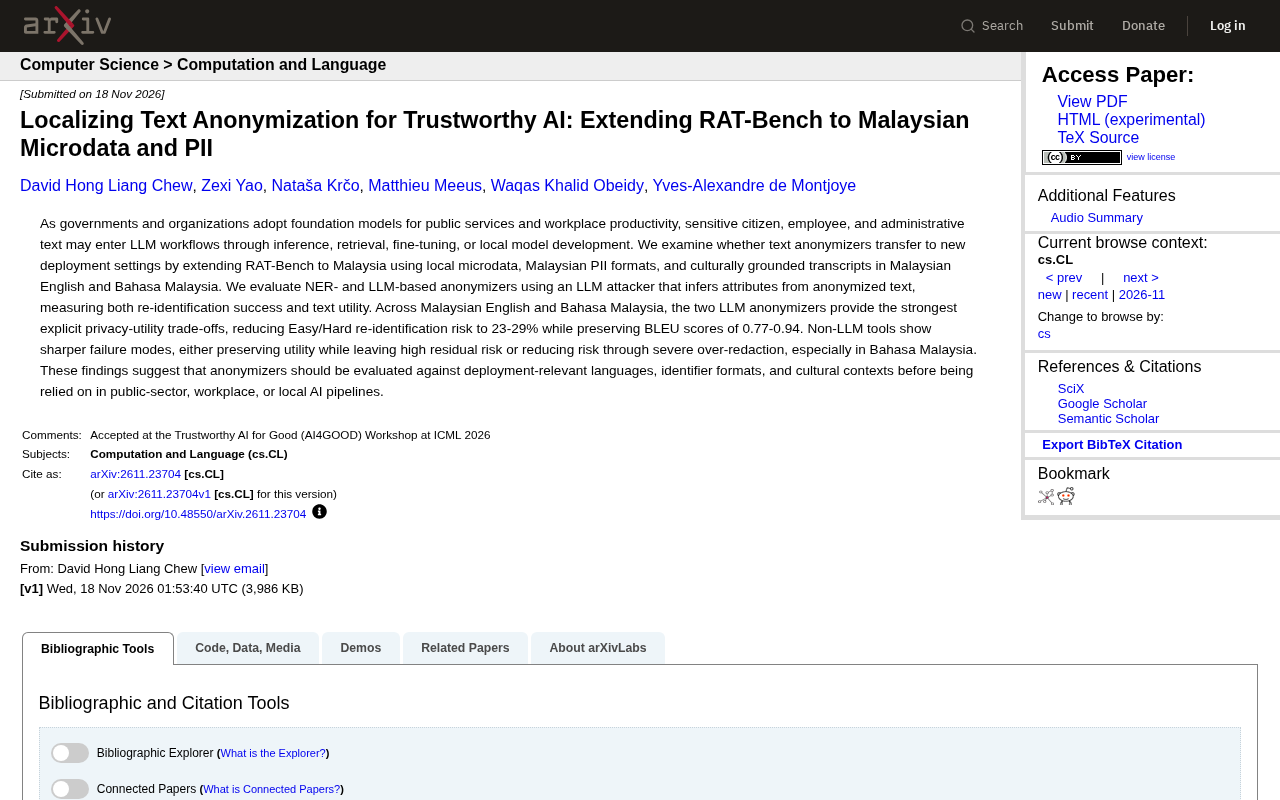
Study extends RAT-Bench to Malaysia, finding LLM anonymization tools more robust in cross-lingual privacy-utility trade-offs.
A recent study extends the text anonymization benchmark RAT-Bench to Malaysia's multilingual environment, using local microdata, PII formats, and Malay and Malaysian English transcripts to evaluate NER-based and LLM-based anonymization tools. Using an LLM as an attacker and measuring both re-identification risk and text utility, it finds that two LLM-based tools reduce Easy/Hard re-identification risk to 23-29% while maintaining BLEU scores of 0.77-0.94, offering the strongest privacy-utility trade-off; non-LLM tools show sharper failure modes, either leaving high residual risk or severely over-anonymizing in Malay. The study stresses that anonymization tools cannot be assumed to transfer seamlessly and must be evaluated under deployment-relevant language, identifier formats, and cultural context.
As government agencies and enterprises bring foundation models into public services and office workflows, text from citizens, employees, and administrative documents may enter LLM workflows through inference, retrieval, fine-tuning, or local model development. Such text often contains personally identifiable information (PII), and any leak poses serious privacy risks. Text anonymization tools are therefore seen as a critical line of defense for trustworthy AI deployment. But can these tools remain effective in new deployment environments? A recent study systematically examines this question by extending RAT-Bench to Malaysia.
Why localized anonymization evaluation is needed
Existing anonymization benchmarks are mostly designed for English and high-resource-country PII formats. When these tools are transferred directly to other languages and cultural contexts, their performance may degrade substantially. The study points out that anonymization tools should be evaluated in the languages, identifier formats, and cultural contexts relevant to deployment, rather than assuming cross-environment generalization.
Malaysia is a typical multilingual society where English and Bahasa Malaysia coexist, and PII formats also carry local characteristics. The research team built an extended RAT-Bench evaluation set using local microdata, Malaysian PII formats, and culturally grounded Malay and Malaysian English transcripts. This approach directly addresses a real-world problem: public-sector, workplace, or local AI pipelines need to know the privacy-utility trade-offs of anonymization tools in real language environments before relying on them.
RAT-Bench (Robustness Assessment Test for Text Anonymization Benchmarks) is a benchmark framework for systematically evaluating the privacy-utility trade-offs of text anonymization tools. Its core design uses an LLM as an attacker, simulating attribute inference attacks under realistic threat models, while quantifying both re-identification success rate and text utility. The original RAT-Bench was built primarily for English and high-resource-country contexts, so extending it to Malaysia required incorporating local microdata, PII samples in Malaysian formats, and Malay and Malaysian English transcripts. This extension reflects the methodology of benchmark localization: rather than simply translating the original benchmark, the evaluation data is rebuilt according to the language distribution, identifier formats, and cultural context of the target deployment environment, thereby testing the tools' generalization in real scenarios.
Evaluation method: LLM attacker and dual metrics
The study adopts an evaluation approach that closely reflects realistic threat models: it uses an LLM as an attacker to infer attributes from anonymized text while measuring two dimensions—re-identification success rate and text utility. The former reflects privacy protection effectiveness, while the latter reflects whether the anonymized text remains usable for downstream tasks.
The evaluation covers both NER-based and LLM-based anonymization tools. This design reveals the failure modes of different technical approaches in cross-lingual and cross-cultural scenarios, rather than merely giving a broad "good" or "bad" conclusion.
Re-identification risk measures the probability that an attacker can successfully infer a specific identity or sensitive attribute from anonymized text. In the evaluation framework of this paper, it is further divided into two difficulty levels, Easy and Hard: Easy means the attacker only needs to use obvious residual identifiers or contextual cues in the text to complete the inference, while Hard requires the attacker to combine information from multiple fragments. This metric directly reflects the privacy protection strength of anonymization tools, with lower values indicating more effective protection. The corresponding text utility is usually measured by automatic metrics such as BLEU scores, which capture the semantic and structural similarity between anonymized and original text; higher scores indicate that the text is more suitable for downstream tasks. The essence of the privacy-utility trade-off is that excessive anonymization can reduce re-identification risk but sacrifices utility, while retaining too much information may leak privacy. Evaluation tools need to find an acceptable balance between the two.
NER-based anonymization tools rely on named entity recognition models to locate entities such as names, locations, organizations, and phone numbers in text and replace them with placeholders or pseudonyms. Their effectiveness depends heavily on the NER model's coverage of the target language and local identifier formats, and they are prone to missed detections in cross-lingual scenarios. LLM-based anonymization tools leverage the contextual understanding of large language models to identify and rewrite a broader range of potential identity information, including implicit references and combinable identifiability. The difference between these technical approaches determines their different failure modes in cross-lingual and cross-cultural environments: NER tools are limited by entity recognition recall, while LLM tools are better at handling indirect identifiers in context but may also introduce excessive rewriting or omissions. Understanding this distinction helps explain why LLM tools perform more robustly in Malaysia's multilingual environment.
Key finding: LLM anonymization tools are more robust
In both Malaysian English and Malay language environments, the two LLM-based anonymization tools provided the strongest explicit privacy-utility trade-offs. They reduced Easy/Hard re-identification risk to 23-29% while maintaining BLEU scores between 0.77 and 0.94. This means that while significantly reducing privacy risk, the text still retains most of its usability.
In contrast, non-LLM tools exhibited sharper failure modes. They either left high residual risk while maintaining utility, or reduced risk through severe over-anonymization—the latter being particularly prominent in the Malay environment. Although over-anonymization lowers re-identification risk, it can destroy the semantic integrity of the text and make it difficult to use for practical tasks.
This contrast shows that the choice of technical approach is crucial in localized deployment. LLM anonymization tools show advantages in balancing privacy and utility, while non-LLM tools perform less consistently in cross-lingual environments.
Implications for trustworthy AI deployment
The study concludes that anonymization tools cannot be assumed to transfer seamlessly to new deployment environments. Before relying on anonymization tools in public services, workplace productivity tools, or local AI pipelines, targeted evaluations should be conducted for the languages, identifier formats, and cultural contexts relevant to deployment.
For organizations planning to deploy LLMs in multilingual environments, this means incorporating anonymization evaluation into localization processes rather than treating it as a one-time generic configuration. The Malaysian case shows that even tools of the same type can differ significantly in privacy-utility performance across languages. Trustworthy AI implementation depends on careful consideration of local contexts.
One-line Summary
A study extends RAT-Bench to Malaysia and finds that LLM-based anonymization tools offer more robust cross-lingual privacy-utility trade-offs.
Paragraph Summary
A recent study extends the text anonymization benchmark RAT-Bench to Malaysia's multilingual environment, using local microdata, PII formats, and Malay and Malaysian English transcripts to systematically evaluate NER-based and LLM-based anonymization tools. Using an LLM as an attacker, the study measures both re-identification risk and text utility. Results show that two LLM-based anonymization tools reduce Easy/Hard re-identification risk to 23-29% while maintaining BLEU scores of 0.77-0.94, providing the strongest privacy-utility trade-off; non-LLM tools exhibit sharper failure modes, either leaving high residual risk while maintaining utility or severely over-anonymizing in the Malay environment. The study concludes that anonymization tools cannot be assumed to transfer seamlessly and must be specifically evaluated under deployment-relevant languages, identifier formats, and cultural contexts, and incorporated into localization processes.
Related articles

GLM-5.4 vs. Opus and Neon: How Far From the Top?
No official benchmarks for GLM-5.4. Based on a YouTube deep test and developer trials, we analyze its gap vs. Claude Opus 5.5 and Gemini Neon, the speed bottleneck from marathon-style thinking, and its real position in enterprise agent scenarios.

From Gobbler to Sloppy Joe: The Hit-Making Playbook of a New Jersey Deli Institution
NYT Cooking visits Milburn Deli in New Jersey to break down the hit logic behind the Gobbler turkey sandwich and the local Sloppy Joe: bread sliced to order, house-made sauces, a group shout culture, and customer co-creation behind six locations.
In the Age of AI Programming, When Do You Still Need to Write Code by Hand?
Is handwritten code still valuable once AI programming agents are widespread? This article outlines three scenarios where handwriting is essential—learning, style development, and prototype validation—and provides a division-of-labor framework between AI and humans to help developers balance efficiency and skill growth.