REA: Let AI Agents Reverse Engineer Closed-Source Application Code

REA packages reverse engineering tools as AI Agent capabilities, letting models directly analyze closed-source apps.
REA is a tool that integrates reverse engineering capabilities into AI Agents. Traditional reverse engineering requires proficiency with disassemblers like IDA Pro, Ghidra, and radare2, understanding assembly instructions and file formats—an extremely high barrier. REA packages this capability as tools Agents can invoke, letting models interpret disassembly and decompilation results. One command integrates it with mainstream AI coding tools like Cloud Code, Codex, Cursor, and Gemini without restructuring workflows, covering native binaries, Electron apps, .NET programs, Android packages, and firmware. Reverse engineering analysis runs locally to reduce sensitive code leakage risk, but the model interpretation step still requires attention to transmission boundaries. The article also discusses its value in security auditing, compatibility troubleshooting, and learning/research, and the legal and ethical issues from lowered barriers.
Every application you run is essentially a black box. You have no way of knowing what it does internally, how it handles data, or whether it harbors hidden behaviors. REA attempts to break through this barrier—it plugs reverse engineering tools directly into your AI Agent, enabling the model to "read" the internal code logic of closed-source applications rather than being limited to guesswork.

What Problem Does REA Solve
Traditionally, reverse engineering has been an extremely high-barrier endeavor. You need to be proficient with disassemblers like IDA Pro, Ghidra, or radare2, understand assembly instructions, PE/ELF file formats, and function calling conventions. For Electron apps, .NET programs, or Android packages, you'd have to switch to entirely different toolchains.
REA's approach is to encapsulate this capability into tools that an Agent can invoke. You don't need to master reverse engineering yourself; instead, you let the AI Agent execute the analysis workflow, and the model is responsible for interpreting the output from disassemblers and decompilers. This lowers the operational barrier to reverse engineering analysis while keeping the critical step—analysis execution—localized.
Reverse engineering refers to the process of inferring the structure, logic, and behavior of a compiled program in the absence of source code. It is not a single action but a pipeline: first identify the file format (such as PE on Windows or ELF on Linux), then disassemble into assembly instructions, then attempt to reconstruct high-level-language-like control flow through decompilation, and finally combine with a debugger to dynamically trace runtime behavior. Traditional tools like IDA Pro excel at interactive analysis and cross-referencing, Ghidra is known for being open-source and its decompiler, while radare2 leans toward command-line and scripting. The common bottleneck of these tools is that the assembly and pseudocode they output are obscure and massive in scale, making manual reading extremely costly. REA's value lies precisely in handing off the most labor-intensive part—"reading results, finding clues, drawing conclusions"—to AI models that excel at processing vast amounts of text and patterns.
One Command Integrates with Mainstream AI Coding Tools
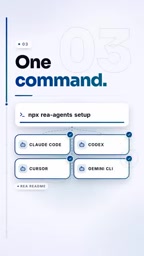
REA is straightforward to use: a single command adds it to Cloud Code, Codex, Cursor, or Gemini. This means existing AI coding workflows don't need major changes—the Agent simply gains a reverse engineering analysis capability.

The design intent behind this integration approach is clear: reverse engineering should not be a standalone, isolated work step. If you're using Cursor for code auditing, or debugging the behavior of some dependency library in Cloud Code, invoking REA's reverse engineering tools directly in the same conversation is far more efficient than switching to another tool and manually passing results back and forth.
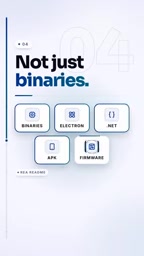
Covers Multiple Application Forms, Not Just Binaries
REA supports a fairly broad range of reverse engineering targets:
- Native binaries: Requires disassembler support; the model reads disassembly output
- Electron apps: These apps are packaged on web technology stacks and often contain readable JavaScript code internally, but packaging methods vary and require specialized handling
- .NET programs: Decompilation of IL intermediate language is relatively mature, and the toolchain is well-developed
- Android packages (APK): Involves decompilation of DEX bytecode, resource extraction, and manifest analysis
- Firmware: Embedded device firmware typically has diverse architectures and lacks symbol information, making it the most difficult to analyze
The significance of this multi-form coverage is that real-world reverse engineering needs are rarely of a single type. A security researcher might spend the morning analyzing Android malware and the afternoon dismantling an IoT device's firmware. If each type required switching between different tools, the efficiency loss would be significant. REA unifies these under a single Agent interface.
The reverse engineering challenges for these application forms differ. Electron apps are essentially programs packaged with Chromium and Node.js runtimes, where business logic is often embedded as JavaScript within asar archives—theoretically readable, but often compressed, obfuscated, or encrypted, requiring unpacking before restoration. .NET programs compile to IL (intermediate language) rather than machine code, and with tools like dnSpy and ILSpy, they can often be decompiled into results close to the original source code, making them the most readable among all forms. Android packages are actually ZIP structures whose core is DEX bytecode, requiring jadx, apktool, and similar tools for decompilation and resource extraction. Firmware is the most challenging: it targets multiple architectures like ARM, MIPS, and RISC-V, typically stripped of symbol tables, and may be compressed or encrypted—the starting point is often locating an entry point from an unknown stream of bytes.
Analysis Runs Locally
REA emphasizes local execution: the analysis itself runs on your own machine.
For reverse engineering scenarios, local execution is not a nice-to-have but a basic requirement. The targets of reverse engineering analysis often involve sensitive code, proprietary algorithms, and security vulnerability details. Sending this data to cloud services carries obvious compliance and confidentiality risks. Local execution means the analysis artifacts—disassembly output, function call graphs, string extraction—never leave your machine.
It's worth noting that "local" here refers to the execution of reverse engineering tools. If the model itself runs in the cloud, the analysis results still need to be transmitted to the model for interpretation. There's a boundary worth paying attention to here: raw data output by disassemblers may contain sensitive information, and data sanitization must be considered when sending it to cloud models. REA keeps the analysis step local, reducing but not completely eliminating paths for data leakage.
Understanding this requires distinguishing between two phases: "analysis" and "interpretation." The analysis phase refers to computation-intensive operations like disassembly, decompilation, symbol extraction, and control flow reconstruction, performed by local tools; the interpretation phase is where the model performs reasoning, summarization, and conclusion generation based on these structured outputs. If the model is deployed in the cloud, this step must go through network transmission. Therefore, what truly determines whether data leaks is the input content of the second phase. Disassembly output may contain hardcoded keys, internal API addresses, debug strings, or even residual user data, all of which could be sent along with the context. In scenarios with strict compliance requirements, consider performing filtering and sanitization locally first, sending only function fragments relevant to the target question to the model, or directly using a locally deployed model to completely close the data chain.
Implications for Extending AI Agent Capabilities
REA's emergence reflects a trend: AI Agents are extending from "generating code" to "understanding existing code," and closed-source applications are the final piece of the puzzle for understanding existing code.
In practical scenarios, this could mean:
- Security auditing: Having the Agent analyze whether a closed-source library has suspicious network requests or data collection behaviors
- Compatibility troubleshooting: When a closed-source SDK behaves abnormally, locating the root cause through reverse engineering
- Learning and research: Understanding the core algorithm implementation approach of an application
Of course, reverse engineering itself involves legal and ethical boundaries. Analyzing software you have legitimate authorization for, for security research or interoperability purposes, is different from bypassing copyright protection or malicious cracking. The tool itself is neutral; the user's intent determines its nature.
REA's attempt to agentify reverse engineering capabilities lowers the barrier to using this technology. The efficiency gains from lowered barriers and the accompanying risk of abuse are two sides of the same coin.
One-line Summary
REA encapsulates reverse engineering tools as capabilities AI Agents can invoke, letting models directly analyze closed-source applications.
Paragraph Summary
REA is a tool that integrates reverse engineering capabilities into AI Agents. Traditional reverse engineering requires proficiency with disassemblers like IDA Pro, Ghidra, and radare2, plus understanding of assembly instructions and file formats—an extremely high barrier. REA encapsulates this capability into tools Agents can invoke, letting the model interpret disassembly and decompilation results. It integrates with mainstream AI coding tools like Cloud Code, Codex, Cursor, and Gemini with a single command, requiring no workflow restructuring, and covers native binaries, Electron apps, .NET programs, Android packages, and firmware. Reverse engineering analysis runs on the local machine, reducing the risk of sensitive code leakage, but the model interpretation step still requires attention to transmission boundaries. The article also discusses its value in security auditing, compatibility troubleshooting, and learning/research, as well as the legal and ethical issues arising from lowered barriers.
Related articles

Gmod TTT: Boba's Winning Streak and Game Design Insights
An in-depth analysis of Gmod TTT's role system, creative items, and social gameplay mechanics, exploring the relationship between randomness design and game balance through Boba's winning streak phenomenon.

FlexBudget: Fair Comparison of KV Cache Eviction Strategies Under a Unified Compute Budget
AMD engineer proposes FlexBudget at PyTorch Conference: a training-free fair comparison method for KV cache eviction rules using fixed kernels and memory budgets, all in core PyTorch.
