React: The Benchmark UI Library for Web and Native Interfaces

React continues to shape modern frontend development with over 250,000 stars through componentization, declarative programming, and cross-platform capability.
React is an open-source UI library maintained by Meta with over 250,000 GitHub stars and about 244 new stars per day. Its core philosophy is to break interfaces into independent, reusable components and describe interface state declaratively rather than manually manipulating the DOM, improving maintainability for large applications. Through React Native, the same component-based philosophy extends to native iOS and Android development, embodying the "learn once, write anywhere" idea; React itself is not bound to a rendering target, with renderers such as React DOM and React Native handling rendering in layers. Its vast ecosystem covers routing, state management, build tools, and testing, reducing problem-solving costs while also creating selection costs for beginners. Overall, React's benchmark status is built on component-based design, cross-platform capability, and community vitality, and its declarative paradigm has profoundly influenced modern frontend development thinking.
React, one of the most influential UI libraries in the frontend world, has garnered over 250,000 stars on GitHub, with roughly 244 new stars added daily. Maintained by Meta as an open-source project, it continues to define how modern web and native application interfaces are developed through its declarative programming model and component-based architecture.
Component-Based Thinking: From UI Description to Reusable Units
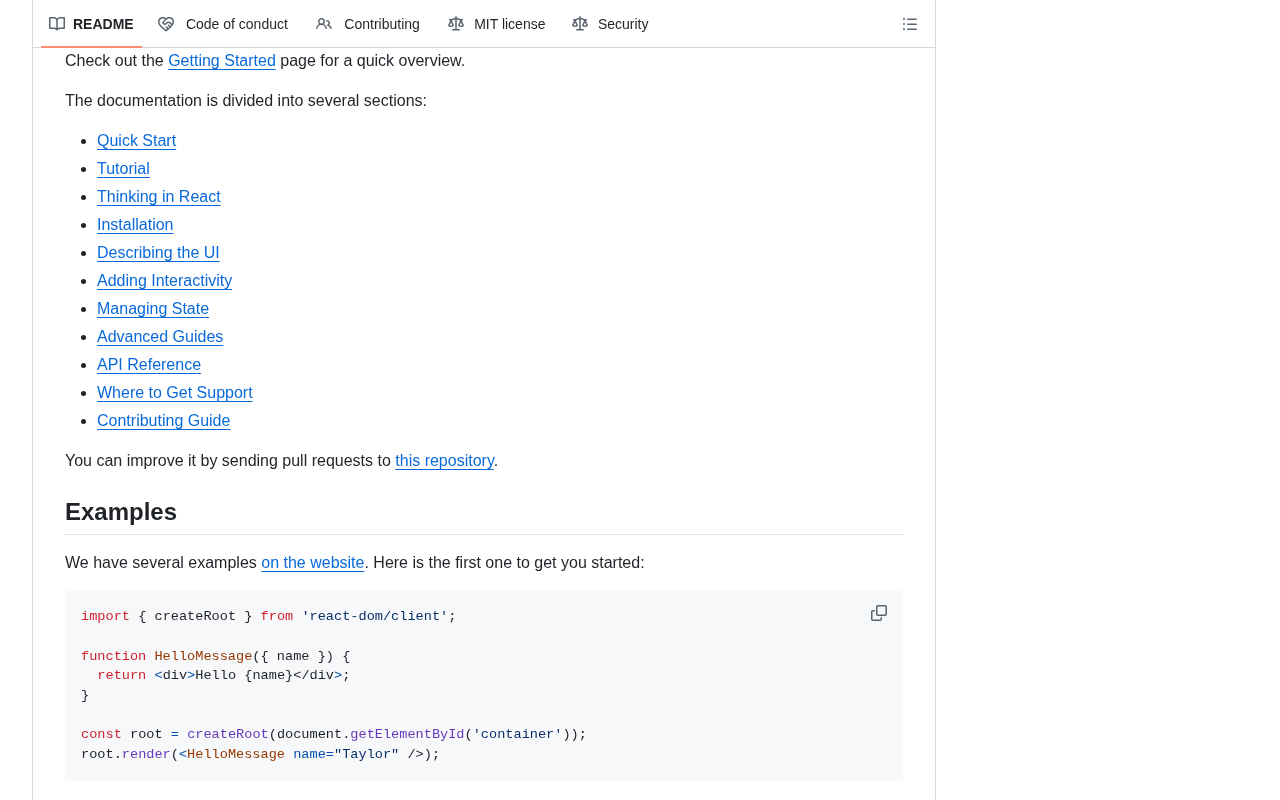
React's core philosophy is to break interfaces down into independent, reusable components. Each component encapsulates its own state and rendering logic, and complex interfaces are built through composition. This pattern allows developers to declaratively describe "what the interface should look like" rather than manually manipulating the DOM step by step. For large applications, the maintainability gains from componentization are especially pronounced—teams can develop different components in parallel and then integrate them through clear interfaces.
According to GitHub repository data, React has over 51,000 forks, and its vast community ecosystem has spawned a huge number of third-party component libraries and toolchains, further lowering the barrier to component reuse.
The contrast between declarative and imperative programming is the key background for understanding React's design philosophy. Imperative programming focuses on "how to do it": developers must manually retrieve DOM nodes and step by step modify their attributes, styles, and content, for example document.getElementById('app').innerHTML = '...'. When application state and views need to be synchronized frequently, this pattern is prone to missed updates or inconsistencies. Declarative programming focuses on "what to do": developers simply describe what the interface should look like given a particular state, and the framework is responsible for efficiently mapping state changes to the actual DOM. React achieves this through the virtual DOM and its reconciliation mechanism: when state changes, it first computes a new virtual DOM tree, then compares it with the old tree, and finally batches minimal real DOM operations. This abstraction frees developers from tedious DOM manipulation and makes interface behavior more predictable and easier to test.
Cross-Platform Capability: A Unified Abstraction for Web and Native Interfaces
React's scope is not limited to the browser. Through React Native, the same component-based philosophy extends to native iOS and Android app development. Developers can write interface logic in JavaScript and compile it into native component rendering. This "learn once, write anywhere" philosophy allows frontend teams to enter mobile development with a relatively low learning cost.
It is worth noting that React itself is not bound to any specific rendering target—it provides an abstraction layer for describing UI, while the actual rendering is handled by renderers such as React DOM and React Native. This layered design leaves room for the community to explore more rendering scenarios (such as server-side rendering and desktop applications).
React Native's native rendering mechanism deserves further explanation. Unlike WebView or hybrid app approaches, React Native does not render HTML in a WebView; instead, it runs React component logic on a JavaScript thread and then passes UI descriptions to the native thread via the "Bridge" or, in the new architecture, JSI (JavaScript Interface), with rendering ultimately completed by platform-native components (such as iOS's UIView or Android's View). As a result, React Native apps look and perform closer to native apps. Its companion Yoga layout engine translates Flexbox layout rules into each platform's layout calculations, enabling developers to describe cross-platform interfaces with a unified style syntax. This also explains why React can decouple "the abstraction layer for describing UI" from "the specific rendering target": React core is only responsible for the component tree and state management, while React DOM and React Native handle rendering responsibilities for the browser and native platforms respectively.
Ecosystem and Community: The Developer Network Behind 250,000 Stars
The 252,032 stars on GitHub and roughly 244 new stars per day reflect React's continued ability to attract new developers. Behind this number is a mature ecosystem: routing, state management, build tools, and testing frameworks are all covered by official or community solutions. For enterprise technology selection, React's community scale means it is easier to find solutions and talent when problems arise.
However, a thriving ecosystem also brings selection costs. Beginners facing numerous companion tools can easily fall into "choice paralysis," which is a commonly discussed aspect of React's learning curve.
The meaning and limitations of GitHub stars need to be viewed objectively. Stars are a lightweight way for developers to express interest in or approval of a project, and they do not directly equate to production usage or code quality. A project may gain a large number of stars due to topic popularity, tutorial recommendations, or historical accumulation, so 250,000 stars is better used as a reference indicator of "community attention" rather than the sole basis for technology selection. When evaluating a frontend technology stack, it is usually also necessary to comprehensively consider npm weekly downloads, GitHub Issue response speed, release cadence, long-term maintenance commitments (such as Meta's continued investment in React), and the distribution of demand in the corporate hiring market. For React, its star count, download volume, and ecosystem scale corroborate one another, but readers should still understand the statistical definitions and limitations behind any single metric.
The Long-Term Value of Declarative Programming
From the perspective of technological evolution, the declarative UI programming paradigm promoted by React has been widely accepted. It makes synchronization between state and view predictable and reduces bugs caused by manual DOM manipulation. As application complexity increases, the advantages of this programming model become more pronounced. For teams evaluating frontend technology stacks, React's maturity and community vitality remain important reference indicators.
Overall, React's benchmark status as a UI library is built on its component-based design, cross-platform capability, and vast ecosystem. It is not the only choice, but its influence has profoundly shaped the way modern frontend development is approached.
Related articles
 Tech Frontiers
Stylome Bot Slammed as Useless Junk: Why Do AI Detection Tools Keep Failing?
Reddit users test the Stylome AI detection bot: Gemini-rewritten text judged human-written, consistently low confidence. An analysis of AI text detection's technical dilemmas, privacy concerns, and credibility crisis in community governance.
 Tech Frontiers
When AI Becomes a Productivity Divide: Clarity or "AI Psychosis"?
A civil engineer's deep use of agentic AI boosted efficiency but bred contempt for peers who refuse to learn. Is this clarity or AI psychosis? An analysis of the cognitive and psychological challenges behind the AI productivity divide.
 Tech Frontiers
Opus 5.5 Benchmark Scores Climb, Community Says Its "Weights Are Blessed"
Reddit community discusses Opus 5.5's rising scores on the Benchmaxxing Bench, with users describing its performance as "weights are blessed." This article interprets the community reaction and cautions against conflating benchmark scores with real capability.