Reactive Optimizers: Rewriting Optimizer Source Code During Training — A New Paradigm for Performance Gains

Reactive Optimizers dynamically rewrites optimizer source code during training to achieve code-level adaptivity.
Reactive Optimizers proposes dynamically rewriting optimizer source code during training rather than merely tuning hyperparameters, enabling real-time adjustment of internal logic based on training state. Its core mechanism relies on abstract representations such as ASTs or intermediate representations, then generating new code from feedback like gradient statistics. This treats the optimizer algorithm itself as the search space, distinguishing it from meta-learning and NAS and bringing it closer to program synthesis. It offers finer-grained adaptivity than hyperparameter search but risks non-deterministic training and challenges in reproducibility and stability. It imposes new requirements on training frameworks for hot-swapping code and may drive dynamic compilation development. Currently it is closer to proof-of-concept.
When Optimizers Learn to "Modify Themselves"
In deep learning training, optimizers (such as SGD and Adam) are typically treated as fixed components whose behavior is determined before training begins. Reactive Optimizers proposes a counterintuitive idea: dynamically rewriting the optimizer's own source code during training, allowing the optimizer to adjust its internal logic in real time based on training state. This concept sparked discussion on Hacker News. Although the original post received only 8 upvotes and no comments at the time, the design philosophy behind it is worth exploring in depth.
According to the project description on Hacker News, Reactive Optimizers does not simply adjust hyperparameters but directly modifies the optimizer's implementation code. This means the optimizer's update rules, state management, and even numerical computation methods can be regenerated during training. This "meta-optimization" approach transforms the optimizer from a static artifact into a dynamically adaptive system.
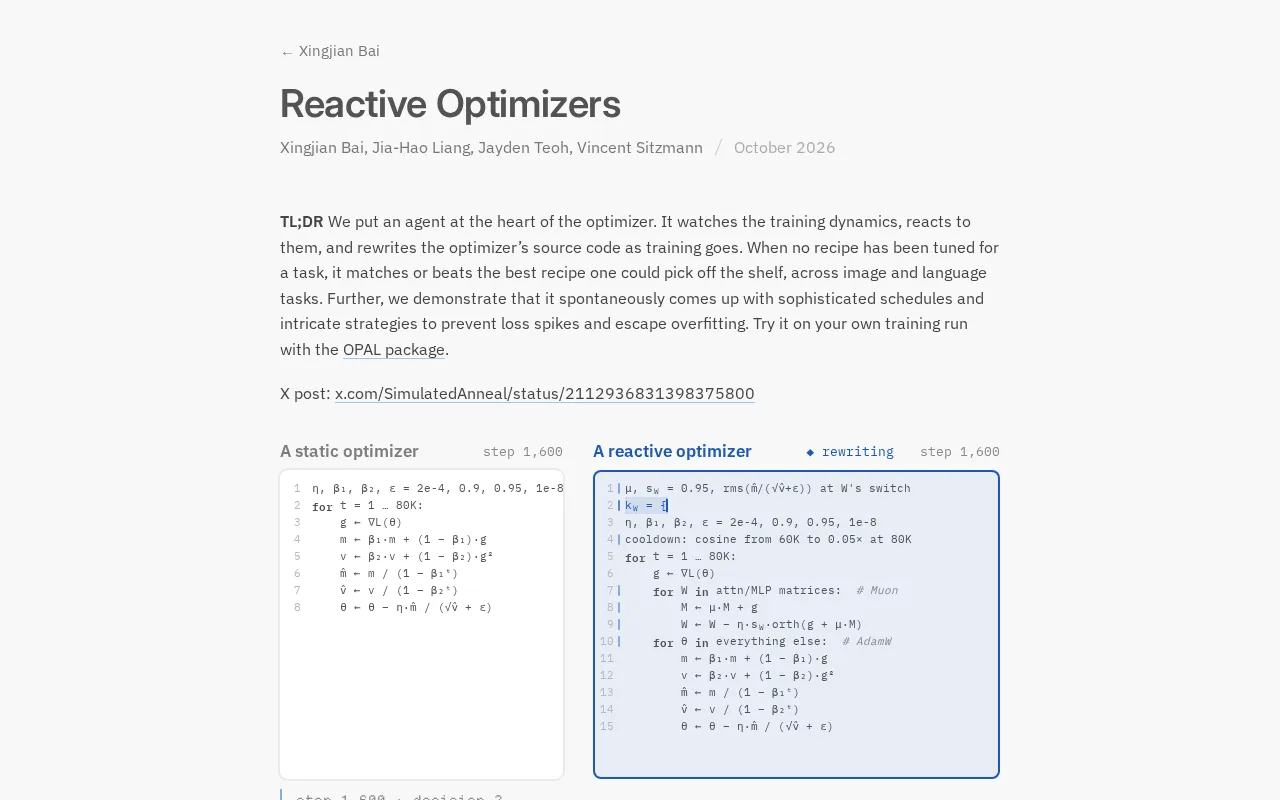
Core Mechanism: Runtime Source Code Rewriting
How Is Code-Level Adaptivity Achieved?
Traditional hyperparameter scheduling (such as learning rate decay) only adjusts numerical values, whereas Reactive Optimizers intervenes at the code level. Its implementation relies on an abstract representation of the optimizer source code—for example, parsing the optimizer logic into an abstract syntax tree (AST) or intermediate representation, then generating new code snippets based on training feedback (such as gradient statistics and loss changes).
Since the original material does not provide specific implementation details, it remains unclear whether it uses just-in-time compilation (JIT) or interpreted execution. However, it can be inferred that this approach requires a low-latency code generation and replacement mechanism; otherwise, it would severely slow down training. From an engineering perspective, this may limit its direct application in large-scale distributed training, but it has exploratory value in small-scale experiments or research scenarios.
An abstract syntax tree (AST) is a tree-like representation of the syntactic structure of source code, where each node corresponds to a construct in the code (such as an assignment, function call, or conditional branch). After parsing optimizer logic into an AST, a program can replace, insert, or delete specific nodes without modifying the original text, thereby achieving code-level adaptivity. An intermediate representation (IR) is a lower-level abstraction commonly used by compilers to facilitate optimization and code generation. In the context of Reactive Optimizers, ASTs/IRs enable the system to manipulate optimizer logic in a structured way rather than relying on string concatenation, which improves the safety and controllability of code rewriting. However, constructing and traversing an AST itself incurs overhead, and the syntactic correctness of the rewritten code must be guaranteed, which places higher demands on low latency.
Differences from Meta-Learning and Neural Architecture Search
Meta-learning usually learns initialization parameters or hyperparameters, while neural architecture search (NAS) searches over network structures. What makes Reactive Optimizers unique is that it treats "the optimizer algorithm itself" as the search space. This is closer to the intersection of program synthesis and machine learning. One viewpoint from a single source suggests that this approach may lead to optimizers automatically customized for specific tasks, reducing bias from manual design.
Program synthesis is a field of computer science that aims to automatically generate programs satisfying given conditions based on user intent (such as input-output examples, formal specifications, or natural language descriptions). Unlike traditional search, program synthesis typically combines deductive reasoning with inductive search to find correct implementations within a program space. Reactive Optimizers treats the optimizer algorithm itself as the search space, which can be seen as an application of program synthesis in machine learning: the system synthesizes new update rule code based on training feedback. This differs from meta-learning (learning parameters) and NAS (searching structures) and places greater emphasis on generating executable algorithmic logic. The challenges faced by program synthesis—search space explosion and correctness verification—will likewise arise in Reactive Optimizers and are an important perspective for evaluating its feasibility.
Potential Benefits and Risks
Benefits: Finer-Grained Adaptivity
An optimizer's update rules are often human-designed heuristics. For example, Adam's adaptive moment estimation may perform poorly in sparse gradient scenarios, but it is difficult for researchers to exhaustively enumerate all variants. Reactive Optimizers allows the training process to rewrite update formulas based on real-time gradient distributions, theoretically achieving finer adaptation than hyperparameter search.
Risks: Stability and Reproducibility Challenges
Modifying source code during training means the training process is no longer deterministic—the same initial configuration may produce different results due to different code generation paths. This poses a challenge to experimental reproducibility. In addition, dynamically generated code may introduce numerical instability or security risks (such as generating illegal operations). The original material does not mention whether there is a sandbox or rollback mechanism, which is key missing information for evaluating the practicality of this approach.
A sandbox is an isolated execution environment that restricts code access to system resources and prevents malicious or erroneous code from causing damage. In Reactive Optimizers, if dynamically generated code is executed directly without inspection, it may contain risks such as illegal memory operations, infinite loops, or numerical overflow. A sandbox mechanism can limit the permissions of generated code (for example, prohibiting file I/O and limiting CPU time), thereby improving security. A rollback mechanism automatically restores the previous optimizer version when new code causes training anomalies (such as loss explosion). The original material does not mention these mechanisms, but they are necessary engineering components for achieving safe code-level adaptivity. Without sandboxing and rollback, a scheme that dynamically rewrites source code would be difficult to run reliably in real training.
Impact on AI Research and Engineering
From a research perspective, Reactive Optimizers pushes optimizer design from "manual tuning" toward "automatic programming," echoing the current trend of code generation driven by large models. If it can be combined with LLMs to generate optimizer code snippets, it may enable natural-language-guided optimizer adaptivity.
From an engineering perspective, this approach imposes new requirements on training frameworks: frameworks need to support hot-swapping optimizer code while ensuring the stability of the training loop. This may drive further development of dynamic compilation in frameworks such as PyTorch and JAX.
As a supplementary note, because the original material contains limited information (only a title and a very brief description), the technical details inferred in this article should be treated with caution. Reactive Optimizers currently looks more like a proof of concept or early experiment and is still far from production-grade application. However, its idea of "rewriting source code during training" provides a noteworthy new dimension for optimizer research.
Hot swapping refers to dynamically replacing code or components during program execution without restarting the entire system. In training frameworks, hot-swapping optimizer code means the training loop cannot be interrupted; the framework needs to safely unload the old optimizer logic and load the new logic while maintaining consistency of model parameters and optimizer state (such as momentum and variance). This poses challenges for frameworks such as PyTorch and JAX: PyTorch's dynamic graph characteristics are relatively flexible, but optimizer state is tightly coupled with the computation graph; JAX's static compilation and functional characteristics require retracing and recompilation. Implementing hot swapping requires frameworks to provide code version management, state migration interfaces, and synchronization mechanisms, potentially driving the development of dynamic compilation and modular design.
One-line Summary
Reactive Optimizers dynamically rewrites optimizer source code during training to achieve code-level adaptivity.
Paragraph Summary
Reactive Optimizers proposes dynamically rewriting optimizer source code during training rather than merely adjusting hyperparameters, enabling the optimizer to adjust its internal logic in real time based on training state. Its core mechanism relies on an abstract representation of the optimizer source code (such as an AST or intermediate representation), then generating new code based on feedback such as gradient statistics. This approach treats the optimizer algorithm itself as the search space, distinguishing it from meta-learning and neural architecture search and bringing it closer to program synthesis. The advantage is finer-grained adaptivity than hyperparameter search, but the risk is that the training process is no longer deterministic, creating challenges for reproducibility and stability. It imposes new requirements on training frameworks for hot-swapping code and may drive the development of dynamic compilation techniques. At present, the approach is closer to the proof-of-concept stage.
Related articles

Underdog Saluki 27B: A Practical Guide to Tool Calling Under 2-Bit Quantization
An in-depth look at Underdog Saluki 27B's GSQ-RCO-based 2-bit quantization, covering GGUF header structure, memory usage analysis, and BFCL tool-calling test points under native llama.cpp.

GPU-unlock: Unlocking the FP/BF16 Instruction Issue Rate of Nvidia 3000-Series GPUs
gpu-unlock explores the FP16/BF16 instruction issue rate limits of Nvidia 3000-series GPUs, covering measurement methods, unlocking approaches, community debates, and implications for GPU performance optimization.

Cognition Open-Sources Devin Vulnerability Fixes Plugin: AI Agent Automatically Patches Critical PHP/Node.js/GitLab RCE Flaws
Cognition open-sources Devin Vulnerability Fixes, with 3 MIT-licensed agent skills targeting critical RCE flaws in PHP, Node.js, and self-hosted GitLab—automating inventory, patching, testing, and one PR per repo.