RealEmbedBench: How LLMs Really Perform in Embedded Application-Layer Development

RealEmbedBench evaluates LLMs on embedded application-layer tasks with 5,142 samples, revealing key effects of context and translation direction.
RealEmbedBench is the first benchmark systematically evaluating LLMs in embedded application-layer software development. With 5,142 samples across code generation and completion, state machine modeling and implementation, and cross-OS code translation, it tests six representative models. Results show the local code window significantly affects generation/completion; models model state machines reasonably but struggle to produce executable code; and cross-OS translation varies greatly by direction, with Harmony-to-RT-Thread averaging only 0.1667 pass rate. The article advises prioritizing local context and choosing models by translation direction, and calls for more real state machine implementation code in training data.
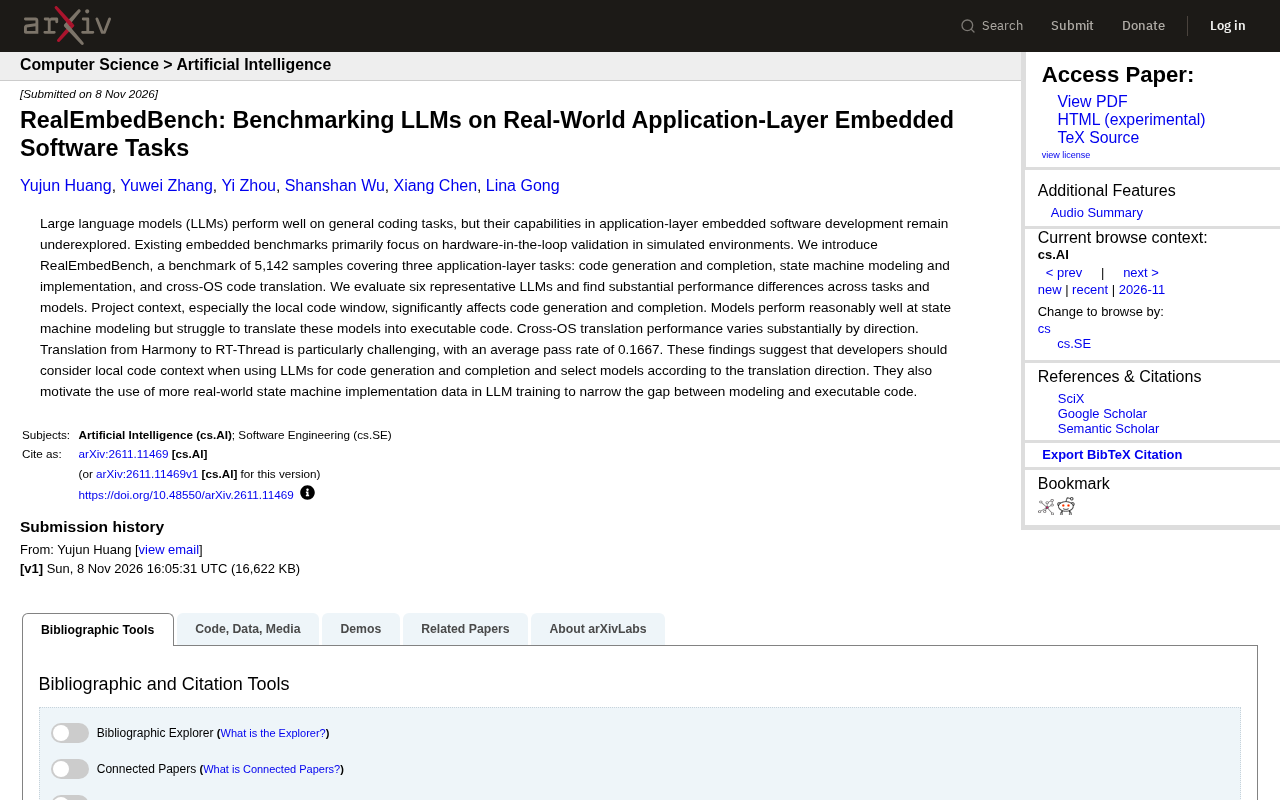
Large language models perform impressively on general programming tasks, yet their capabilities in embedded application-layer software development have rarely been systematically evaluated. Existing embedded benchmarks mostly focus on hardware-in-the-loop validation in simulated environments, whereas tasks like code generation, state machine modeling, and cross-system porting in real projects are the core challenges developers face day to day. The recently proposed RealEmbedBench fills this gap: it contains 5,142 samples spanning three categories of application-layer tasks and puts six representative models through empirical testing.
Three Dimensions of Application-Layer Embedded Tasks
RealEmbedBench's design philosophy is clear: rather than simulating hardware behavior, it examines how models perform in real embedded software engineering. The benchmark includes three task categories:
- Code generation and completion: generating or completing embedded application-layer code based on context.
- State machine modeling and implementation: building a state machine model from a requirements description and converting it into executable code.
- Cross-OS code translation: migrating code from one embedded operating system to another.
These three categories cover the typical workflow from design to porting, and are much closer to engineering practice than isolated function-level code generation.
Embedded operating systems (RTOS) are real-time operating systems running on embedded devices, responsible for basic services such as task scheduling, memory management, and peripheral drivers. Common embedded OSes include FreeRTOS, RT-Thread, Harmony (Hongmeng), and others. Different OSes differ significantly in API naming, task creation methods, and synchronization mechanisms (such as semaphores and mutexes). Therefore, cross-OS code translation is not simple syntax substitution; it requires understanding the semantic mapping between the two systems in concurrency models and resource management. The cross-system translation tasks in RealEmbedBench precisely examine whether models can correctly handle these low-level differences.
Model Performance Varies Markedly
Evaluation of six representative models shows considerable performance differences across tasks and models. One notable finding is that project context, especially the local code window, has a significant impact on code generation and completion tasks. This means that in practice, providing appropriate local context matters more than relying solely on model scale.
On state machine modeling tasks, models perform reasonably well, but they generally struggle when converting models into executable code. This phenomenon of "can model, hard to implement" reveals a gap in training data: the shortage of real-world state machine implementation code makes it difficult for models to bridge the gap from abstract models to runnable code.
State machine modeling refers to the process of abstracting system behavior into a finite state machine (FSM), including defining the state set, events, transition conditions, and actions. In embedded development, state machines are commonly used in control logic, protocol parsing, and user interaction scenarios. Going from a requirements description to a state machine model belongs to the design phase, while going from the model to executable code involves converting the state transition diagram into switch-case structures or table-driven implementations, and handling state entry/exit actions, event queues, and concurrency safety. The latter imposes higher demands on engineering completeness of the code, and it is precisely where model performance drops noticeably.
Directional Differences in Cross-System Translation
Cross-OS code translation performance varies greatly by direction. Translation from Harmony to RT-Thread is especially difficult, with an average pass rate of only 0.1667. This result suggests that when choosing a model for code migration, developers must consider the translation direction rather than assuming the model has uniform capabilities across all directions.
Local code window refers to the surrounding code snippets that the model can directly see during code generation or completion, typically a certain number of lines centered on the current editing position. Compared with full project context, the local window focuses more on variable naming, calling conventions, and error-handling style within a function or adjacent modules. RealEmbedBench's findings show that properly constructing the local code window can significantly improve the consistency of generated code with the existing codebase, and its impact can even exceed differences brought by model parameter scale. This suggests that developers should prioritize providing immediately adjacent context in prompts rather than massive amounts of irrelevant code.
Implications for Development Practice
RealEmbedBench's findings offer strong practical guidance. When using LLMs for embedded code generation or completion, attention should be paid to constructing local code context; when performing cross-system porting, models should be selected according to the translation direction. At the same time, the benchmark results call for introducing more real state machine implementation data into model training to narrow the gap between modeling and executable code. For embedded developers, this means LLMs are powerful assistive tools, but they are still far from "out-of-the-box" usability and must be used carefully in light of specific tasks and context.
One-line Summary
RealEmbedBench evaluates LLMs on embedded application-layer tasks with 5,142 samples, revealing the key influence of context and translation direction.
Paragraph Summary
RealEmbedBench is the first benchmark to systematically evaluate LLM capabilities in embedded application-layer software development. It contains 5,142 samples covering three task categories—code generation and completion, state machine modeling and implementation, and cross-OS code translation—and empirically tests six representative models. Results show that the local code window significantly affects code generation and completion; models perform reasonably on state machine modeling but generally struggle to convert models into executable code; and cross-OS translation performance varies greatly by direction, with an average pass rate of only 0.1667 from Harmony to RT-Thread. The article accordingly advises developers to prioritize local context construction and choose models based on translation direction, and calls for more real state machine implementation code in training data.
Related articles

Snapchat Opens AI Assistant Lens Building: Supports Claude Code and Cursor
Snapchat lets Lens creators describe AR filters in natural language, with AI assistants like Claude Code and Cursor handling the full build process, greatly lowering the AR creation barrier.

Is the Planck Length the Smallest Distance? Why Physicists Are Skeptical
The Planck length is often called the smallest distance in the universe, but science videos point out this claim has never been experimentally confirmed. This article explains the origins of the Planck length, the obstacles of microscope thought experiments, and what it really tells us—the scale at which quantum gravity becomes unavoidable, not spacetime pixels.

AI Agents Drive Spend Management: Payhawk Raises $280M
Payhawk raises $280M at a $2B valuation. The 2018-founded enterprise finance platform uses AI agents to track and manage expenses and procurement. This article analyzes its product evolution, valuation signals, and impact on the spend management space.