Rebuilding Education for the AI Era: A Manifesto for Tearing Down and Starting Over

A radical call to rebuild education for the AI era—abolish grades, allow AI in exams, and embrace lifelong micro-credentials.
Microsoft Research's Manohar argues today's education system is fundamentally broken and cannot be fixed by patching it with AI. He proposes a six-pillar framework—Ekalavya and Shiksha—featuring AI-permitted exams, portfolio assessment, micro-credentials, and problem-driven learning, urging a complete rebuild to avert a demographic and employment crisis.
In an era where AI is sweeping through every industry, the future of the education system has become one of the most contentious and urgent issues. In a keynote titled Reimagining Education and Skilling for the Age of AI, Manohar, an independent researcher from Microsoft Research, shared his incisive critique of and bold blueprint for reconstructing India's—and indeed the world's—education system. This was not another mild discussion about "how AI can assist teaching," but a manifesto calling for tearing everything down and starting over.
The Existing Education System Is Completely Broken
The speaker got straight to the point with a judgment that might offend many: "Our entire system—from primary school, middle school, university, all the way to the top IITs—is completely broken. But we pretend everything is fine, because on the surface it still looks okay."
The IIT (Indian Institutes of Technology) system is India's most elite network of engineering and technical institutions. There are currently 23 of them, regarded as India's answer to MIT. Each year about 1.2 million students take the JEE (Joint Entrance Examination), competing for roughly 16,000 undergraduate seats—an acceptance rate below 2%. IIT graduates enjoy tremendous prestige in the global tech world, with a large contingent of alumni at top institutions like Silicon Valley companies, Microsoft, and Google. Yet this near-mythical status precisely reinforces the cognitive bias the speaker critiques: the elite mistake their own success—achieved after passing through extreme filtering—as proof that the entire education system works well, while ignoring the systemic exclusion this system imposes on the other 99% of the population.
He pointed out a cruel cognitive bias: everyone sitting in the conference room belongs to India's top 0.01% privileged group, yet they habitually generalize their own success to the entire population. "I graduated from this university, so this university can't be bad; I'm a professor, so the professors here can't be bad." This logic of sweeping generalization masks systemic failure.
Even more alarming is the social crisis behind the data: about 25% of India's youth aged 19 to 30 are in a state of "three-nots"—neither in Employment, Education, nor Training (NEET). This phenomenon is not unique to India. The NEET concept was first introduced by UK statistical agencies in the late 1990s to measure the disconnect in youth social participation. In India, the NEET population already exceeds 200 million, driven by multiple overlapping structural factors: a scarcity of rural education resources, the stigmatization of vocational education, gender-based employment barriers, and manufacturing job growth lagging far behind labor force growth. World Bank research shows that a high NEET rate not only causes direct economic losses but also significantly increases the risk of social instability—a hidden danger that is especially pressing for India, home to the world's largest youth population. The speaker argues that the chaos on the streets is a tiny signal of the deep dissatisfaction of 200 million young people, and the employment shock brought by AI will dramatically amplify this contradiction in the future.
Regarding AI's employment shock, it's worth clarifying a key technical backdrop: the term AGI (Artificial General Intelligence), which appears frequently in current discussions, refers to AI systems capable of performing intellectual tasks across any domain, like a human—as distinct from today's "narrow AI," which only excels at specific tasks. Researchers at organizations like OpenAI and DeepMind hold vastly divergent views on the timeline for AGI's arrival, ranging from "within a few years" to "never." On the employment shock front, a 2023 report from the McKinsey Global Institute estimated that by 2030, roughly 300 million jobs worldwide could be substantially affected by generative AI, with knowledge-based, white-collar work being the hardest hit—contrary to the traditional prediction that "AI will replace manual labor first." This is the core technical basis for the speaker's insistence that the education system must be completely rebuilt rather than patched.
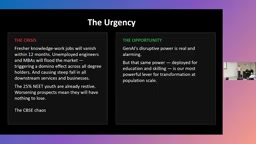
Patching a Broken System With AI Only Amplifies the Problem
The speaker leveled sharp criticism at how the current education sector applies AI. Most institutions are merely doing "spot fixes": improving assessment, providing personalized tutoring, and easing teachers' workloads. But he argues: "Using AI to patch any broken part is actually amplifying something broken. Since it's already broken, why give it more energy through AI to make it worse? It's better to just leave it as it is."
This view cuts straight to the heart of the matter—technology itself is not the cure. If the underlying incentive structures and evaluation systems remain unchanged, AI will only make a distorted system run more "efficiently."
Six Pillars: The Twin Framework of Ekalavya and Shiksha
To achieve real transformation, the speaker proposed two complementary frameworks: Ekalavya (reimagining educational workflows) and Shiksha (an agentic framework that makes radical change possible). The two are like the two sides of yin and yang—neither can exist without the other. He emphasized that without the support of agentic AI, all these ideas are mere castles in the air.
The name "Ekalavya" itself carries profound cultural symbolism. Ekalavya is an iconic figure in the Indian epic Mahabharata—he longed to study archery under the master Drona, but was rejected because of his low birth. He then trained himself in the forest using a clay idol of Drona as his teacher, becoming a marksman whose skill surpassed all of Drona's formal students. However, when Drona discovered this, he demanded that Ekalavya cut off his right thumb as "tuition," utterly destroying his archery ability. Naming the education reconstruction framework "Ekalavya" carries profound irony and re-interpretation: it points to a self-driven learning model that does not depend on traditional entry thresholds, while also implicitly critiquing how the current education system systematically suppresses marginalized learners—the Ekalavya of the AI era no longer needs to be turned away by gatekeepers.
Meanwhile, the core technology in the "Shiksha" framework—Agentic AI—refers to AI systems capable of autonomously planning, executing multi-step tasks, and interacting with external tools, fundamentally different from traditional large language models that can only handle single-turn Q&A. Typical architectures include ReAct (Reasoning and Acting loops) and AutoGPT. In educational settings, agentic AI can play the role of a "continuously accompanying mentor": proactively tracking student progress, breaking down complex projects, coordinating multiple knowledge sources, generating personalized exercises, and providing instant feedback. This is precisely the technical foundation of the Shiksha framework—it is not a Q&A tool, but an autonomous system that can continuously intervene, adjust, and support throughout a student's entire learning journey.
The core of the reform is distilled into "Six Pillars":
1. Exams Should Also Allow the Use of AI
"If employers want employees to use AI from day one, then students should be able to use AI throughout the entire course—including exams." The speaker argues that the closed-door, three-hour exams with cameras watching for cheating are absurd. He posed a difficult question to teachers: if students can use AI at any time, what will you teach? How? And why?
Behind this lies the profound insight of "threshold concepts" theory. This theory was proposed by British educators Jan Meyer and Ray Land in 2003, and its core claim is that every discipline has a small number of key concepts that, once truly understood by students, trigger an irreversible cognitive shift into an entirely new way of thinking. These threshold concepts have five characteristics: transformative, irreversible, integrative, bounded, and troublesome. For example, "opportunity cost" in economics and "limit" in mathematics are typical threshold concepts. The logic of incorporating AI into exams stems from this: if AI can easily complete a task, it suggests the task may not involve crossing a true threshold concept, and the focus of teaching should shift to the cognitive leaps that AI cannot replace. Each discipline has only a few key thresholds, and the purpose of teaching is to ensure students genuinely cross them.
2. Return the Initiative for Learning to Students
"Even the best agentic teaching assistant is useless if students lack the motivation to use it." Just as students won't necessarily proactively ask the best teacher what to learn, intrinsic motivation must be sparked by giving students the initiative to "choose which problem to solve"—the vehicle for learning should be decided by the students themselves.
3. Drive Learning With Real Problems
Take IIT Jammu as an example: the school set the grand challenge of "achieving campus carbon neutrality within 15 years." This big goal can be broken down into countless sub-problems. When new students enroll, they are told: "Here's a pile of real problems to solve—pick one, and we have a team of teachers to guide you."
4. Abandon A/B/C/D Grading in Favor of Portfolio Assessment
The speaker proposed abolishing the traditional letter-grade system in favor of three tiers: A (Accomplished), B (Best effort), and I (In progress). Whether students have truly learned is judged through the "verified portfolio" accumulated throughout their learning journey—including failed attempts and their retrospectives, which are equally valuable outcomes, all transparent and publicly viewable.
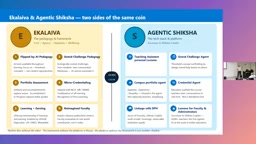
5. Micro-credentials and Flexible Learning Paths
Another major problem with the existing system is its rigid path: it takes 20 years to go from primary school all the way to a PhD, and in India, those who drop out midway have almost no chance of ever returning to formal education. Micro-credentialing breaks learning into many small units; students accumulate a credit each time they complete one, enabling "lifelong learning and lifelong earning in parallel" rather than a segmented "learn first, earn later."
Micro-credentialing rose to prominence in the wake of the MOOC boom in the 2010s, with representative offerings including Coursera's professional certificates, edX's MicroMasters, and MIT's MicroBachelor program. Unlike traditional degrees, micro-credentials break learning into modular units ranging from a few hours to several months in length, with learners receiving digital badges verified via blockchain or third-party organizations upon completion. Their core advantages are flexibility and immediate employment value. However, micro-credentials also face credibility challenges: employer recognition of non-traditional credentials varies widely, and quality control standards have not yet been unified. India's National Credit Framework (NCrF) attempts to provide institutional continuity through government endorsement, allowing accumulated micro-credential credits to be exchanged for formal qualifications—a policy frontier being explored globally, and precisely the institutional basis for what the speaker means by "fully consistent with the current policy framework."
The speaker quoted the American education philosopher John Dewey: "Education is not preparation for life; education is life itself."
6. Teachers Are the Core of Change, but the Incentive Structure Must Change
"Our obsession with a single number is everywhere: JEE rank, CGPA, h-index..." The speaker sharply pointed out that AI can already write better papers than 90% of researchers, so what meaning is there in the outdated standard of evaluating teachers by paper count and citations? He advocates shifting incentives toward "what real change you have brought to your institution and community."
You may not have noticed, but he emphasized that this entire plan is "fully consistent with the current policy framework," requiring no regulatory changes—India already has the institutional foundations of a National Credit Framework, multiple-entry-multiple-exit mechanisms, and cross-institutional credit transfer; they simply lack unified integration.
From Higher Education to Universal Skilling: The Concept of Pluriversity
After collaborating with more than 20 institutions for over a year, the speaker realized India faces an even larger problem: it needs to provide skills training and employment for 200 to 300 million people, or else the "demographic dividend" will become a "demographic disaster." Over the past 15 years, organizations like the National Skill Development Corporation have invested hundreds of billions of rupees with little effect, and the root cause lies in the "silo effect" of each department operating on its own.
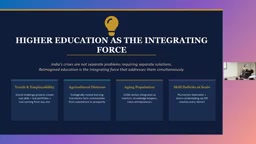
He proposed the concept of Pluriversity: enabling neighboring institutions to collaborate across campuses, with teachers and students sharing each other's strengths and resources. This concept aligns closely with emerging educational organization theories such as "distributed universities" and "polycentric learning ecosystems," with theoretical roots traceable to political economist Elinor Ostrom's theory of common-pool resource governance—she demonstrated that under appropriate institutional design, communities can self-manage shared resources without central control or full privatization. Transplanting this logic to education means that institutions within a region form a "capability sharing pool": School A's cybersecurity faculty serve School B's students, School B's lab equipment is opened to School C, and all parties maintain their motivation to participate through credit mutual recognition and honor attribution mechanisms, transforming "scarcity" into "complementarity."
He cited cybersecurity skills training in Kalaburgi, Karnataka, as an example—a college with expertise trains teachers from surrounding polytechnics, the teachers in turn train students, and the female students, upon returning to their villages, train their own relatives and neighbors.
"Because you're training your own family, there's no incentive to inflate the numbers. You take pride in having taught your aunt." In this way, if 500 students each train 3 people around them, basic cybersecurity education can reach 1,500 people, while the students earn micro-credits that can later be converted into degree credits. He estimated that if the mechanism is in place, 50,000 people could master cybersecurity skills within a year.
What AI Cannot Replace: Advice for Young People
Facing an audience composed mainly of students from elite institutions, the speaker offered simple yet profound advice. He admitted that many people, in order to prepare for the IIT exams, abandoned everything else from high school through college. And in the AI era, what is truly scarce is precisely what AI cannot solve:
"AGI may arrive, but who will clean up the garbage around your home? Who will solve the million-scale problems of education, nutrition, health, women's health, and children's health? Not robots, but the 200 million people in the community."
He called on young people to cultivate "play, friendship, curiosity, loyalty, companionship, and joy"—qualities that AI can never replace—and when people collaborate as a community to solve real problems, all of this will naturally come together.
Onstage Clash: How Does Idealism Land in Reality?
The Q&A session after the talk was quite lively, with several questioners posing sharp challenges:
On the separation of employment and employability: Someone pointed out that AI will enhance employability, but capital is replacing labor, and jobs are actually decreasing. The speaker's answer was "nano-entrepreneurship"—referring to ultra-small-scale commercial activities conducted by individuals or small teams using digital tools at extremely low cost, distinct from traditional entrepreneurship in that the barrier to entry is extremely low, the risk is controllable, and returns are immediately visible. Typical forms include freelancing on gig economy platforms, local service transactions, and using AI tools to provide translation or content creation services for communities. In the context of education reform, the significance of nano-entrepreneurship lies in breaking the linear time assumption of "learn first, earn later"—students acquire skills in the process of solving real problems around them and sell the solutions to more people. A first-year student can perfectly well create income while studying, compressing the opportunity cost of the learning cycle to near zero.
On the lessons of the flipped classroom: Someone questioned whether flipped learning before the arrival of AI (such as Khan Academy and NPTEL) had failed to deliver on its promises. The flipped classroom model was first systematically practiced by Jonathan Bergmann and Aaron Sams in Colorado in 2007, and was widely promoted by Khan Academy and NPTEL, once regarded as a tool for educational equalization. However, extensive empirical research shows that in contexts of unequal resources, the flipped classroom often exacerbates educational inequality—students with strong self-discipline and ample family support benefit significantly, while disadvantaged students fall further behind. The speaker's response was that AI is merely a "catalyst" for change, not the core: "80% of Ekalavya's components have been tried over the past hundred years, but they never went mainstream because they were never integrated into a unified framework. The entire system must change together, or nothing will work." If the original grading system is retained, students will still game the system for high scores.
On learning purely for interest: Someone cited their own study of Sanskrit as an example, noting that learning and problem-solving are two different things. The speaker clarified that the "problem" he speaks of is broad—"anything meaningful and worth doing for an individual" counts as a problem; learning for joy and writing for creation need no additional incentive, "you just need to remove the disincentives that kill it."
On AI breeding "soulless output": The final questioner argued that integrating agentic systems without genuine mentor guidance is a bad idea. The speaker emphasized again: when students solve problems of their own choosing, they have no reason to submit perfunctory answers—just as students in a hackathon will give their all to a project they've invested in. "I hope that five years from now, teachers will wake up and say, 'I want to change the world.' Essentially, all of this is about joy."
Conclusion: The Educator as "Sower"
The speaker compared himself to a "seed distributor": "I go everywhere saying, this is what you should do, here's the seed, take it. Some throw it away, some plant it and let it grow. The miracle is that every seed grows into a unique plant, depending on where it's planted and who cares for it."
The most moving thing about this talk is not that it proposed some perfectly complete solution—the speaker himself admitted, "For every pillar taken alone, I can find ten flaws"—but that it, with a rare candor and sense of urgency, confronted the structural crisis of the education system head-on and placed AI in the position of "supporter" rather than "savior." At a time when everyone is talking about AI disrupting education, this may be the most clear-headed voice of all.
Key Takeaways
Key Takeaways
Related articles

Disaster and Glory of the Apollo Program: The History We Must Revisit Before Returning to the Moon
From the fatal Apollo 1 fire to Apollo 8's daring lunar orbit to Apollo 11's successful landing—revisiting the disasters, fears, and compromises of the Apollo program and their lessons for today's return to the Moon.

Netflix Trust Exercise Turns Into Firing Trap: Where Are the Boundaries of Corporate Trust?
A Netflix employee was fired after sharing private info in a trust exercise. We analyze the risks of corporate trust exercises and how employees can protect themselves.

AMD CDNA5 Architecture Deep Dive: Technical Evolution and the AI Computing Competition Landscape
Deep analysis of AMD's CDNA5 architecture covering Chiplet packaging upgrades, HBM memory evolution, and low-precision compute optimization, examining how AMD challenges NVIDIA's AI chip dominance.