Recall.ai Startup Program Explained: A Meeting Recording API at $0.25 Per Hour
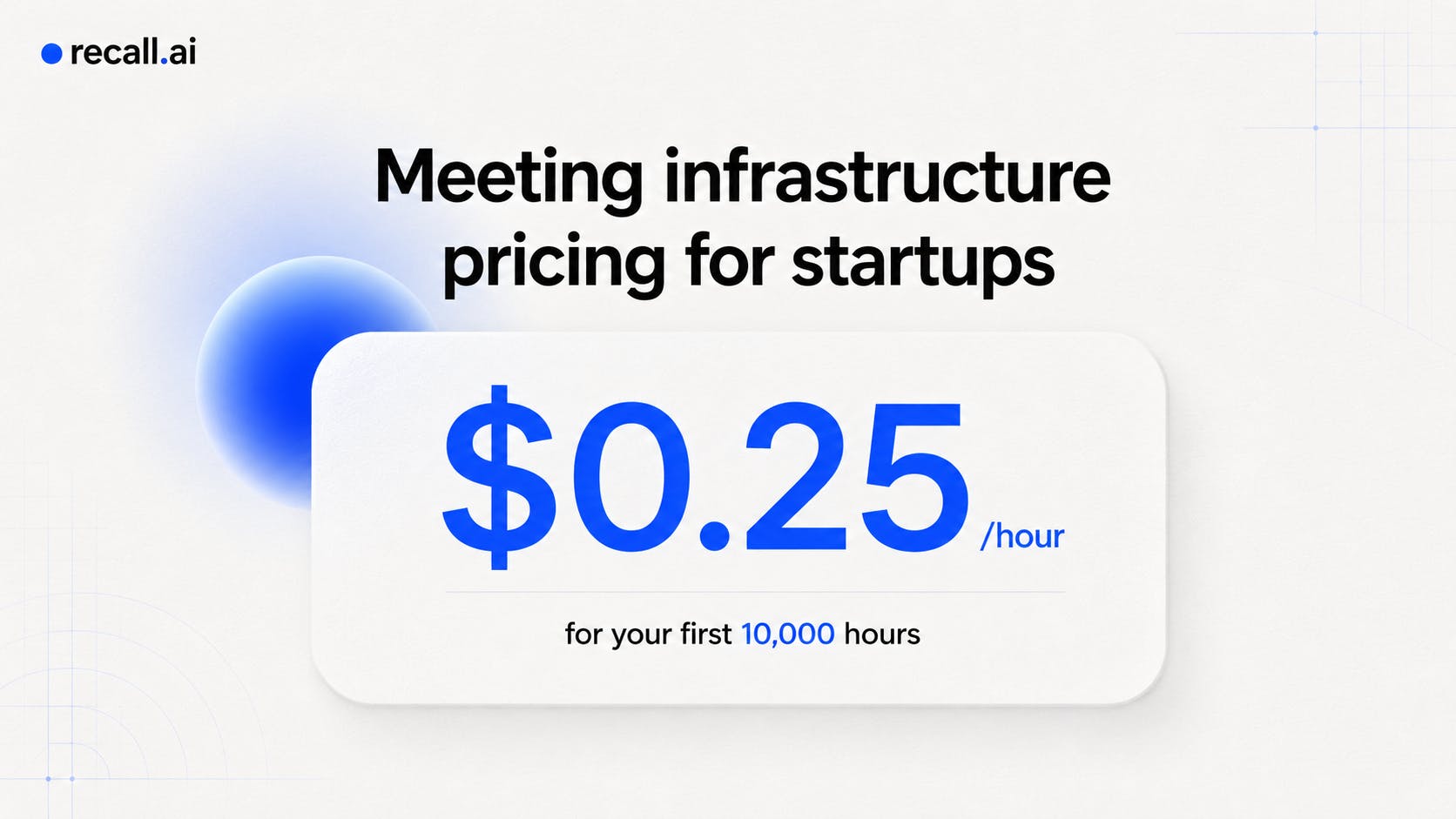
Recall.ai's Startup Program offers meeting recording APIs at $0.25/hour for early-stage AI teams.
Recall.ai launched a Startup Program offering cross-platform meeting recording infrastructure at $0.25 per hour for the first 10,000 hours. Covering Zoom, Google Meet, and Teams, it includes MCP access, engineering support, and calendar integration, helping early-stage teams build AI meeting products without tackling complex recording infrastructure themselves.
A New Player in Meeting Recording Infrastructure
Amid the explosion of AI applications, products for meeting notes, transcription, and analysis are emerging in droves. But few people pay attention to the underlying technical challenges behind these products — how to reliably record audio and video from various meeting platforms like Zoom, Google Meet, and Microsoft Teams. Recall.ai is an infrastructure provider focused on solving exactly this problem, and their recently launched Startup Program on Product Hunt makes this foundational capability available to early-stage teams at a highly attractive price point.
The product received 108 upvotes on Product Hunt, ranking 6th on launch day, and was categorized under API, Meetings, and SDK. While the vote count wasn't the highest among products launched around the same time, it addresses a very real developer pain point: the prohibitive cost and complexity of building a meeting recording system from scratch.
Core Features of the Recall.ai Startup Program
According to the official description, the Recall.ai Startup Program provides early-stage teams with a comprehensive meeting recording infrastructure, covering the following key areas:
Entry Pricing at $0.25 Per Hour
The most eye-catching aspect of the plan is its pricing strategy — the first 10,000 hours of meeting recording cost just $0.25 per hour. For early-stage startup teams, this means they can validate their product ideas at a relatively low startup cost without having to invest heavily in building and maintaining a recording system from the outset.
Calculated at the 10,000-hour quota, teams would only need to pay approximately $2,500 total to gain enough recording capacity to support early product validation and growth. This "pay-as-you-go plus quota cap" model essentially lowers the barrier to technical experimentation for startup teams.
Engineering Support and Full Product Line Coverage
Beyond the pricing advantage, the program also offers dedicated engineering support, fast bot joins capability, coverage across all recording product lines, MCP (Model Context Protocol) access, and calendar integration.
The inclusion of MCP access is particularly noteworthy. MCP (Model Context Protocol) is an open protocol introduced by Anthropic in late 2024, designed to standardize how AI models interact with external data sources and tools. Before MCP, every AI application that needed to connect with different external services (such as databases, calendars, CRMs, etc.) required custom integration code, resulting in massive duplication of effort. MCP provides a unified communication specification that enables AI Agents to discover, invoke, and interact with external tools and data in a standardized way. By exposing meeting recording data through MCP, Recall.ai allows developers to let AI Agents directly "understand" and operate on meeting recording data — for example, enabling Claude or GPT-4 to automatically retrieve transcription text from specific meetings or extract key decision points, without writing additional data pipeline code. This transforms meeting data from passive storage into an actively callable resource within AI workflows, making it far more convenient for developers to integrate meeting content into various AI Agent and LLM workflows.
Why Does Meeting Recording Need Dedicated Infrastructure?
Many people might wonder: isn't recording a meeting just a matter of clicking a "record" button? Why would you need dedicated infrastructure?
In reality, cross-platform, scalable meeting recording is far more complex than most people imagine:
- Cross-platform integration differences: Zoom, Google Meet, Teams, Webex, and other platforms each have different integration methods — some provide official APIs, while others require "recording bots" that join meetings as participants to capture audio and video streams
- Stability and performance: Bot join latency, audio-video synchronization, multi-platform compatibility, and reliability under high-concurrency scenarios are all engineering challenges that require long-term refinement
- Ongoing maintenance costs: Platforms frequently update their interfaces and policies, requiring continuous investment to maintain any self-built system
It's worth diving deeper into the "recording bot" technical approach here. The working principle is as follows: the system automatically creates a virtual participant that joins a meeting room on platforms like Zoom or Google Meet as a regular attendee, then captures the meeting's audio and video streams on the server side. This approach is widely adopted because not all meeting platforms provide comprehensive recording APIs — for example, Google Meet has long lacked a native recording interface for third parties, forcing developers to obtain data indirectly through bots. The technical challenges that recording bots must handle include: capturing and decoding audio/video streams via the WebRTC protocol, layout processing for multi-participant views, speaker identification and audio track separation, and reconnection with data integrity guarantees under network fluctuations. The cumulative effect of these challenges makes the engineering effort required for a self-built recording system far exceed most teams' expectations.
For a startup team looking to build an AI meeting assistant, spending a large amount of effort on these underlying recording issues would undoubtedly slow down iteration on their core product. The value of Recall.ai lies precisely in encapsulating these complexities into simple APIs and SDKs, allowing developers to focus on upper-layer application logic — whether that's auto-generating meeting minutes, extracting action items, or building conversational intelligence analytics.
Strategic Positioning for AI-Native Applications
From an industry perspective, the launch of the Recall.ai Startup Program aligns with a clear trend in the current AI application ecosystem: platformization of foundational capabilities and lightweight application layers.
Over the past two years, Meeting Intelligence has become a hot track in AI applications, spawning a large number of transcription, summarization, and sales conversation analysis products. Representative products in this space include Otter.ai (real-time transcription and notes), Fireflies.ai (meeting notes and CRM integration), Gong.io (sales conversation intelligence), and Chorus.ai (acquired by ZoomInfo). The core capability chain for these products typically includes: audio/video capture → speech-to-text (ASR) → speaker diarization → natural language understanding and summary generation → action item extraction and integration with CRM/project management tools. According to Grand View Research, the global conversational intelligence market is expected to exceed $4 billion by 2030.
However, the first link in this value chain — stable and reliable audio/video capture — happens to be the most technically challenging yet least perceptible to end users. The common prerequisite for all these products is the ability to reliably obtain high-quality meeting audio and video data. By lowering this barrier, Recall.ai is effectively providing infrastructure support for the entire AI meeting application ecosystem.
By targeting early-stage teams through the Startup Program, Recall.ai's business logic is also crystal clear: attract developers to adopt its infrastructure early in their projects with low pricing, and once their products grow and recording hours exceed the quota, these teams will naturally convert into long-term paying customers. This is a classic "developer-first, volume-for-future" growth strategy, in the same vein as the early playbooks of successful developer tools companies like Twilio and Stripe.
It's worth expanding on the industry precedents for this strategy. Twilio attracted developers early on with extremely low SMS and voice call API pricing, naturally converting them into high-paying users as their products scaled, eventually growing into a communications platform worth tens of billions of dollars in market cap. Stripe similarly started with a minimalist payment integration experience and small-developer-friendly fee structures, gradually penetrating into large enterprises. What these companies share in common is that they abstracted complex foundational capabilities (communications, payments) into clean APIs, built developer ecosystems through low-barrier customer acquisition, and then achieved natural revenue expansion as their customers' businesses grew. The Recall.ai Startup Program clearly follows the same logic — $0.25/hour pricing is low enough for early-stage teams to adopt painlessly, and once a product enters its growth phase, the exponential increase in recording hours will drive significant revenue conversion.
Risks to Evaluate Before Adoption
For teams considering this program, a few points are worth thinking about in advance:
Compliance and Privacy Concerns
Meeting recording inherently involves sensitive data, especially in enterprise scenarios where data storage locations, encryption methods, and compliance with regulations like GDPR are unavoidable issues. Joining meetings as a recording bot may also raise concerns related to platform terms of service and participant informed consent requirements.
Specifically, the compliance frameworks surrounding meeting recording are far more complex than they appear on the surface. Under the EU's GDPR framework, meeting audio and video qualify as personal data, and the act of recording requires a clear legal basis (typically explicit consent from participants). Varying laws across U.S. states add further complexity — California, Illinois, and others adopt an "all-party consent" standard, meaning all participants must be informed and agree to the recording. Additionally, the terms of service for platforms like Zoom and Google Meet typically impose explicit restrictions on third-party bots: Zoom requires that bot recording clearly notify participants, while Google Meet takes a conservative stance toward unauthorized automation tools. Enterprise customers also need to consider data sovereignty issues — which geographic region's servers store the recorded data, whether bring-your-own-key encryption (BYOK) is supported, and whether data retention policies meet industry regulatory requirements (such as HIPAA for healthcare and SOC 2 audit requirements for SaaS services).
Vendor Lock-in Risk
Relying entirely on a single third-party service for the critical data capture layer means that any price adjustments or service disruptions could have a significant impact on the application built on top of it. The standard pricing after the 10,000-hour quota is exhausted is also a cost item that teams need to calculate in advance.
Summary: A Pragmatic Choice for Validating Meeting Intelligence Products at Low Cost
The launch of the Recall.ai Startup Program reflects the intensifying competition at the infrastructure layer in the age of AI applications. For early-stage teams looking to quickly enter the meeting intelligence space, this is an option that can significantly lower both the technical barrier and startup costs — trading $0.25 per hour for reliable recording capabilities that would otherwise require months of engineering effort to build. The value proposition is hard to ignore.
At the same time, founders should be clear-eyed about the long-term costs and risks that come with foundational dependencies. Making a rational trade-off between "buy" and "build" is the right approach to fully leveraging infrastructure services like this.
Key Takeaways
Related articles
Personal Reasoning Models: How to Make AI Truly Understand Your Values and Way of Thinking
Explore how to build a personal reasoning model that lets AI reason based on your values and decision preferences. Covers system prompts, RAG, fine-tuning, and the echo chamber risk.
LoRa Handheld Device Antenna Optimization in Practice: Iterating from Ceramic to FPC Antennas
A deep dive into LoRa handheld antenna optimization: from ceramic to FPC antenna + Pogo Pin across three iterations, with S11 return loss data and 3km field testing of compact Sub-GHz RF design.
Agent Sandbox in Practice: Boxing Software Factories with Three-Layer Architecture
Deep dive into agent sandbox three-layer orchestration architecture, running multiple software factories in parallel with Best-of-N mode for true isolation, scale, and autonomy. Covers tech stack choices, model layering strategies, and test results analysis.