Reconstructing Schrödinger Bridges with the Yasue Action: Neural ODEs for High-Dimensional Generative Modeling

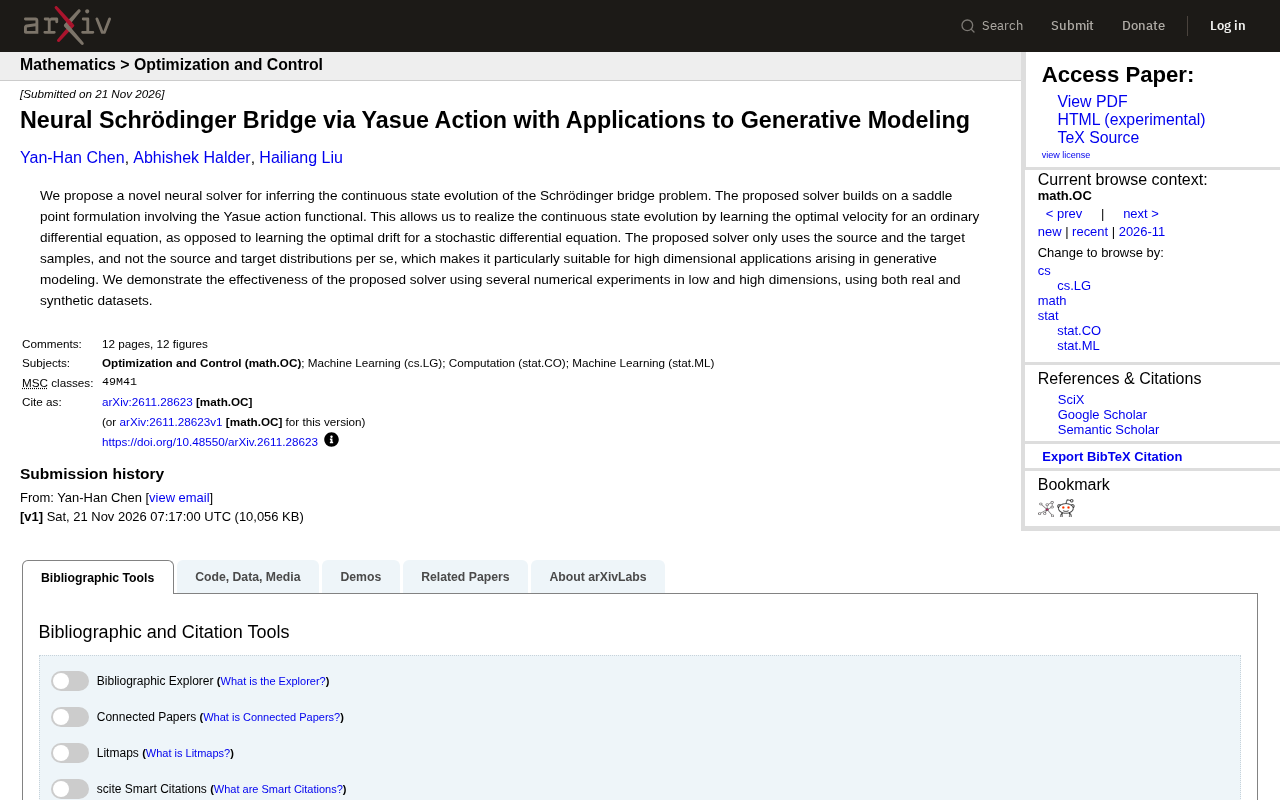
A new paper reconstructs the Schrödinger bridge using the Yasue action's saddle-point form, replacing SDE drift learning with ODE velocity learning and requiring only samples.
The paper introduces a novel Schrödinger bridge solver based on the saddle-point form of the Yasue action, transforming SDE drift learning into ODE optimal velocity field learning. This leverages the variational structure of the Yasue action, making deterministic ODE integration more stable and efficient than SDE sampling. Requiring only source and target samples without density estimation, the method suits high-dimensional generative modeling. Numerical experiments were conducted on low- and high-dimensional, real and synthetic datasets. While theoretically novel, training stability, high-dimensional tractability, and fair comparison with diffusion models require further study; the contribution remains at the framework and preliminary experiment stage.
The Schrödinger Bridge problem describes how to find the most likely stochastic evolution path between two distributions, and it has long been regarded in generative modeling as the theoretical superior alternative to diffusion models. However, traditional solutions require learning the drift term in a stochastic differential equation (SDE), which is computationally expensive and not friendly to high-dimensional data. A new paper proposes reconstructing this problem using the saddle-point form of the Yasue action, replacing "learning the drift" with "learning the velocity," so that the continuous state evolution can be solved using only samples from the source and target domains.
From SDE Drift to ODE Velocity: A Shift in Perspective
The core operation of the paper is to transform the solution of the Schrödinger bridge into a saddle-point problem whose objective function is based on the Yasue action functional. The Yasue action corresponds to the stochastic version of the classical action in stochastic mechanics, and its variation yields the stochastic Hamilton-Jacobi equation. The authors exploit this structure to have a neural network learn the optimal velocity field of an ordinary differential equation (ODE), rather than the optimal drift field of an SDE.
The practical value of this transformation lies in the fact that numerical integration of ODEs is more stable and efficient than sampling simulation of SDEs. SDEs must handle the stochastic term of Brownian motion, and sampling errors accumulate in high-dimensional spaces; in contrast, the deterministic evolution of ODEs allows the use of adaptive step-size solvers and provides cleaner gradient propagation paths. For generative modeling, this means that the computational barriers for both training and inference may be lowered.
It should be noted that this is not the first work to attempt replacing SDEs with ODEs, but using the Yasue action for saddle-point reconstruction is a relatively novel entry point. It embeds the duality from stochastic optimal control directly into the training objective of the neural solver, rather than making an approximation after the fact.
The Yasue action is a generalization of the classical action functional in stochastic mechanics, proposed by the Japanese mathematician Kunio Yasue in the 1980s. In classical mechanics, particles move along paths that extremize the action; in the framework of stochastic mechanics, particle motion obeys a stochastic differential equation whose drift and diffusion terms jointly determine the statistical behavior of the paths. The Yasue action is defined through the expected Lagrangian of stochastic paths, and its variational derivative yields the stochastic Hamilton-Jacobi equation—the stochastic counterpart of the classical Hamilton-Jacobi equation. In the Schrödinger bridge problem, using the saddle-point form of the Yasue action can transform the original minimization problem over the drift field into a saddle-point problem over the velocity field and adjoint variables, thereby providing a variational foundation for neural networks to learn ODE velocity fields. This structure allows the duality from stochastic optimal control to be embedded directly into the training objective, rather than serving as a post-hoc approximation.
Samples Only, No Distributions: A Key Design for High-Dimensional Settings
The paper particularly emphasizes that the proposed solver requires only samples from the source and target domains, without needing to know the analytical form or density functions of the two distributions. This design decision directly determines the method's applicability in generative modeling—real-world high-dimensional data (images, audio, point clouds) typically exist only as samples, and the distributions themselves are unknown.
Many classical numerical methods for Schrödinger bridges rely on estimating distribution densities or kernel density approximations, which quickly fail as dimensionality increases. The sample-driven training approach bypasses this bottleneck: the network learns the velocity field directly from data pairs, and the geometric information of the distributions is implicitly encoded in the samples. The authors conducted numerical experiments on low-dimensional and high-dimensional, real and synthetic datasets to verify this point. Although the original text does not provide specific performance numbers, "feasibility in high dimensions" itself is the core claim the method attempts to establish.
Schrödinger Bridges and Entropy-Regularized Optimal Transport: The Schrödinger bridge problem was originally proposed by Schrödinger in 1932, aiming to find the most likely stochastic evolution path between two given marginal distributions. It is closely related to the optimal transport problem but introduces an entropy regularization term, making the path distribution stochastic rather than deterministic. Specifically, the Schrödinger bridge is equivalent to minimizing the KL divergence relative to a Brownian motion reference measure among all path distributions satisfying the marginal constraints. This entropy regularization makes the Schrödinger bridge robust to noise and allows path branching, making it more suitable for the transformation from simple distributions to complex data in generative modeling. Diffusion models can be viewed as a special case of the Schrödinger bridge under a specific reference process (such as variance-exploding or variance-preserving forward processes). Therefore, solving more general Schrödinger bridges means being able to handle broader distribution transformation scenarios such as non-Gaussian priors and unpaired data translation, rather than being limited to the standard framework of diffusion models.
Potential Position in Generative Modeling
From the perspective of the technical roadmap of generative models, the Schrödinger bridge connects entropy-regularized optimal transport between two arbitrary distributions, which is more general than the forward noising process of diffusion models. Diffusion models can be seen as a special case of the Schrödinger bridge under specific conditions. Therefore, an easier-to-train Schrödinger bridge solver could theoretically cover broader distribution transformation scenarios than diffusion models, such as non-Gaussian priors and translation between unpaired data.
However, this line of work is still far from practical deployment. The training stability of the saddle-point problem, the numerical tractability of the Yasue action in high dimensions, and fair comparisons with existing diffusion models under equal compute are all aspects not yet elaborated in the original text. The paper's contribution currently remains at the level of a methodological framework and preliminary experiments; judging whether it can become a practical tool for generative modeling will require validation on larger-scale benchmarks.
Summary
This work shifts the solution of the Schrödinger bridge from SDE drift learning to ODE velocity learning. By leveraging the saddle-point form of the Yasue action, it achieves inference of continuous state evolution relying solely on samples. For readers interested in the theoretical boundaries of generative models, it offers a direction worth following: the dual structure of stochastic optimal control may become an organizing principle for the training objectives of next-generation generative models.
One-line Summary
A new paper reconstructs the Schrödinger bridge using the saddle-point form of the Yasue action, replacing SDE drift learning with ODE velocity learning and requiring only samples for the solution.
Paragraph Summary
This paper proposes a novel method for solving the Schrödinger bridge based on the saddle-point form of the Yasue action, transforming the traditional problem of learning the drift term of a stochastic differential equation (SDE) into learning the optimal velocity field of an ordinary differential equation (ODE). This transformation exploits the variational structure of the Yasue action in stochastic mechanics, making the deterministic numerical integration of ODEs more stable and efficient than SDE sampling. The method requires only samples from the source and target domains, without density estimation, making it suitable for high-dimensional generative modeling. The authors conducted numerical experiments on low-dimensional and high-dimensional, real and synthetic datasets. Although the method is novel in its theoretical framework, its training stability, high-dimensional numerical tractability, and fair comparison with diffusion models remain to be further studied; its contribution currently remains at the level of a methodological framework and preliminary experiments.
Related articles
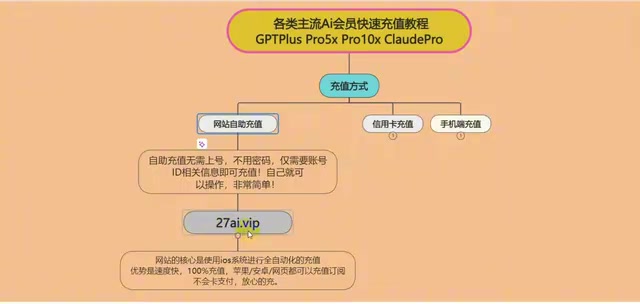
ChatGPT Plus Top-Up in China: Third-Party Website Recharge That Supports WeChat Pay and Alipay, No Overseas Card Needed
A Bilibili creator tests ChatGPT Plus top-up methods in China: comparing third-party website recharge, direct credit card, and mobile in-app purchase, with a full walkthrough of password-free WeChat/Alipay recharge and an analysis of Session credential and payment risk-control risks.

6GB Delivers Opus-Level Performance: Bonsai 2.5 27B Hands-On Test
Prism ML releases Ternary Bonsai 2.5 27B: ternary quantization brings it to just 5.9GB, runnable on a single consumer GPU while retaining 262k context and vision. Hands-on agentic benchmarks approach full-precision Qwen 3.8 27B, exceeding 150 tokens/s on a 4090, with impressive frontend and dashboard results, though game development and long tasks remain weak spots.

System Exchange Spawns an Offbeat Journey to the West: Why This Comedy Series Works
A Bilibili comedy short series reimagines Journey to the West with a system-exchange premise, as the protagonist challenges Sun Wukong, Erlang Shen, and other classics.