Reddit Debate on Pre-IPO Investing: Should Everyday Investors Get In?
Retailization of Pre-IPO lowers entry barriers, but liquidity and information risks remain prominent.
Starting from a brief Reddit question about whether to subscribe to a Pre-IPO, the article unpacks the trend of Pre-IPO investing moving toward retailization. Pre-IPO refers to equity financing or old-share transfers before a company's listing, traditionally dominated by institutions but now split by platforms into small units open to ordinary investors, with its appeal lying in betting on post-listing valuation premiums. However, retail investors face three real obstacles: shares are almost untransferable before listing, locking up capital long-term; disclosed information is far less than that available to institutions; and purchase prices may already include premiums while term details like liquidation preference, anti-dilution, and lock-up periods are often overlooked. The article notes uneven risk awareness among participants, warns of herd effects from social sharing, and offers a four-point judgment framework.
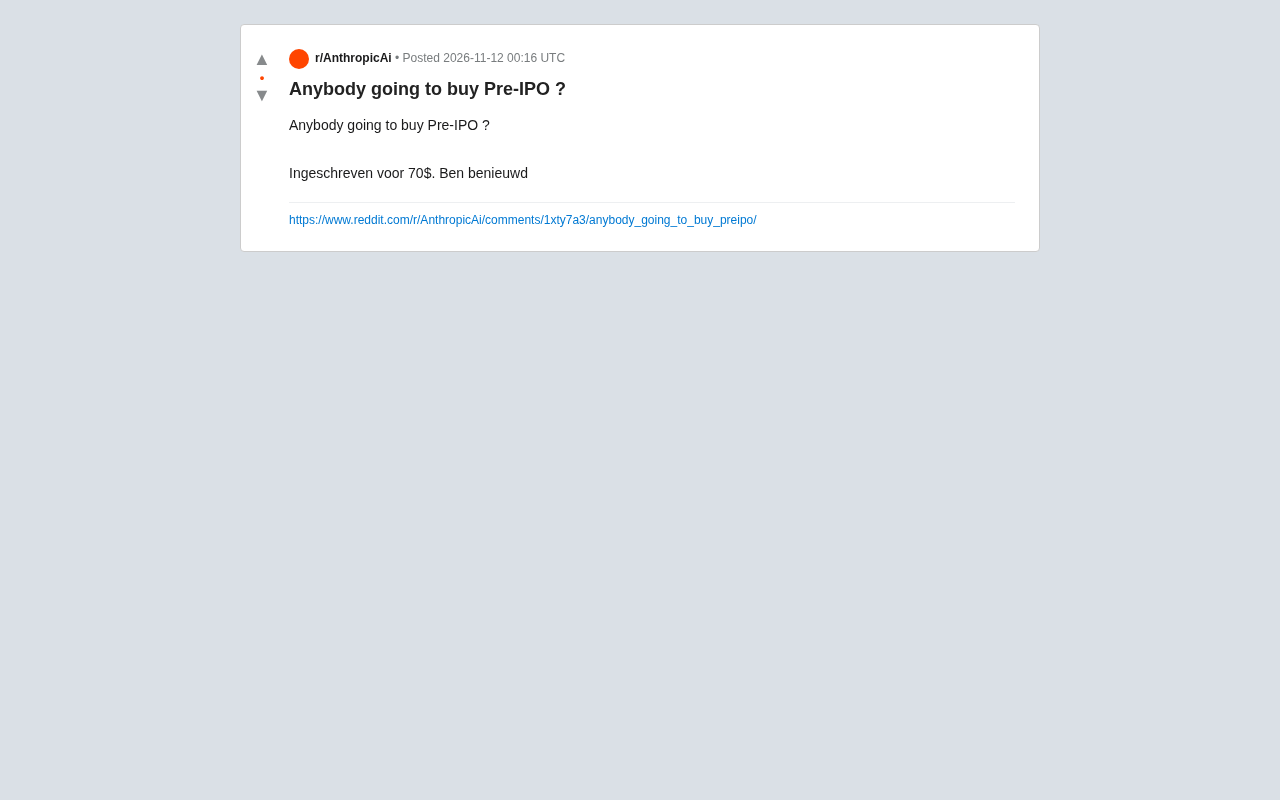
Pre-IPO investing is moving from an institutional-only realm into the view of retail investors. Recently, a short question on Reddit — "Anybody going to buy Pre-IPO ?" — sparked discussion. The poster said they had already subscribed at $70 and wanted to see how others felt. The post itself carries little information, but it reflects a topic worth unpacking: when Pre-IPO shares are packaged into low-threshold products and placed in front of ordinary investors, is it an opportunity or a trap?
What Pre-IPO Actually Is, and Why It Suddenly Got Hot
Pre-IPO refers to equity financing or secondary share transfers that a company conducts before its formal public listing. Traditionally, these transactions were dominated by venture capital, private equity funds, and large institutions, making them hard for ordinary investors to access. What has changed in recent years is that some platforms have split Pre-IPO shares into smaller units, lowering the nominal barrier to entry and letting retail investors "get on board early."
The appeal is easy to understand. If a company's valuation rises substantially after listing, early buyers could theoretically earn considerable returns. The tech industry has no shortage of such cases in history, and this is the fundamental reason Pre-IPO products continue to attract attention on social media. The Reddit poster's subscription at $70 is essentially a bet on the "listing premium."
There are two common forms of transactions at the Pre-IPO stage: first, the company directly issues new shares to raise capital (primary market financing); second, existing shareholders (founders, employees, early investment institutions) transfer old shares. The latter is more common in recent retail-oriented products, because the company itself may not need new capital while old shareholders have liquidity needs. The price of old-share transfers is determined through negotiation between buyer and seller, lacking a public market pricing mechanism — which is why the same company may be quoted at noticeably different prices across different Pre-IPO products.
The so-called "lowering of the threshold" is usually achieved through a special purpose vehicle (SPV): the platform sets up an SPV that pools funds from multiple retail investors, and the SPV holds the target company's shares on their behalf, with investors indirectly enjoying the corresponding rights and interests. This means retail investors are not directly registered as shareholders of the company but hold a layer of structured indirect interests, whose exercise of rights, access to information, and exit arrangements are all governed by the SPV agreement. Understanding this layer of structure is a prerequisite for judging the actual risks of the product.
Three Real Obstacles for Retail Investors Participating in Pre-IPO
Liquidity Is Virtually Zero
Pre-IPO shares generally cannot be freely transferred before listing. Once you buy in, your capital may be locked up for months or even years, with no exit channel during that period regardless of how the company performs or whether you personally need cash. This is fundamentally different from secondary-market stocks that can be sold at any time. For retail investors with tight financial arrangements, liquidity risk is often more fatal than valuation risk.
The lock-up period is a key concept for understanding liquidity. After a company's IPO, early shareholders and insiders usually must also comply with a 90- to 180-day lock-up period during which they cannot sell shares. In other words, even if the company lists smoothly, the capital lock-up time for Pre-IPO investors often adds this lock-up period on top of the "waiting before listing." If the company delays its listing or ultimately fails to list, the lock-up period may be extended indefinitely.
In addition, some Pre-IPO products include transfer restriction clauses in their contracts, requiring company approval for transfers or limiting them to specific parties. The liquidity of secondary share transfer markets (such as certain private equity secondary market platforms) is also far lower than that of public stock markets and often comes with significant discounts. When assessing "whether I can exit," investors should treat the worst case — failed listing and long-term tied-up capital — as the baseline assumption rather than the exception.
Severe Information Asymmetry
Institutional investors at the Pre-IPO stage typically have access to more complete financial data, operating metrics, and due diligence materials, while disclosures for retail-oriented products are often far more simplified. What you see may be only the valuation story and listing expectations, without the full risk factors. Making pricing judgments under opaque information conditions puts you at a disadvantage from the start.
Valuation and Terms Are Easily Overlooked
Pre-IPO prices are not necessarily cheaper than future IPO offering prices. Old-share transfers in hot companies often carry significant premiums, and retail purchase prices may already have priced in post-listing upside. In addition, terms vary greatly across products — liquidation preference, anti-dilution, and lock-up arrangements all materially affect final returns, yet these details are almost never mentioned in brief social media discussions.
Liquidation preference is one of the arrangements in Pre-IPO terms most easily overlooked by retail investors yet most impactful on returns. It stipulates that in the event of an acquisition, liquidation, or specific exit event, preferred shareholders have the right to recover funds ahead of common shareholders at an agreed multiple (such as 1x or 2x the investment amount), with the remainder distributed to common shareholders. If retail investors buy common shares while institutions hold preferred shares with liquidation preference, then when the company's exit valuation falls short of expectations, retail investors may receive almost nothing.
Anti-dilution clauses, meanwhile, protect early preferred investors when the company later raises funds at a lower valuation, reducing the extent of their share dilution by adjusting the conversion price; common shareholders typically do not enjoy this protection. It is also important to check whether the valuation is pre-money or post-money, as the two differ significantly when calculating per-share prices. These term details won't appear in social media discussions, yet they directly determine the actual return structure of the investment.
What This Reddit Post Tells Us
The post itself provides only one data point: someone subscribed at $70 and publicly asked whether others would follow. The comment section did not form a clear consensus — some expressed interest, while others took a wait-and-see attitude. This divergence is itself a valuable signal: the retailization of Pre-IPO is still in its early stages, and participants' understanding of risk varies widely.
It should be emphasized that a single post cannot represent overall market sentiment. It is more like a sample, prompting us to pay attention to the behavioral patterns behind such discussions: subscription sharing on social platforms easily creates herd effects, while Pre-IPO is precisely an investment category that requires independent judgment, a long-term perspective, and risk tolerance.
A Few Judgment Frameworks for Those Considering Participation
First, clarify whether this money can be left untouched for the long term. If the answer is no, Pre-IPO is basically unsuitable.
Second, figure out exactly what you are buying. Is it common stock or preferred stock? Is there a lock-up period? What is the exit mechanism? The answers to these questions matter far more than "how famous the company is."
Third, stay skeptical about valuation. Listing does not equal gains, and breaking the issue price is not uncommon among tech companies. Treating Pre-IPO as a high-uncertainty investment rather than a sure-win opportunity is a more reasonable psychological expectation.
Fourth, control your position size. Even if you decide to participate, you should limit it to an amount within your tolerable loss range and avoid over-concentration in a single target.
The retailization of Pre-IPO investing is an ongoing trend that brings participation opportunities while amplifying information and liquidity risks. That brief question on Reddit is precisely a microcosm of this conflicted mindset: wanting to seize the opportunity while being unsure whether it's worth it. For ordinary investors, the answer lies not in whether others are buying, but in whether you truly understand all the terms of this transaction.
One-line Summary
Retailization of Pre-IPO lowers the barrier to entry, but liquidity and information risks remain prominent.
Paragraph Summary
Starting from a brief question on Reddit about whether to subscribe to a Pre-IPO, the article unpacks the phenomenon of Pre-IPO investing moving toward retailization. Pre-IPO refers to equity financing or old-share transfers before a company's listing, traditionally dominated by institutions but now split by platforms into small units open to ordinary investors, with its appeal lying in betting on post-listing valuation premiums. However, retail investors face three real obstacles: shares are almost impossible to transfer before listing, locking up capital for the long term; disclosed information is far less than that available to institutions, putting them at a disadvantage in pricing judgments; and purchase prices may already include premiums, while term details such as liquidation preference, anti-dilution, and lock-up periods are often overlooked. The article notes that a single post reflects uneven risk awareness among participants and that social sharing easily triggers herd effects, and it offers a four-point judgment framework covering capital horizon, product terms, valuation skepticism, and position control.
Related articles

The Battle of Bakhmut: How Political Symbols Hijacked Military Rationality
Military analysts on the Lex Fridman podcast review the Battle of Bakhmut: Wagner's prisoner attrition tactics, Ukraine's two-front dilemma, and how "Bakhmut Syndrome" let political symbols override military rationality, leading to overcommitment and strategic misallocation.

Skills as Programs: A New Paradigm for LLM Application Development
Skills are the programs of LLMs—this analogy reveals a new paradigm for LLM app development: skill modularization, message-board orchestration, experimentation, and community sharing.

AI in Four Years Will Be Unrecognizable: The Leap from GPT-3.5 to Superintelligence
Over four years AI went from GPT-3.5 toy to expert intern like Aster. Why verifiable domains are key, and how AI may surpass humans in chip design, trading, and materials.