Reddit Developer Launches Philosophize Learning App to Make Studying Easier and More Enjoyable
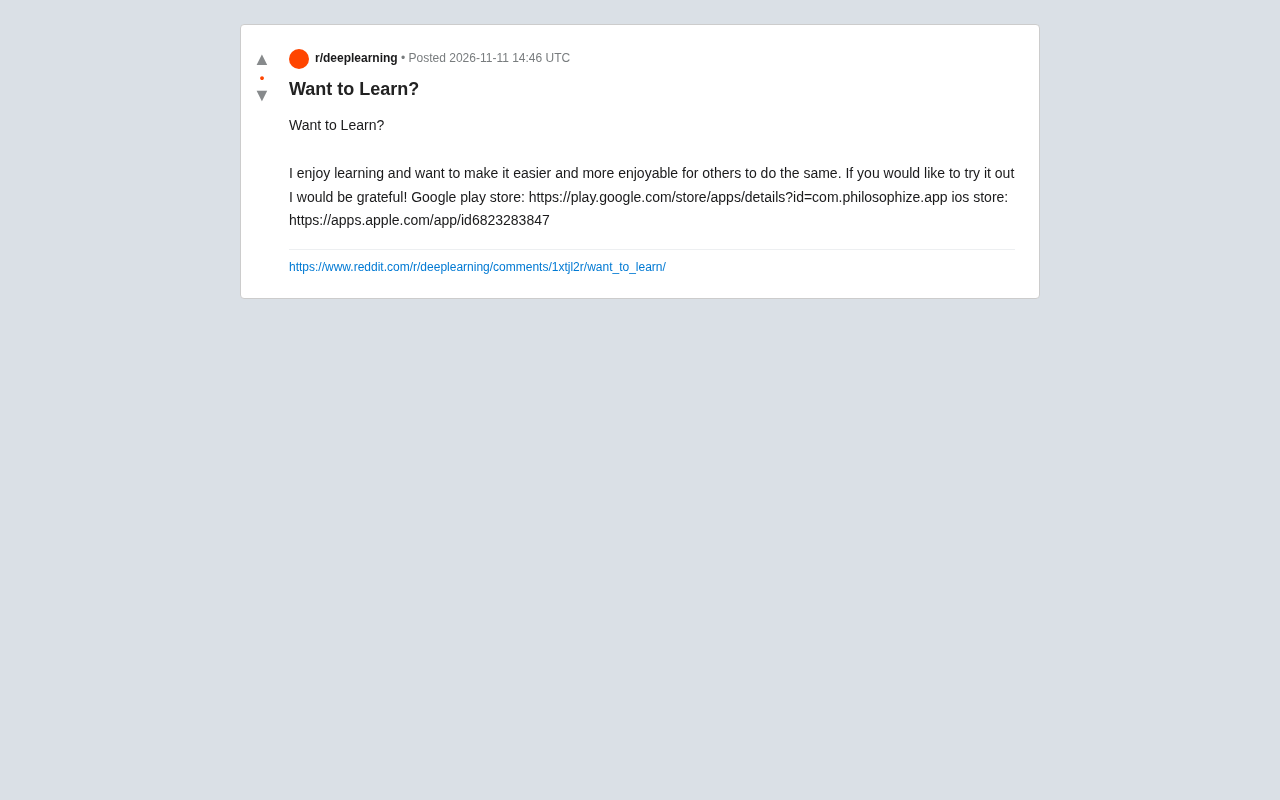
Reddit user independently builds Philosophize learning app, launches on both platforms, and invites community feedback.
A Reddit user introduced Philosophize, a learning app they developed to make studying easier and more fun, now live on Google Play and the iOS App Store. The post skips feature lists and technical architecture, focusing on the product's intent: learning is enjoyable but often friction-filled, and Philosophize tries to smooth that out. Starting from personal experience, the developer humbly invites community trials—a typical "solve your own problem first" indie path. Without user numbers, ratings, or specific features, real-world experience and market performance remain to be seen.
A Reddit user posted about Philosophize, a learning app they developed with the goal of making studying easier and more fun. The user said they love learning and want to help others have the same experience, and the app is now available on Google Play and the iOS App Store.
From Personal Interest to a Shipped Tool
The poster didn't share many technical details, but the product's intent comes through clearly: learning itself is enjoyable, but the process is often not smooth. Philosophize tries to reduce that friction so users can slip into a learning state more easily. This path of building a product from personal experience is common in indie developer communities—solve your own problem first, then see whether it helps others too.
An indie developer usually refers to someone who independently handles product design, development, and release as an individual or as part of a very small team, as opposed to an engineering role employed by a company and delivering to spec. They often start from their own pain points—what's commonly called "scratch your own itch": build a tool you'd want to use yourself, then validate through community feedback whether it's equally valuable to others. This model has formed a stable ecosystem for showcasing and feedback in communities like Hacker News, Product Hunt, and Reddit's r/SideProject. Its advantages are a short decision chain, fast iteration, and a consistent product voice; the challenges lie in the lack of market research and operational resources, and many projects stall at "peak at launch." That's why indie developer communities broadly emphasize shipping early, building in public, and getting feedback from real users.
Launched on Both Platforms Simultaneously
The app landing on both Google Play and the App Store means the developer covers mainstream mobile users. For an independent project, dual-platform release requires extra adaptation and maintenance costs, but it also shows the author has made a real investment in the product. For now, the post only provides download links without expanding on feature lists or technical architecture, so how it actually feels will require users to try it themselves.
Google Play and the iOS App Store are the two main channels for mobile app distribution today, but their release mechanisms differ noticeably. Google Play's review is relatively lenient—first-time listings usually take anywhere from a few hours to a few days—and it supports staged rollouts and fairly quick version rollbacks. The App Store is known for strict review, with a higher proportion of manual checks; apps involving subscriptions, user-generated content, or educational features may be asked for additional clarification, and first review cycles commonly range from a day to a week. For indie developers, dual-platform means maintaining two sets of signing and packaging pipelines and handling platform differences in push notifications, payments, and deep links. A common approach is to use cross-platform frameworks like Flutter or React Native to reduce duplicated work. Shipping on both stores at once usually indicates the developer has completed compliance preparations such as account registration, privacy policies, and store assets.
Community Feedback and What to Watch Next
The post is mainly an invitation to try the app, written in a humble tone with a sincere "I'd really appreciate it if you'd give it a try" attitude. This style of launch tends to get kind responses in Reddit's learning-related subreddits, but whether the product retains users ultimately depends on whether the learning flow really is easier and more fun. Since the material doesn't mention user numbers, ratings, or specific feature modules, its market performance can't be assessed for now.
For those interested in learning tools and independent AI applications, Philosophize is a lightweight product worth keeping an eye on. Its value isn't in stacking up complex technology, but in whether it can turn the simple goal of "enjoying learning" into usable interaction design.
Reddit product launch posts usually go in r/SideProject, r/AppHookup, or vertical subreddits related to learning and productivity. Community culture has clear expectations for self-promotion: explain what you built, why you built it, and what kind of feedback you want, rather than just dropping a download link. Posts with a humble tone that actively respond to comments tend to get more friendly engagement and are more likely to be kept by moderators; overly marketing-style wording is often downranked or removed. It's worth noting that early upvotes and praise on Reddit don't equal retention. The real test for learning apps is whether users open them again in the second or third week, so metrics like retention rate, daily active users, and course completion rates reflect product value better than download counts.
Background Notes
For learning apps, the goal of "making learning easier and more fun" usually comes down to several observable design dimensions. First, reducing startup friction—for example, using short lessons, clear learning paths, or daily goals instead of long course catalogs. Second, immediate feedback—sustaining motivation through progress visualization, streaks, or achievement systems. Third, content organization—common approaches are spaced repetition and active recall, both repeatedly validated in cognitive science as more effective for long-term memory. Since the material doesn't disclose whether Philosophize uses these mechanisms, its experience still needs to be judged by actual use. When evaluating lightweight products like this, it's worth focusing on the path length from first use to completing the first learning unit, and the willingness to return after a week.
One-line Summary
A Reddit user independently developed the learning app Philosophize, launched it on both platforms, and invited the community to try it.
Paragraph Summary
A Reddit user posted about Philosophize, a learning app they developed to make studying easier and more fun, now available on both Google Play and the iOS App Store. The post doesn't disclose a feature list or technical architecture, mainly conveying the product's intent: learning itself is enjoyable, but the process often involves friction, and Philosophize tries to reduce it. Starting from personal learning experience, the developer humbly invites the community to try it—a common indie developer path of "solving your own problem first, then validating others' needs." Lacking information on user numbers, ratings, and specific feature modules, the product's actual experience and market performance remain to be seen.
Related articles

AI Writes Your Code—Do You Still Need to Learn Git? Five Reasons
AI coding agents handle Git operations automatically—is it still necessary to learn Git? Five reasons: team communication, reviewing agent PRs, monitoring code changes, fallback when AI goes down, and the joy of learning—plus how the focus of learning Git is shifting in the agent era.

Anthropic Reportedly Prices IPO at $83 Per Share, Valuing Company at $1.5 Trillion
Anthropic reportedly prices IPO at $83 per share, above the expected range, with a fully diluted valuation of $1.5 trillion. This article analyzes the signal significance of the pricing and its impact on the AI industry's financing environment.

Open-Source Code Hosting Platform Codeberg Suffers Outage, Sparking Debate in Developer Community
Open-source code hosting platform Codeberg.org suffered an outage, sparking Hacker News debate over nonprofit platform stability and open-source infrastructure dependency risks.