Reddit Hot Take: Another Agent, Another RAG — Is AI Stuck in a Cycle of Repetitive Innovation?

A Reddit quip exposes the innovation inertia and path dependence behind the templated Agent+RAG formula in AI apps.
Starting from a Reddit user's quip — "Another Agent, another RAG" — the article analyzes the growing homogeneity of the AI application layer. Agent and RAG have become the default tech recipe due to ease of deployment and clear business narratives, creating three dilemmas: technology path dependence, homogenized evaluation systems, and numbed user perception. The community discussion isn't a rejection of these technologies but a wariness of the thinking inertia of "letting tools define the problem." The article urges developers to return to the essence of the problem and let specific problems choose the tools.
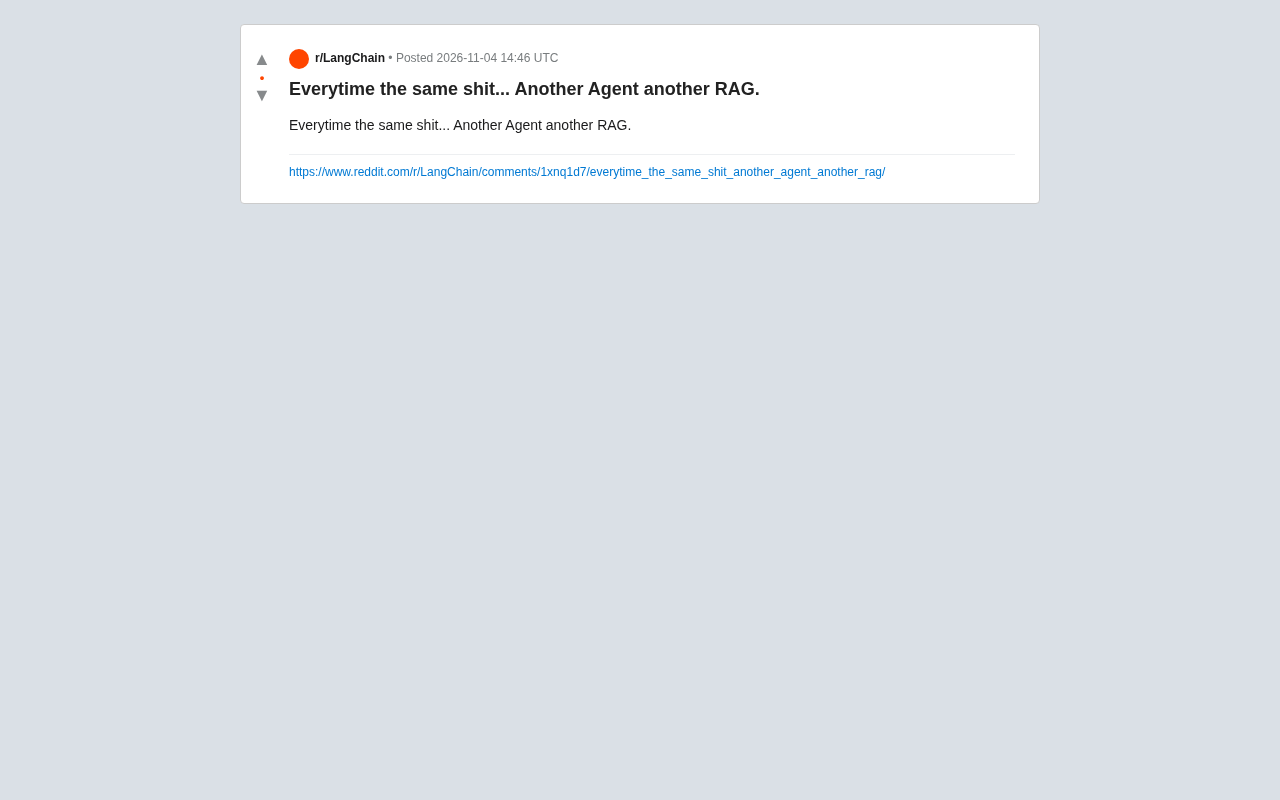
A short but sharp-edged post on Reddit struck a chord with many: "Everytime the same shit... Another Agent another RAG." No long essay, no technical deep dive — just that one sentence, yet it precisely captured a kind of collective fatigue in the AI developer community right now.
When "Agent + RAG" Becomes the Default Recipe
For a while now, the tech stack for AI applications has settled into an almost fixed template: spin up an Agent framework, hook up a vector database, plug in RAG for retrieval-augmented generation, and then market it as an "intelligent assistant." The reason this Reddit user's complaint sparked discussion is precisely that it voiced what many practitioners quietly feel — innovation is turning into assembly-line work.
There are real reasons behind this homogeneity. Agent and RAG are indeed the easiest-to-deploy, easiest-to-pitch tech combo right now. RAG solves the LLM's knowledge staleness and hallucination problems, while Agent handles task orchestration and tool calling — combined, they can cover most enterprise AI use cases. So whether it's a startup or a big-tech team, the tendency is to apply this paradigm directly rather than think from scratch about whether the problem even needs to be solved this way.
RAG (Retrieval-Augmented Generation) works by first retrieving relevant document chunks from an external knowledge base, concatenating them into the prompt, and then having the model answer based on that context. It was first proposed by Meta (then Facebook AI) in a 2020 paper, originally to address the problem that an LLM's parametric knowledge can't be updated in time and is prone to hallucination. Engineering implementations typically involve document chunking, vector embedding, approximate nearest neighbor retrieval, and reranking — which is why vector databases (such as Pinecone, Milvus, Weaviate) have become standard components. RAG's advantage is that it injects private or time-sensitive knowledge without retraining the model, with controllable cost and fast iteration — the fundamental reason it quickly became the go-to solution for enterprise AI deployment.
Three Dilemmas Behind Repetitive Innovation
Path Dependence in Technology
Once a tech combo is proven effective, capital, talent, and attention rapidly converge on it. Agent frameworks keep proliferating, and RAG variants have evolved from naive retrieval all the way to multi-hop reasoning, graph retrieval, and hybrid retrieval — but the underlying logic never escapes the "retrieve-concatenate-generate" framework. This path dependence leaves developers with little incentive to explore fundamentally different architectures.
An AI Agent refers to a system that can autonomously perceive its environment, plan steps, call external tools, and iteratively execute to accomplish goals — typically using an LLM as its reasoning core, combined with function calling, memory modules, and task decomposition. Unlike traditional single-turn Q&A, Agents emphasize multi-step decision-making and tool orchestration; typical frameworks include LangChain, AutoGPT, and the ReAct paradigm. The engineering challenge lies in the reliability of long-horizon tasks: every tool call and intermediate result can introduce errors that accumulate along the chain. This is why many products billed as "agents" actually only implement limited-state workflow orchestration. Understanding this helps explain why the Agent + RAG combo easily degenerates into a template — both are general-purpose capability components with a low barrier to combination, but truly solving reliability problems in specific scenarios still requires substantial targeted design.
Homogenization of Evaluation Systems
When the industry measures AI applications with the same benchmarks and the same demo scenarios, products naturally converge. Everyone is optimizing similar metrics and building similar demos, so what comes out ends up looking increasingly alike. The sarcastic tone of the original Reddit post is, in a way, a rebellion against this "metric-driven innovation."
The convergence of AI application evaluation systems is closely tied to the industry's shared benchmark ecosystem. In RAG, common metrics include retrieval hit rate, recall, and LLM-based faithfulness scores (such as the RAGAS framework); in Agent, task completion rate and tool-calling accuracy are more common. These benchmarks facilitate cross-comparison, but they also foster a tendency of "optimize whatever is easy to quantify." The deeper problem is that benchmarks are often detached from the complex constraints of real business scenarios, leading teams to chase leaderboard scores that are hard to translate into user-perceivable differentiation. When evaluation dimensions are monopolized by a few public benchmarks, product diversity is naturally compressed — one reason the community is calling for scenario-specific, task-level evaluation.
Numbed User Perception
For end users, there's often no fundamental difference between the Nth "intelligent assistant" and the N+1th. When every product claims it can understand context, call tools, and retrieve from knowledge bases, differentiation disappears. Developers' fatigue and users' aesthetic exhaustion are really two sides of the same coin.
Community Sentiment: Beyond Complaints, There's Reflection
Though the post is just one sentence, the sentiment it represents is far from isolated in the developer community. Similar discussions keep recurring on Hacker News, Twitter, and various tech Slack groups: Is the AI application layer going through a phase of "low-level repetition"?
One view holds that this is a normal stage in technology maturation — real innovation only emerges at the application layer after infrastructure is standardized. Another, sharper take: while everyone is busy building Agents and wiring up RAG, the truly hard problems — like model reasoning reliability, long-term memory, and multimodal understanding — are being set aside.
It's worth distinguishing that griping about "another Agent, another RAG" doesn't mean denying the value of these two technologies themselves. RAG and Agent are genuinely useful engineering approaches; the problem is that they've been treated as universal answers rather than specific solutions to specific problems.
Implications for Developers
If you're also building AI applications, this post is worth using as a mirror. Before you start building the next Agent, ask a few questions: Does this problem really need an Agent to orchestrate it? Is the content retrieved by RAG really more reliable than the model's own knowledge? If you remove these two components, what core value does the product have left?
Technological homogeneity isn't scary — what's scary is homogeneity of thought. That blunt complaint on Reddit is essentially reminding the entire industry: don't let tools define the problem; let the problem choose the tools.
Conclusion
"Another Agent, another RAG" — the spread of this phrase lies precisely in its crudeness and authenticity. It doesn't represent a rejection of technology, but a wariness of innovation inertia. As tech stacks become standardized, true competitiveness will return to understanding scenarios and defining problems. Perhaps that's the most valuable reminder this short Reddit post leaves for AI practitioners.
One-line Summary
A single Reddit quip reveals the innovation inertia and path dependence behind the templated Agent + RAG formula in AI applications.
Paragraph Summary
Using a Reddit user's quip — "Another Agent, another RAG" — as its entry point, the article dissects the growing homogeneity of the AI application layer. The author notes that Agent and RAG have become the default tech recipe because they're easy to deploy and offer a clear business narrative, but this has created three dilemmas: path dependence in technology, homogenized evaluation systems, and numbed user perception. Community discussion shows this isn't a rejection of the two technologies themselves, but a wariness of the thinking inertia of "letting tools define the problem." The article closes by urging developers to return to the essence of the problem — before building the next Agent, examine whether the scenario truly needs these components, and let the specific problem choose the tools rather than the reverse.
Related articles

Glasshand: Giving AI Agents a Real iPhone and Mac
Glasshand lets AI agents rent real iPhones and Macs, supporting Claude Code, Codex, and more to post, book services, and test iOS apps on real devices. This article explains how it works, its use cases, and potential boundaries.

ChatGPT Images 2.6 Released: GIF Generation, Reference Image Reuse, and 50% Speed Boost
ChatGPT Images 2.6 released: prompt-to-GIF animation with frame-by-frame editing, reusable reference images for yourself, pets, or characters, 50% faster generation, plus Flare and Sunburst API model variants and SVG export for developers.

Rerun: Turn Your AI Subscription into an AI Coworker Team
Rerun, #3 on Product Hunt, turns your ChatGPT or Claude subscription into a team of AI coworkers that run on schedules or triggers, each with tools, a computer, and a shared workspace. It asks before risky actions, is open source (AGPL v3), and supports self-hosting.