Refs: Feed Your AI Movie-Grade References and Teach Claude to Make Videos

Refs turns 3,000+ films into structured blueprints so Claude can reference real cinematic craft when planning videos.
Refs is a tool designed to improve AI-assisted video creation. Its core is a library of 3,000+ films, each broken down cut by cut into a 15-plate creative blueprint with ready-to-use prompts. A single command connects it to Claude Code, Codex, and Cursor, letting developers reference real filmmaking parameters without leaving their workflow. The approach mirrors RAG principles — rather than retraining a model, it injects high-quality vertical references at inference time, addressing AI's core gap of having capability without taste. The product just launched on Product Hunt, and copyright handling and real-world effectiveness remain to be validated, but its direction of supplying general-purpose models with professional references carries clear practical value.
When AI Starts to Understand the Language of Film
Generative AI has become remarkably capable in text and image domains, but when it comes to video creation, large models have always lacked one critical ability — an understanding of cinematic language. You can ask Claude to write a storyboard, but the result is often little more than a pile of words, lacking the genuine rhythm and visual logic that makes content compelling.
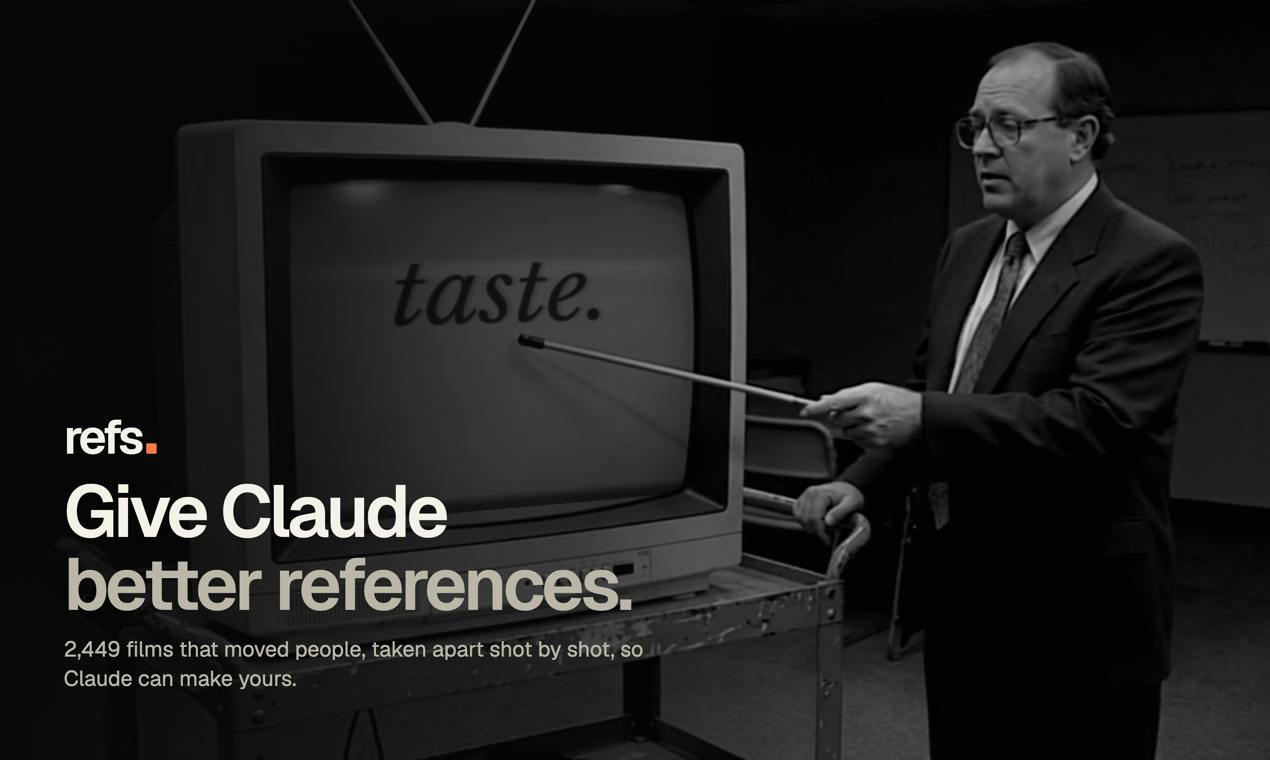
A tool called Refs, which recently launched on Product Hunt, is trying to fix that. Its pitch is straightforward: Give Claude better references for your videos. The product has earned 85 upvotes on Product Hunt, ranking #8, and sits at the intersection of three categories: developer tools, artificial intelligence, and video.
Breaking Films Down into Reusable "Blueprints"
At the core of Refs is a library containing 3,000+ emotionally resonant films. What makes it distinctive isn't the volume — it's the methodology. Every film is measured and analyzed cut by cut, then distilled into a 15-plate blueprint paired with a ready-to-use recipe prompt.
This means each film is no longer just something you watch. It's deconstructed into a set of creative parameters that machines can understand and reuse. Shot length, editing rhythm, compositional structure — things that once lived only in a filmmaker's intuition — are quantified into structured data. For a team planning a launch film, this is essentially packaging the creative experience of top directors into callable templates.
Why "Cut-by-Cut Measurement" Is the Key
Most video reference tools stop at "here's an example to look at." Refs goes further, breaking references down to the granularity of individual cuts. When AI models generate video scripts or storyboards, their biggest weakness is a lack of perception for real-world rhythm. With measurement data for every edit point, Claude is no longer imagining a video from scratch — it's structuring one the way real productions actually work.
One Command to Connect with Leading AI Coding Environments
Refs takes a remarkably lean approach to engineering integration. Rather than asking you to learn a new platform or interface, it connects to Claude Code, Codex, or Cursor — developer-familiar AI toolchains — with a single command.
The design philosophy here is interesting. It turns video creation references into a "knowledge plugin" inside the developer workflow. When you're planning a product launch video inside Claude Code, the real-film blueprints from Refs become the AI's reference foundation, shifting the output from "something that looks like a script" to "a plan informed by genuinely great work."
For independent developers and small teams, this dramatically lowers the barrier to professional video creation. You don't need to hire a director or editor — you can let AI build your video framework based on real, film-grade references.
Claude Code, Codex, and Cursor represent three distinct archetypes of AI-assisted programming today. Claude Code is Anthropic's command-line coding assistant, running directly in the terminal and suited for deep integration into development workflows. Codex is OpenAI's code generation model, widely used as an API by third-party tools. Cursor is an AI code editor built on VS Code, offering inline completions and conversational coding for everyday developers. When Refs claims to connect with all three via "one command," it's essentially exposing its film blueprint database as an externally callable tool through MCP (Model Context Protocol) or a similar tool-calling protocol. This means developers can have the AI reference cinematic data directly inside their familiar coding environment — no context switching required — turning video reference lookup into a transparent step in the development workflow.
The Real Pain Point It Addresses
Refs targets a long-overlooked gap: AI can generate content, but it can't generate taste. Taste comes from understanding and learning from great work — and that's precisely what current AI lacks most.
By structuring 3,000+ films into a reference library that AI can call on, Refs is essentially supplying large models with "visual aesthetic training data" — except this data isn't used for training. It's injected directly as context at inference time. This aligns with the broader trend of RAG (Retrieval-Augmented Generation) and external knowledge bases: rather than asking the model to create from nothing, give it genuinely high-quality references to work from.
Of course, as a product that just launched on Product Hunt, Refs still has limited public information. The specific sources of those 3,000 films, how copyright is handled, the actual precision of the blueprints, and whether the output quality truly reaches "film grade" all remain to be validated through real-world use. But the direction it proposes — using structured references from real works to improve AI video quality — does address a genuine core weakness in AI content generation today.
RAG (Retrieval-Augmented Generation) is one of the dominant engineering paradigms for large model applications today. The core idea: rather than changing a model's parameters, dynamically retrieve relevant content from an external knowledge base at inference time and inject it into the context window, giving the model temporary access to specialized knowledge it wouldn't otherwise have. This is fundamentally different from fine-tuning, which requires large amounts of labeled data and significant compute. RAG is lighter-weight and easier to update. Refs is essentially a vertical-domain implementation of this pattern: rather than retraining a model to "understand film," it uses movie blueprints as retrieval material, injecting them in real time when you ask Claude to plan a video. The general-purpose model temporarily "borrows" professional filmmaking knowledge for that conversation. The advantage is flexibility and an ever-expandable content library; the tradeoff is that results depend heavily on retrieval quality and context window constraints.
Takeaway
Refs represents a category of AI-assist tools on the rise: ones that don't build their own large models, but instead focus on giving existing models more specialized, domain-specific reference data. In an era where anyone can generate content with AI, differentiation will increasingly come down to the quality of the references feeding it. By breaking filmmaking craft into callable blueprints, Refs lets a general-purpose model like Claude borrow the "eyes" of a professional creator. That's a direction worth paying attention to.
Related articles

"Black October": Did AI Uncover 3% of All Critical Vulnerabilities Ever?
A Reddit post claims 3% of all critical software vulnerabilities ever were found in the past month, dubbed 'Black October.' We break down the statistical issues, how AI-assisted code auditing accelerates discovery, and how developers should respond.

Microsoft Project Gecko: Using AI to Bridge Language Gaps for African Farmers
Microsoft's Project Gecko launches PharmaChat, letting African farmers ask questions in their native language and get precise video clips and farming book chapters via AI. The project also releases three interactive manuals to advance inclusive AI.

Musk's Space Dominance: How Starlink Throttling Undermines Ukraine's Defense
SpaceX's Starshield throttling disabled Ukraine's high-speed interceptor drones, exposing how Musk's private control over low Earth orbit communications affects battlefield dynamics and national security, and highlighting the risks of commercial space militarization and space governance dilemmas.