Reimagining AI Programming with Dao De Jing Thinking: The Minimalist Rule Design Where Less Is More
Apply Dao De Jing philosophy to design minimalist rules that boost AI programming collaboration
An AI programming developer discovered through practice that instead of piling on rules, memory, and workflows for AI, it's better to embrace the Dao De Jing's philosophy of white space and design a minimalist set of roughly thirty global rules. The core idea: humans and AI are collaborative partners. Provide underlying goals rather than specific steps, and use moderately ambiguous high-level instructions to activate AI's autonomous planning capabilities — ultimately producing superior results.
Introduction: The Fundamental Dilemma of AI Programming
When we talk about AI programming, most tutorials focus on tool configuration, UI features, and conversation techniques — yet no one can clearly articulate the core question: How exactly should we communicate with AI?
It's like communication between people — you can't simply apply a standardized process to improve emotional intelligence. AI programming faces the same dilemma: how do you get AI to produce results that truly match your needs?
A developer with over a year of deep experience in AI programming studied the four core elements of Agents (rules, skills, workflows, and memory) and arrived at a surprisingly unconventional answer — the Dao De Jing.
From the Four Agent Elements to Minimalist Rule Design
The Four Core Elements of Mainstream Agents
The prevailing view is that an AI Agent requires four core elements:
- Rules: Similar to a company's policies and regulations, they constrain the boundaries of AI behavior
- Skills: The various capabilities AI has mastered, like a person learning guitar or writing essays
- Workflows: Step-by-step processes for completing tasks, from requirements analysis to final delivery
- Memory: AI's records of and access to historical interactions
AI Agents are the core architectural paradigm for current large language model applications. Unlike traditional single-turn Q&A, Agent systems can autonomously plan, invoke tools, and execute multi-step tasks. Rules (System Prompt) define the Agent's behavioral boundaries and values; Skills (Tools/Functions) are the external capabilities an Agent can call upon, such as code execution, web search, and file operations; Workflow is the orchestration mechanism that decomposes complex tasks into ordered steps — the core functionality of frameworks like AutoGen and LangGraph; Memory is divided into short-term context memory and long-term vector database storage. Current mainstream IDEs like Cursor, Windsurf, and Claude Code are continuously iterating on all four dimensions, but the "full injection" problem in memory systems is a widely recognized pain point in the industry — it consumes large amounts of context window, actually degrading the model's reasoning quality.
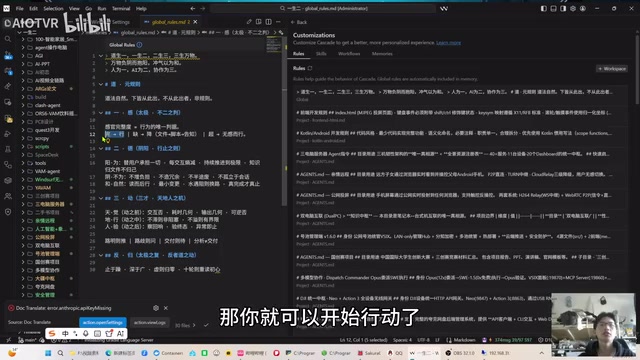
However, in practice, this developer found that current IDE memory systems are designed in a "rigid" way — they force-feed all memories to the AI, rather than allowing natural recall when needed, the way humans do. As a result, the developer chose to clear the memory, gradually removed workflows, and ultimately retained only a single set of minimalist global rules.
The Philosophy of White Space Behind Thirty Rules
This set of global rules contains only about thirty entries, many of which are actually empty — the real count is perhaps only ten to twenty. Why such radical simplicity?
"Thirty spokes share one hub; it is the emptiness at the center that makes the wheel useful."
Thirty spokes form a wheel, and it is precisely the emptiness at the center that allows the wheel to turn smoothly. If it were solid wood, rolling would be laborious; if there were nothing at all, the wheel would collapse. Rules work the same way — too many and AI becomes rigid, too few and it loses control. Only the right balance lets AI operate fluidly.
From the perspective of how large language models work, there is a subtle tension between the length and quality of System Prompts. Research shows that overly long System Prompts lead to "attention dilution" — as the model processes a large number of rules, its adherence to each individual rule actually decreases. This phenomenon is known in academia as the "Lost in the Middle" problem. Official best practices from OpenAI and Anthropic also recommend that rules should be clear, concise, and unambiguous, avoiding contradictory instructions. The engineering logic behind minimalist rule design is this: delegate high-level principled constraints to the model's pre-trained knowledge to fill in the details, rather than trying to exhaustively enumerate every scenario with rules. This mirrors the "Open-Closed Principle" in software engineering — open for extension, closed for modification.
The Daoist Core of AI Programming Rule Design
Dao: The Fuzzy Yet Powerful Underlying Logic
The first three lines of the rules seem enigmatic:
- Original text from Dao De Jing (道可道,非常道)
- Original text from Dao De Jing
- "The human is one, AI is two, collaboration is three"
The third line is the key innovation — AI programming is fundamentally a collaboration between two entities. When humans and AI are in conflict, or when humans force AI to execute in rigid, predetermined ways, nothing works well. Only genuine collaboration produces quality results.
From an information theory perspective, the linguistic characteristics of the Dao De Jing are remarkably unique: extremely high information density paired with extremely low redundancy. Shannon's information theory states that truly valuable information is "surprising" content, not predictable repetition. The high degree of abstraction in every line of the Dao De Jing enables new interpretations in different contexts — this is precisely the trigger condition for large language models to exhibit creativity when processing ambiguous instructions. From a Prompt Engineering perspective, overly specific instructions "lock down" the model's solution space, while moderately ambiguous high-level instructions actually activate broader reasoning pathways. This forms an interesting resonance with the Dao De Jing's teaching "In pursuit of learning, one gains daily; in pursuit of Dao, one loses daily": in AI collaboration, reducing constraints (losing) often improves output quality more than adding rules (gaining).
De: Concrete Behavioral Guidelines
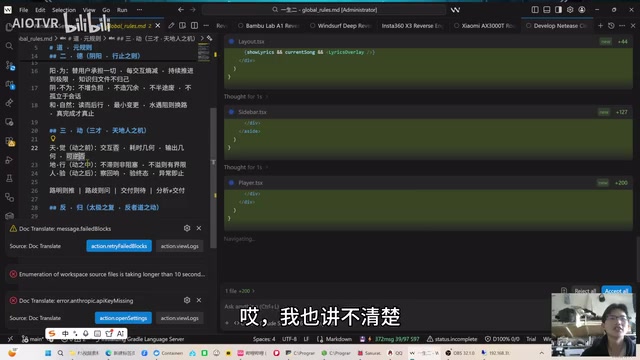
Yang (Action) — What AI should do:
- Take on all virtual-world operations on behalf of the user
- Independently search for information and invoke all available methods
- Use "all methods at its disposal" — try every approach available
Yin (Non-action) — What AI should not do:
- Do not add burden to the user (don't ask the user to test after every step)
- Do not create redundancy (don't write large amounts of useless documentation)
- Do not abandon tasks halfway (don't stop mid-task without reason)
- Do not isolate work within the session (results should be sustainably usable)
Rule Design for Three Phases of Action
Before action:
- Is interaction needed? (Can this be pushed through to completion directly?)
- How long will it take? (Is a timeout mechanism needed?)
- Is the output reversible? (Can we roll back if something goes wrong?)
During action:
- Do not stop mid-task; set automatic timeout termination (e.g., 60 seconds)
- Automatically switch methods when encountering obstacles
After action:
- Check status and results
- If the path is clear, push forward; if there's ambiguity, ask the user
Live Demo: One Sentence to Generate a Complete Music Webpage
The Power of Minimalist Instructions
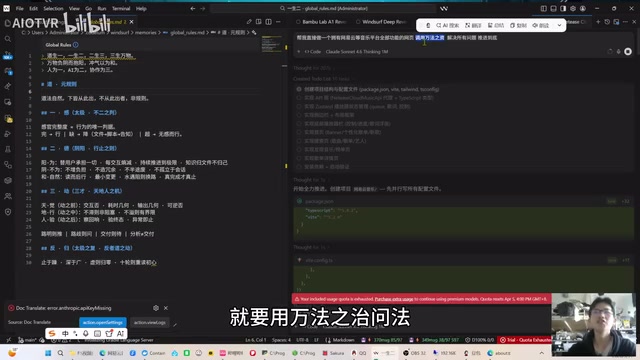
In a live demonstration, the developer entered just a single short sentence — roughly "build a web platform that can play music" — and the AI began 207 seconds of deep thinking, independently planned 10 tasks, and then executed them one by one.
The logic behind this:
- Give the underlying goal, not specific steps
- Define "what to do" like a manager, not "how to do it"
- Leave white space and room for the AI's autonomous intelligence to emerge
"Reversal is the movement of the Dao; weakness is the function of the Dao." The shorter and more powerful the instruction, the more it unlocks AI's potential.
In AI programming, there are two fundamentally different paradigms for instruction design: process-driven and goal-driven. The process-driven approach requires users to describe every execution step in detail — essentially "translating" human thought processes for AI to execute, with the user remaining the true planner. The goal-driven approach describes only the desired end state, fully delegating the planning authority to the AI. The latter corresponds to the "planning capability" in the AI field.
Related articles
 Expert Opinions
Rethinking Scaling Laws: Parameters Are Not the Only Answer
Deep analysis of Scaling Law evolution from Kaplan to Chinchilla to the MoE era, exploring why blindly stacking parameters is a mistake, and how GLM-5.3 proves scaling has multiple knobs.
When AI Treats Humans as Subagents: Ro…
When AI Treats Humans as Subagents: Role Reversal and Hidden Risks in Human-AI Collaboration
Exploring the paradigm shift where humans become "subagents" in AI Agent architectures. Analyzes human node design in LangChain and AutoGen, and the risks of ceding control and cognitive atrophy.
 Expert Opinions
The Lazy Person's Productivity Theory: Why Being 'Lazy' Actually Drives Peak Performance
Explore the engineering philosophy behind 'lazy people are most productive': how constructive laziness drives automation, AI tools amplify efficiency, and systems thinking eliminates wasted effort.