Reinforcement Learning for LLMs: A 'Never Give Up' Strategy for Hard Problems
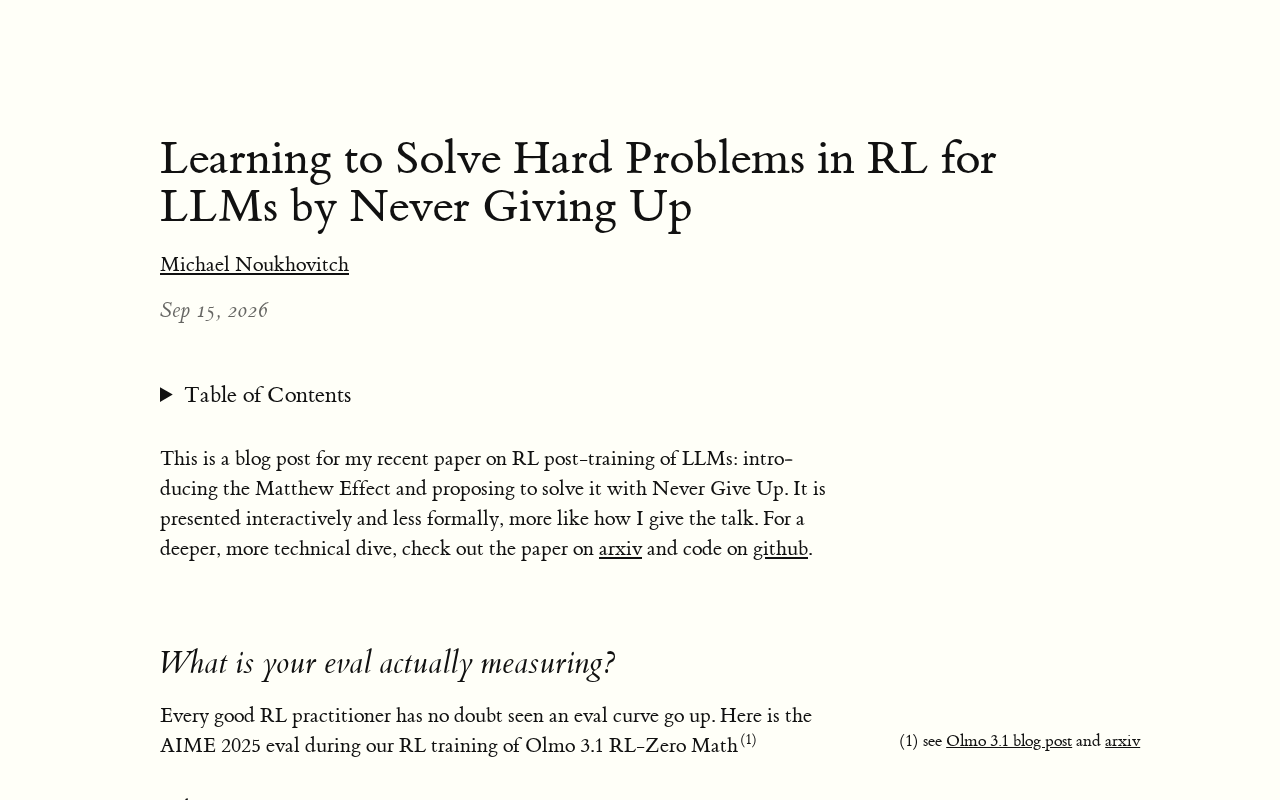
A 'Never Give Up' RL training strategy helps LLMs persist on hard problems by amplifying sparse rewards and sustained exploration.
RL training for LLMs has a systemic flaw: hard problems generate almost no reward signal, causing training to default to medium-difficulty tasks. This paper proposes a 'Never Give Up' strategy — increasing sampling budgets for hard problems, amplifying rare successes, and using curriculum-based difficulty progression to keep useful gradient signals flowing. Drawing on DeepMind's NGU exploration algorithm, the approach aggressively tilts toward exploration in the RL tradeoff, with key implications for hard reasoning tasks like math proofs and multi-step logic.
Introduction: The 'Fear of Difficulty' Problem in LLM Reinforcement Learning
A long-standing challenge in reinforcement learning (RL) training for large language models (LLMs) is how models behave when faced with highly difficult problems. When a model repeatedly fails on a class of hard tasks early in training, standard RL algorithms tend to "route around" those problems — instead reinforcing behavior on easier tasks where rewards are readily available. This causes the model to stagnate precisely where deep reasoning is needed most.
A research paper discussed on Hacker News — titled Learning to solve hard problems in RL for LLMs by never giving up — proposes an intuitive and promising direction: train models to "never give up," and keep pushing them to tackle the problems they initially cannot solve.
Why Hard Problems Get Abandoned in RL Training
The core of reinforcement learning is using reward signals to guide model behavior. For LLMs, if a problem is too difficult, the model can barely produce a correct answer during sampling — and without correct answers, it receives no positive reward. No reward signal means almost no gradient contribution from those examples.
As a result, training naturally gravitates toward problems the model "can" solve — medium-difficulty tasks that provide useful learning signals without completely stumping the model. The hardest problems, the very ones we most want the model to master, are systematically neglected.
This mirrors the "comfort zone" trap in human learning: if you only practice what you already know how to do, your growth hits a ceiling.
At the algorithmic level, this phenomenon is closely tied to how gradient estimation works in commonly used LLM RL algorithms like GRPO and PPO. These methods rely on Monte Carlo sampling to estimate policy gradients: if a hard problem fails across hundreds of samples (pass@k ≈ 0), reward variance is zero, the gradient signal nearly vanishes, and parameter updates approach zero. This is somewhat analogous to the "dead neuron" problem — once gradient flow in a region of the network dies out entirely, learning in that region stops cold. Batch composition compounds the issue: when a batch contains many hard problems, overall gradient estimate variance spikes, causing optimizers to shrink update step sizes and further weakening learning on hard examples. This also explains why simply scaling up model size or extending training time doesn't automatically fix the "hard problem blind spot" — the root cause is missing signal, not insufficient compute.
The Core Idea Behind "Never Give Up"
The "never giving up" philosophy in the paper's title points to a training paradigm: even when a model's initial success rate on hard problems is extremely low, some mechanism should keep it exploring those problems rather than abandoning them.
This idea draws on related concepts from classic RL exploration algorithms — most notably DeepMind's earlier "Never Give Up" exploration method — with the central principle being:
Sustained Exploration of Hard Problems
By increasing the sampling budget for difficult examples, extending exploration time, or introducing intrinsic motivation mechanisms, the model gets more chances to "stumble upon" a correct answer on hard problems, thereby generating a usable reward signal for learning.
DeepMind's "Never Give Up" (NGU) algorithm, proposed in 2020, is an important precursor worth highlighting. NGU's core mechanism combines external rewards with two forms of intrinsic reward: a short-term reward based on episodic novelty — measuring whether the current state is being visited for the first time in the current episode using k-nearest-neighbor distances in embedding space — and a long-term reward based on life-long novelty, estimated via Random Network Distillation (RND) to gauge how rarely a state has been visited throughout all of training. Together, these drive the agent to maintain curiosity about historically under-explored states, escaping local exploration traps. Adapting this to LLM RL training introduces the challenge of language's discrete, high-dimensional nature — how to define "novelty" for an LLM's problem-solving trajectory is one of the core engineering questions the paper needs to answer.
Amplifying Learning from Sparse Positives
Even when success rates are extremely low, the rare occasions when a model does solve a hard problem carry enormous learning value. The right mechanism can amplify these sparse positive examples, helping the model gradually and reliably internalize solutions to difficult problems.
Curriculum-Based Difficulty Progression
Breaking hard problems into stages or organizing training along a difficulty gradient allows models to accumulate capability before taking on the hardest challenges — avoiding the trap of being thrown into a completely signal-free regime from the start.
What This Means for LLM Reasoning Capability
As reasoning models become a central frontier in AI development, enabling models to push past their own capability boundaries and solve genuinely hard problems is increasingly critical. Conventional approaches have achieved solid results on simple and medium-difficulty tasks, but show clear limitations in high-difficulty domains like complex mathematical proofs, multi-step logical reasoning, and code debugging.
At its core, the "never give up" training strategy addresses the exploration-exploitation tradeoff in RL training. It reminds us that a truly powerful reasoning model shouldn't just spin its wheels in familiar territory — it needs the persistent capacity to take on and work through hard problems.
The exploration-exploitation tradeoff is a foundational tension in reinforcement learning: an agent must both "exploit" known effective strategies to collect rewards and "explore" unknown territory to discover better solutions. This tension is especially acute in LLM post-training — model capacity is finite, training compute budgets are fixed, and over-exploring hard problems tanks overall training efficiency, while over-exploiting easy ones creates a capability ceiling. Current industry approaches to this tradeoff include stratified sampling by difficulty (a variant of prioritized experience replay), dynamically adjusting the proportion of different difficulty levels within each batch, and temporarily raising sampling temperature during exploration phases to increase output diversity. The "never give up" strategy is essentially a more aggressive tilt toward the exploration end of this tradeoff — and empirical data on its costs and benefits is the key to evaluating its practical value.
Closing Thoughts
It's worth noting that, given the limited source material currently available (only a title and some discussion activity on Hacker News, with no detailed comments yet), the technical analysis in this article is primarily based on what the title suggests and common practices in the field.
The value of this research direction lies in directly confronting a problem that has been widely observed but difficult to solve in LLM reinforcement learning. For researchers and engineers tracking cutting-edge AI training methods, "how to keep a model from giving up on hard problems" is a topic well worth following closely. Readers who are interested are encouraged to consult the original paper for the complete experimental design and empirical validation.
Related articles
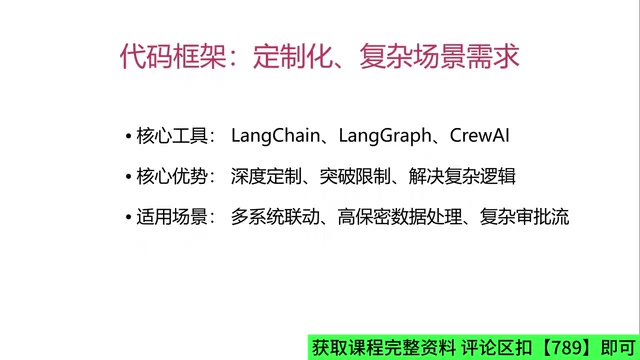
Enterprise AI Agent in Practice: A Dual-Track Strategy with Low-Code and Hardcore Frameworks
A dual-track enterprise AI Agent framework: low-code platforms (Coze/Dify/n8n) and code frameworks (LangChain/LangGraph/CrewAI), covering MCP protocol, nine smart job roles, and four real-world projects.

OpenSpec in Practice: Taming AI Code Generation with Spec-Driven Development (SDD)
AI code goes off-rails after 30 minutes? Learn how OpenSpec uses Spec-Driven Development (SDD) to make AI-generated code trackable, verifiable, and deliverable.

Getting Started with LLM Development: Alibaba Cloud Model Studio Setup and API Key Configuration
A hands-on beginner's guide to LLM development: covers Alibaba Cloud Bailian registration, real-name verification, API Key creation, and free quota management for RAG and Agent development.