Reinforcement Learning from Scratch: Beyond the Sutton Textbook, These Blog Resources Can Accelerate Your Learning
Learners with an ML background can use blogs to dive into RL concepts on demand, then supplement theory with textbooks for accelerated learning.
The article targets readers with a math and ML/DL foundation who want to learn RL efficiently, proposing a blog-centered learning path. Blogs offer on-demand reference and concise breakdowns of specific concepts (MDPs, policy gradients, Q-learning, Actor-Critic) with code and diagrams for easy engineering connection; drawbacks are lack of systematicity and uneven quality. Filtering should focus on author background, content depth, and timeliness. The strategy recommends treating Sutton & Barto as a reference manual rather than the main thread, adopting a "blogs first, textbook supplement" cycle, and watching specific video segments at increased speed only when stuck. Finally, it emphasizes goal-driven learning, selecting 5-6 blog sources, and implementing each algorithm hands-on to close the loop.
Why Blogs Are an Efficient Path for Learning RL
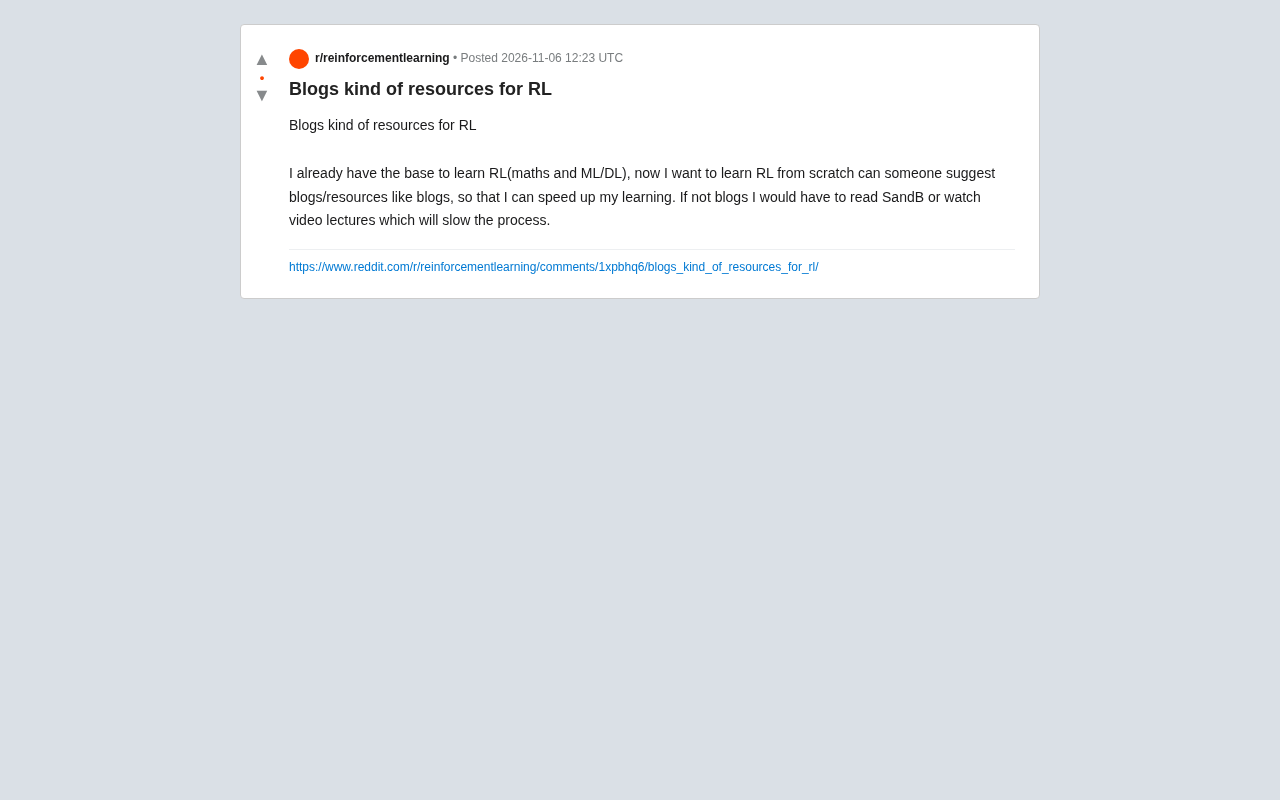
A question from a Reddit user struck a chord: they already have a foundation in math and ML/DL and want to learn reinforcement learning (RL) from scratch, but they don't want to grind through the thick Sutton & Barto (SandB) book from cover to cover, nor do they want to be slowed down by the pace of video courses. They explicitly wanted to find blog-style resources to accelerate their learning.
This actually points to a pain point in RL learning: textbooks are too systematic, video courses have a fixed pace, while blogs often offer concise breakdowns of specific concepts, making them suitable for people with existing foundations to quickly build intuition.
Advantages and Use Cases of Blog Resources
For learners with an ML/DL background, the value of blogs lies in on-demand reference. You don't need to read every chapter linearly; instead, you can find an article that thoroughly explains a single point on specific topics like MDPs, policy gradients, Q-learning, and Actor-Critic.
Blogs are usually written by practitioners and come with code snippets and intuitive diagrams, making them easier to connect to engineering implementation than textbooks. Of course, blogs have obvious drawbacks: lack of systematicity, requiring you to plan your own learning path, and uneven quality.
How to Filter High-Quality RL Blogs
Reddit community suggestions usually point in a few directions: personal blogs of well-known researchers, tutorial-style technical blogs, and explanatory articles accompanying open-source projects. When filtering, focus on three things:
- Author background: whether they have RL research or engineering experience
- Content depth: whether they clearly explain the mathematical derivations and algorithm motivations, rather than just giving conclusions
- Timeliness: the RL field evolves quickly, so prioritize articles covering newer methods
Strategy for Combining with Textbooks and Video Courses
Completely avoiding SandB isn't realistic, but you can treat the textbook as a reference manual rather than the main thread. Use blogs to quickly dive into a topic and build intuition, then return to the textbook to fill in theoretical details. This cycle of blogs first, textbook as supplement can significantly improve efficiency.
Video courses are suitable when you're completely stuck on a certain algorithm—watch specific segments at increased speed as a supplement. The key is not to be bound by a single resource, but to be problem-driven and cross-reference multiple sources.
Advice for Accelerated Learners
Clarify your goal: research or application. Research-oriented learning requires deeper mathematical derivations, while application-oriented learning can prioritize mastering the implementation and tuning of mainstream algorithms. Choose 5-6 high-quality blog sources around your goal and build your own reading list. Every time you learn an algorithm, implement it hands-on once—this forms a closed loop faster than passively reading textbooks or watching lectures.
One-line Summary
Learners with an ML background can use blogs to dive into RL concepts on demand, then supplement theory with textbooks to accelerate learning.
Paragraph Summary
The article targets readers who already have a foundation in math and ML/DL and want to learn reinforcement learning (RL) efficiently, proposing a blog-centered learning path. The advantage of blogs is on-demand reference and concise breakdowns of specific concepts (such as MDPs, policy gradients, Q-learning, Actor-Critic), often with code and diagrams that make it easy to connect to engineering implementation; the drawback is lack of systematicity and uneven quality. When filtering high-quality blogs, focus on author background, content depth, and timeliness. In terms of learning strategy, it's recommended to treat the Sutton & Barto textbook as a reference manual rather than the main thread, adopt a cycle of "blogs first, textbook as supplement," and watch specific video segments at increased speed only when stuck. Finally, it emphasizes being driven by your goal (research or application), selecting 5-6 blog sources, and implementing each algorithm hands-on to form a closed loop.
Related articles
 Tech Frontiers
Stylome Bot Slammed as Useless Junk: Why Do AI Detection Tools Keep Failing?
Reddit users test the Stylome AI detection bot: Gemini-rewritten text judged human-written, consistently low confidence. An analysis of AI text detection's technical dilemmas, privacy concerns, and credibility crisis in community governance.
 Tech Frontiers
When AI Becomes a Productivity Divide: Clarity or "AI Psychosis"?
A civil engineer's deep use of agentic AI boosted efficiency but bred contempt for peers who refuse to learn. Is this clarity or AI psychosis? An analysis of the cognitive and psychological challenges behind the AI productivity divide.
 Tech Frontiers
Opus 5.5 Benchmark Scores Climb, Community Says Its "Weights Are Blessed"
Reddit community discusses Opus 5.5's rising scores on the Benchmaxxing Bench, with users describing its performance as "weights are blessed." This article interprets the community reaction and cautions against conflating benchmark scores with real capability.