Reinforcement Learning Resources for Beginners: Theory, Code, and Math
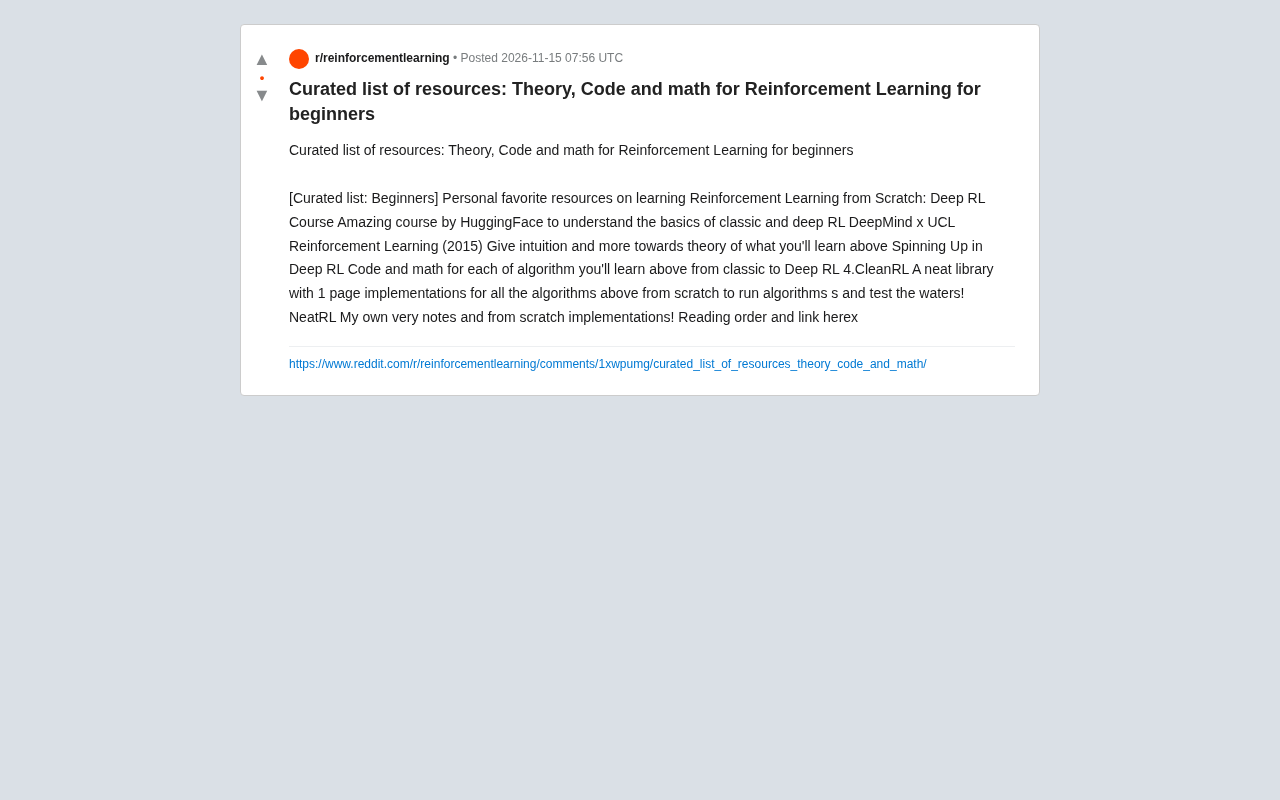
A self-study RL resource list progressing from intuition to theory to code to practice, with usage tips.
The article breaks down a reinforcement learning starter resource list from the Reddit community, recommending four types of materials in learning order: HuggingFace Deep RL Course for building intuition from zero, the DeepMind x UCL course for theoretical depth, OpenAI's Spinning Up for combining code with math, and CleanRL and NeatRL for hands-on validation. It emphasizes the progressive structure over resource quantity and cautions that true understanding comes from debugging.
Why You Need a Structured Reinforcement Learning Starter List
Reinforcement Learning (RL) has a notoriously steep learning curve in machine learning — you need to understand mathematical frameworks like Markov Decision Processes while also handling environment interaction, sampling, and policy updates at the code level. There's plenty of material online, but quality varies wildly, and beginners often get stuck in a loop of "finished reading but can't write code."
A personal resource collection recently circulating in the Reddit community happens to offer a progressive path from intuition to theory to code implementation. The author describes it as the set of resources they used most when "learning reinforcement learning from scratch," covering courses, theory lectures, code libraries, and notes. Below we break it down in learning order, with some notes on why each resource was chosen and how to use it.
Markov Decision Process (MDP) is the core mathematical framework of reinforcement learning, and virtually all RL algorithms are built on it. An MDP consists of a five-tuple (S, A, P, R, γ): state space S, action space A, state transition probability P, reward function R, and discount factor γ. At each step, the agent selects an action based on the current state, the environment transitions to a new state according to P and provides a reward, and the goal is to find a policy that maximizes the expected long-term cumulative reward. The key to understanding MDPs is the "Markov property" — future states depend only on the current state and action, not on history. This assumption makes the problem solvable via dynamic programming and is the prerequisite for concepts like value functions and the Bellman equation. Beginners who skip this layer and jump straight into deep RL algorithms often get lost in the derivations.
Step 1: Build Intuition — HuggingFace Deep RL Course
The first stop on the list is HuggingFace's Deep RL Course. Its positioning is clear: help learners understand the foundational concepts of classical and deep reinforcement learning.
HuggingFace's course style leans toward "run it first, then understand it," using interactive notebooks to help learners build intuitive feel for core concepts like agents, environments, rewards, and policies through hands-on practice. For someone with no RL background at all, this low-barrier entry point is friendlier than diving straight into theory textbooks. The author placed it first on the list precisely because "feeling it first, then seeing the formulas" significantly reduces the frustration of subsequent learning.
One caveat: this course covers the basics and has limited depth. Its value is in helping you quickly build a mental map, not in making you master every algorithm detail.
Step 2: Fill in the Theory — DeepMind x UCL Reinforcement Learning Course
With intuition in place, the list suggests moving to the Reinforcement Learning course (2015) co-produced by DeepMind and UCL. Taught by David Silver, this course is highly regarded in RL education.
Its role is to provide theoretical grounding for the concepts you built in step one: why policy gradients are derived the way they are, what the convergence conditions for value function approximation are, and how the exploration-exploitation tradeoff is expressed mathematically. In the author's words, this course "gives intuition and leans more toward the theory you're learning." In other words, it doesn't aim for code implementation — it helps you think through the "why."
For learners with average math backgrounds, this course can be challenging, especially the parts on dynamic programming, Monte Carlo methods, and function approximation. It's advisable to watch repeatedly alongside notes — don't expect to understand everything in one pass.
Policy Gradient is a class of methods that directly optimize policy parameters, complementing value-based methods like Q-learning. The core idea is to parameterize the policy as πθ(a|s) and then update θ in the direction that increases expected return. The basic REINFORCE algorithm uses the log-derivative trick to derive a gradient estimate, but it has high variance; later Actor-Critic methods introduce a value function as a baseline to reduce variance. Policy gradients naturally handle continuous action spaces and stochastic policies, but typically suffer from low sample efficiency and unstable training. The mention of "why policy gradients are derived the way they are" refers precisely to the process of starting from the objective function J(θ) and using the likelihood ratio trick to obtain a sampleable gradient estimate. Understanding this derivation is essential for reading modern algorithms like PPO and SAC.
Step 3: Code and Math Together — Spinning Up in Deep RL
The third item on the list is OpenAI's Spinning Up in Deep RL. What makes it unique is that it treats "code" and "math" as equally important: from classical algorithms to deep RL algorithms, each one comes with implementation code and mathematical derivations.
This fills exactly the gap left by the first two steps — the HuggingFace course is hands-on but light on theory, while the UCL course is theory-heavy but light on code. Spinning Up stitches the two together, letting you understand the formulas behind the code as you write it. The author describes it as "the code and math for every algorithm you learned above," making it the linchpin of the entire list.
In practice, don't try to read through every algorithm. Picking one or two classic algorithms (such as policy gradient or DQN-style methods), reading their derivations carefully, and getting the code running is far more effective than skimming broadly.
DQN (Deep Q-Network) is a milestone algorithm in deep reinforcement learning, proposed by DeepMind in 2015, and was the first to demonstrate approximating the Q function with a deep neural network and achieving human-level performance on Atari games. DQN introduces three key techniques on top of classical Q-learning: experience replay to break correlations between samples, a target network to stabilize training targets, and convolutional networks to process raw pixel inputs directly. These tricks solved the fatal instability of "online updates of a neural network as a value function." DQN only applies to discrete action spaces; its continuous-action counterpart requires an Actor-Critic architecture. The DQN chapter in Spinning Up is often read alongside policy gradient methods, which helps clarify the philosophical differences between value-based and policy-based design.
Step 4: Hands-On Implementation — CleanRL and NeatRL
After going through theory and methodology, the list recommends two code libraries for "testing the waters."
CleanRL is a reinforcement learning library known for single-file implementations. Its design philosophy is one file per algorithm, with concise code and minimal dependencies, making it easy for learners to read and modify directly. The author calls it a "tidy library," ideal for quickly running experiments to validate your ideas after understanding an algorithm.
NeatRL is the author's own notes and from-scratch implementations. While it hasn't been as widely validated as the other resources, as personal learning notes it offers a different perspective — how a learner at a similar stage understands and implements these algorithms. For readers who like "seeing how others learn," this kind of material often resonates more than formal tutorials.
How to Use This List
The list itself provides a reading order, but you can be more flexible in practice. One feasible rhythm: start with the HuggingFace course to build an overall framework, taking about one to two weeks; then interleave the UCL course to fill in theory, consulting the corresponding Spinning Up chapters whenever you encounter an algorithm you don't understand; finally, use CleanRL to run a few classic algorithms and check your understanding against NeatRL's notes.
A word of caution: RL has many pitfalls — environment setup, hyperparameter sensitivity, and training instability are the norm. The resources on this list can help you avoid detours, but they can't skip the hands-on debugging process for you. True understanding often happens when your code won't run and you're forced to go back to the formulas.
Summary
The value of this list isn't in the number of resources, but in the clear progressive structure it provides: intuition → theory → code → practice. The HuggingFace course handles onboarding, DeepMind x UCL provides theoretical depth, Spinning Up stitches code and math together, and CleanRL and NeatRL enable hands-on validation. For self-learners of reinforcement learning, following this order is far more efficient than jumping between scattered materials.
One-line Summary
A self-study reinforcement learning resource list progressing from intuition to theory to code to practice, with usage tips.
Paragraph Summary
The article breaks down a reinforcement learning starter resource list circulating in the Reddit community, recommending four types of materials in learning order: HuggingFace Deep RL Course for building conceptual intuition from zero, the DeepMind x UCL course (taught by David Silver) for theoretical depth, OpenAI's Spinning Up for combining code implementation with mathematical derivations, and CleanRL and NeatRL for hands-on validation and comparative learning. The author emphasizes that the list's value lies in its progressive structure rather than the quantity of resources, offers flexible pacing suggestions, and cautions that RL involves complex environment setup and unstable training — true understanding happens during debugging and revisiting formulas.
Related articles

Snapchat Opens AI Assistant Lens Building: Supports Claude Code and Cursor
Snapchat lets Lens creators describe AR filters in natural language, with AI assistants like Claude Code and Cursor handling the full build process, greatly lowering the AR creation barrier.

Is the Planck Length the Smallest Distance? Why Physicists Are Skeptical
The Planck length is often called the smallest distance in the universe, but science videos point out this claim has never been experimentally confirmed. This article explains the origins of the Planck length, the obstacles of microscope thought experiments, and what it really tells us—the scale at which quantum gravity becomes unavoidable, not spacetime pixels.

AI Agents Drive Spend Management: Payhawk Raises $280M
Payhawk raises $280M at a $2B valuation. The 2018-founded enterprise finance platform uses AI agents to track and manage expenses and procurement. This article analyzes its product evolution, valuation signals, and impact on the spend management space.