Relations Before Entities: The Deferred Commitment Mechanism in LLM Fact Recall
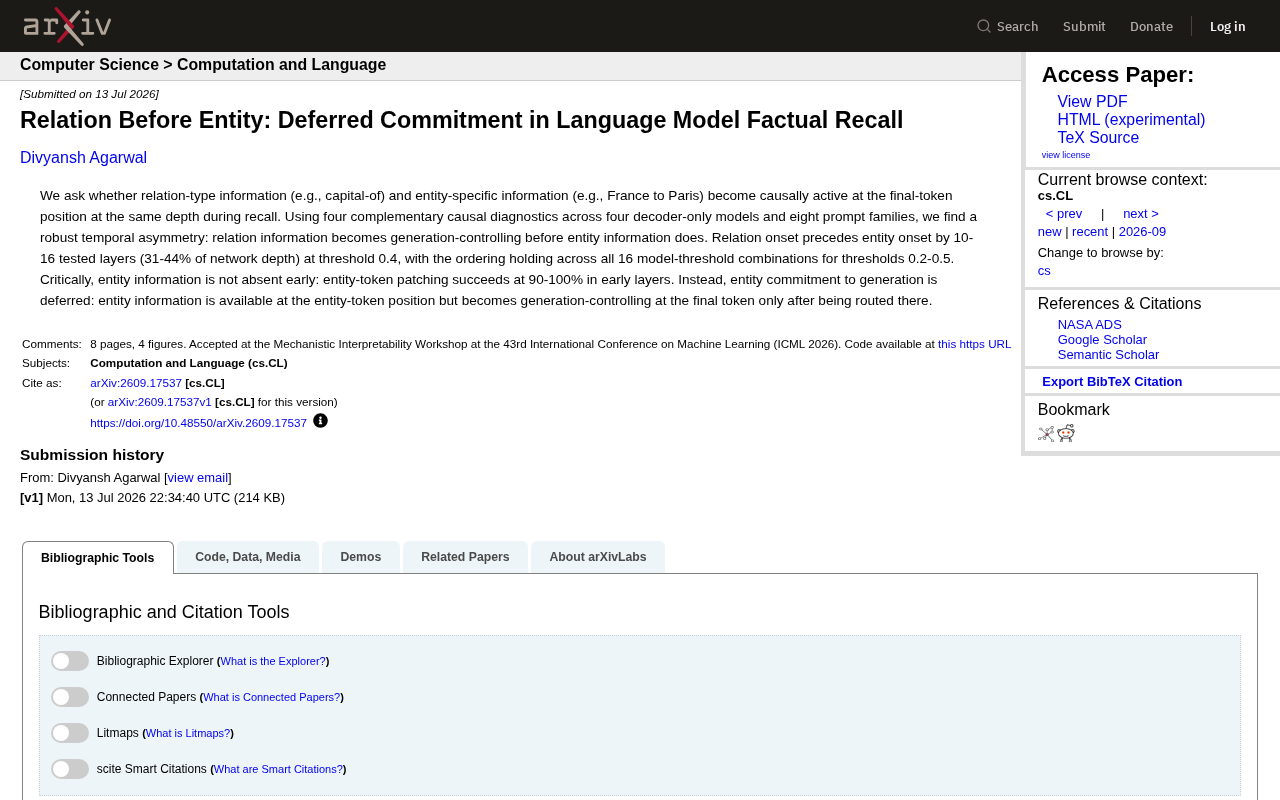
LLMs resolve relation type 10–16 layers before committing to specific entity facts, revealing a layered temporal structure in fact recall.
This arXiv paper investigates the internal temporal structure of LLM fact recall, finding that relation information (e.g., "capital-of") becomes causally active in generation 10–16 layers earlier than entity-specific information (e.g., France→Paris), a gap spanning 31–44% of total network depth. This asymmetry holds robustly across four decoder-only models, four causal diagnostic methods, and 16 parameter combinations. Notably, entity information is available in early layers with up to 90–100% patching success — it isn't absent, but undergoes "deferred commitment," requiring routing via attention to the final token position before driving output. This decouples information storage from information retrieval across network depth, offering a finer-grained framework for mechanistic interpretability and knowledge editing research.
An Overlooked Question: How Do Language Models Organize Fact Recall?
When we ask a language model "What is the capital of France?", it correctly outputs "Paris." This seemingly simple fact recall process hides a poorly understood mechanistic question: does the model internally determine the relation type first (capital-of), or the entity-specific information first (France→Paris)?
A new study on arXiv (arXiv:2609.17537v1) addresses exactly this question. The researchers frame it precisely: do relation-type information and entity-specific information become "causally active" at the same network depth at the final token position? The answer is no — the two exhibit a robust temporal asymmetry.
Relation Information Comes First, Entity Information Lags Behind
The study's central finding is a clear ordering: relation information becomes a controlling factor for generation earlier than entity information does. In other words, the model forms a decision about "I'm going to output a capital city name" before it settles on "which capital city specifically."
Quantitatively, at a threshold of 0.4, the relation onset precedes the entity onset by 10 to 16 tested layers — equivalent to 31% to 44% of the total network depth. This gap isn't an isolated anomaly. The same ordering holds across all 16 model–threshold combinations tested (thresholds ranging from 0.2 to 0.5), demonstrating a consistent pattern across models and settings.
To validate this conclusion, the researchers employed four complementary causal diagnostic methods, covering four decoder-only architecture models and eight different prompt families. This breadth of methods and scenarios gives the "relation before entity" finding substantial credibility.
The concept of "causally active" and the four causal diagnostic methods center on activation patching, the standard intervention technique in mechanistic interpretability research. The basic idea: take the activation values at a specific layer and position from a "clean run," substitute them into the corresponding location in a "corrupted run," and observe whether the output recovers. If patching the relation-relevant activations at a particular layer restores a correct output from an incorrect one, that layer is causally critical for relation information. By systematically scanning every layer and token position, researchers can map out when and where information actually controls model output. The thresholds (0.2–0.5) serve as cutoff lines for determining whether a layer's patching effect is "significant" — converting continuous patching scores into binary activated/not-activated judgments that define the "onset" layer.
Entity Information Isn't Absent — It's "Deferred"
One particularly interesting nuance of this study is that relation information leading doesn't mean early layers lack entity information. Quite the opposite: entity information is already present in the early layers.
Through entity-token patching experiments, the researchers found that patching entity token activations succeeds at a rate of 90% to 100% in the network's early layers. In other words, the model already "knows" that France corresponds to Paris at an early stage — the entity information is available at the entity token position.
The key distinction lies in the timing of commitment. The researchers describe this as "deferred commitment": entity information is present early at the entity token position, but it only becomes a controlling factor for generation after being routed to the final token position. This routing happens later, causing the entity information to lag behind at the generation level.
This distinction is crucial: it separates "whether information exists" from "whether information drives generation." The availability of entity information and its causal influence on generation are two events that occur at different network depths.
Implications for Model Interpretability Research
This work offers a new lens for understanding the internal computation of large language models. Traditionally, we tend to treat fact recall as a single unified action, but this research reveals a layered, sequentially ordered information integration process: the model first locks in a "type framework for the answer," then routes the specific entity content to the output position.
From a mechanistic interpretability perspective, this "relation-first, entity-deferred" structure provides finer-grained coordinates for locating where knowledge is stored and how it is retrieved. For instance, if entity information is already available in early layers, then editing or correcting factual errors may require addressing both the storage location of the information and the timing of its routed commitment — not just modifying representations at a single layer.
It's worth noting that this article is written based on the arXiv abstract. The complete experimental details, specific implementations of the four diagnostic methods, and comparative data across different models still require reference to the original paper. But based on the core conclusions presented in the abstract alone, the "relation before entity" deferred commitment mechanism offers a clear, testable descriptive framework for the temporal structure of fact recall in language models.
Knowledge editing is a hot research direction in current LLM work, aiming to precisely modify specific facts stored in a model (e.g., changing the city associated with the Eiffel Tower) without retraining the entire model. Existing methods like ROME and MEMIT typically assume that factual knowledge is concentrated in the MLP weights of certain layers and target those weights for modification. However, this paper's findings suggest that the "storage" of a fact (entity information's early availability at the entity token) and its "retrieval and commitment" (the timing of routing to the final token position) may involve different network layers and mechanisms. This implies that modifying only the storage layer may be insufficient to fully change model output behavior — intervention in the intermediate routing layers may also be necessary. Otherwise, established routing pathways might bypass the edited result, causing knowledge edits to fail or produce unexpected side effects.
Background
Routing in the Transformer architecture context refers to the process by which information "flows" from one sequence position to another, physically carried by the attention mechanism. In autoregressive decoders, only the residual stream state at the final token position (the position just before the token to be generated) directly determines the probability distribution over the next word. Therefore, even if the entity token position (e.g., "France") already encodes the France→Paris correspondence in its representation, that information must be "written" into the final token's residual stream through subsequent layers' attention heads before it can actually influence the output. "Deferred commitment" describes exactly this: there is a significant layer-depth delay in information transfer from the entity token to the final token position — the existence of entity information and its actual participation in generation decisions are separated into two distinct events at different network depths.
Related articles
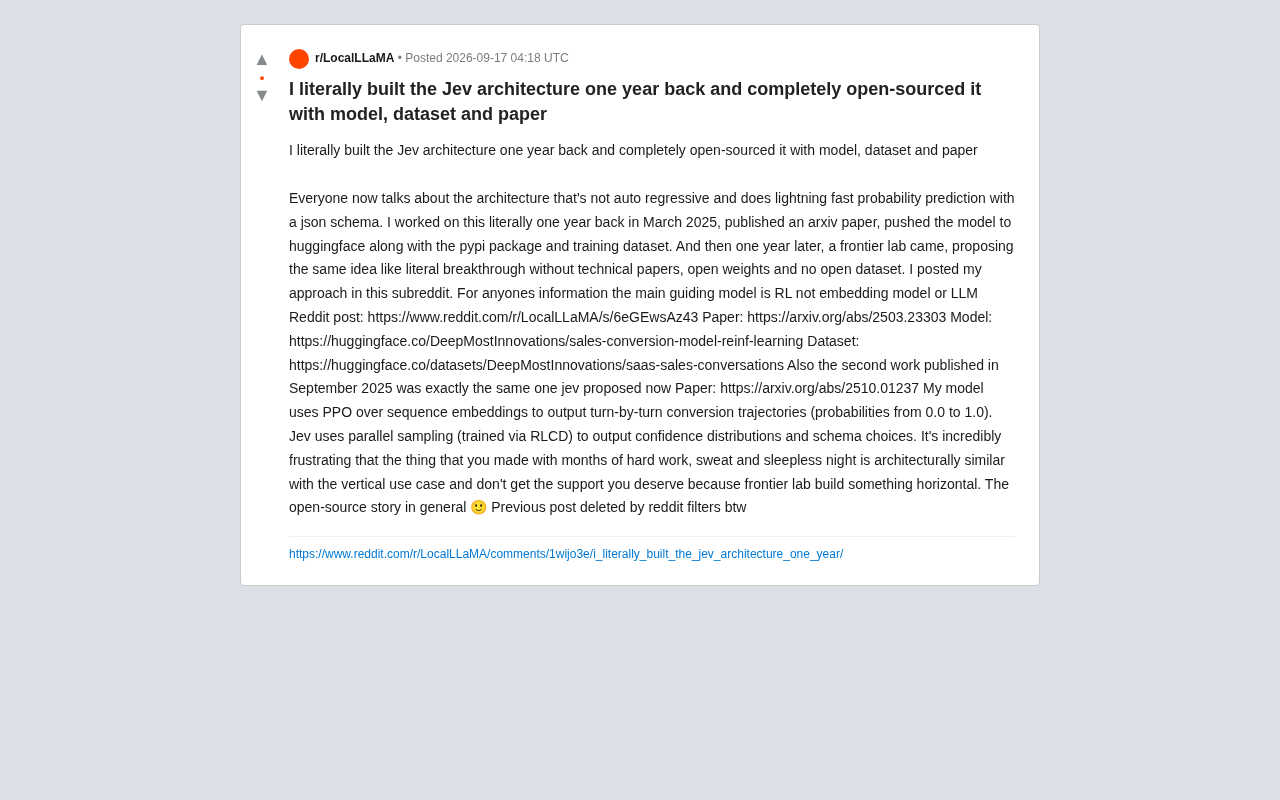
The Open Source Dilemma: A Non-Autoregressive Architecture Pioneer Overshadowed by Frontier Labs
An indie developer claims a frontier lab repackaged his year-old open-source non-autoregressive RL architecture as a breakthrough. We compare PPO sequence embeddings vs. RLCD parallel sampling and examine open source attribution gaps.
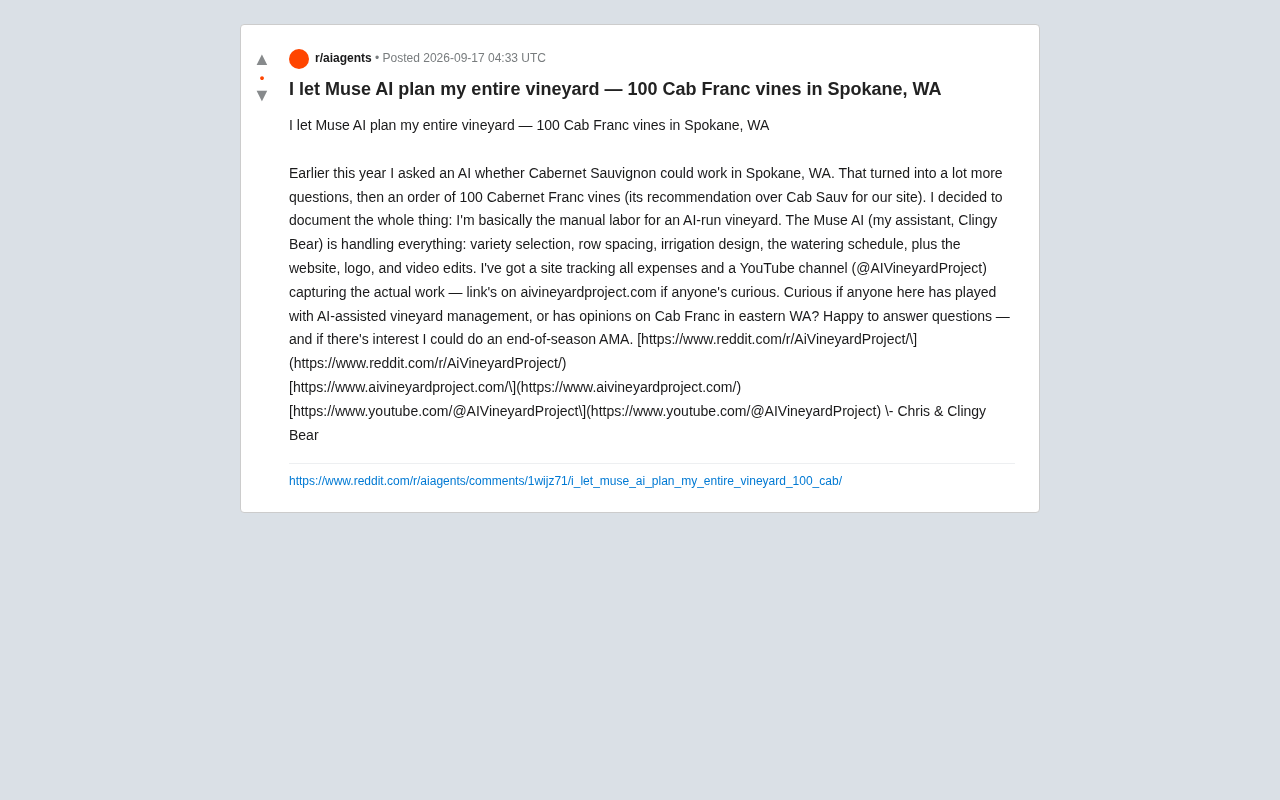
AI Plans an Entire Vineyard: A Real-World Experiment with 100 Grapevines
A Spokane hobbyist let Muse AI plan his entire vineyard — variety, spacing, irrigation, even the logo. He planted 100 Cabernet Franc vines and is documenting everything publicly.
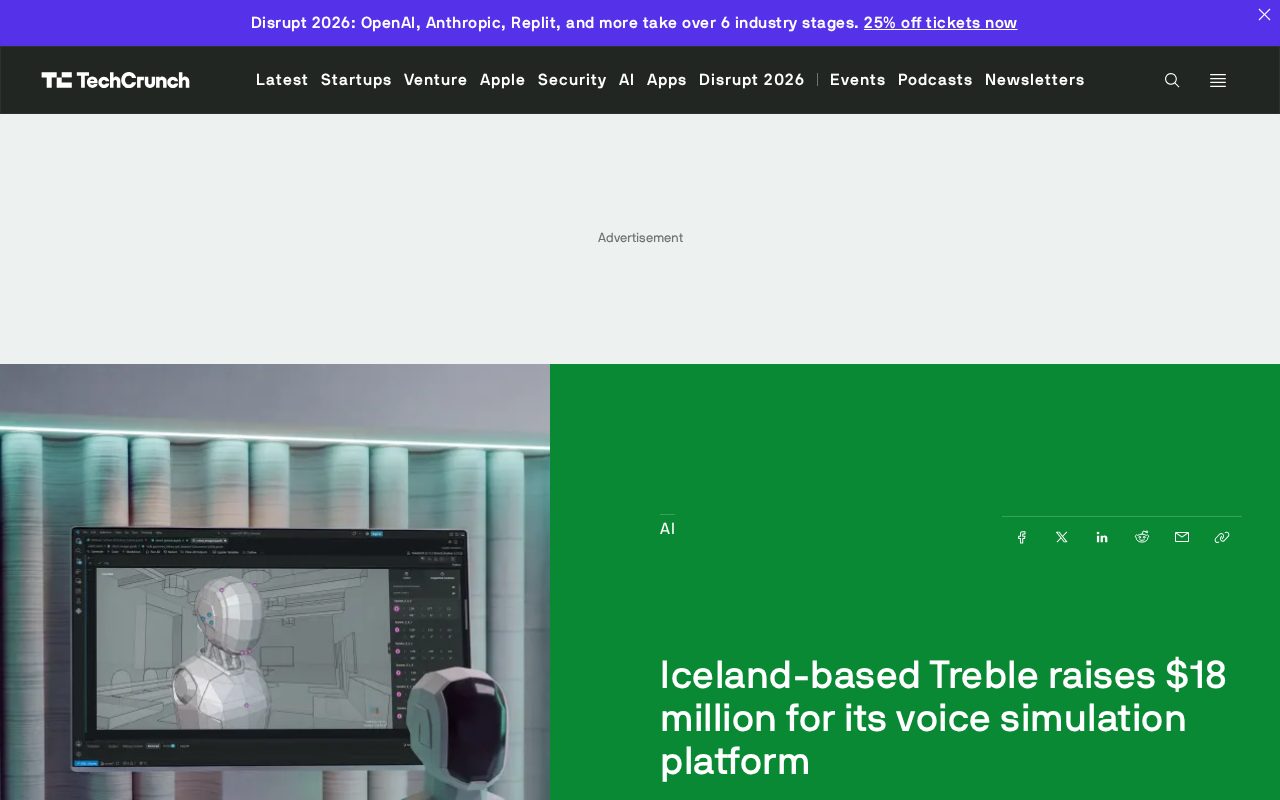
Iceland's Treble Raises $18M to Bet on Voice Simulation Platform
Iceland-based voice simulation company Treble raises $18M. Its platform serves voice AI developers, AI wearables, and robotics firms. A deep dive into the technology and what the funding signals.