Removing the AI Smell: A Monetization Guide to 6 Freelancing Niches for International Clients

A practical guide to 6 AI-powered freelancing niches for earning USD on international platforms.
As clients reject raw AI output ('AI Slop'), freelancers who polish AI work command a premium. This guide details 6 international freelancing directions — writing, design, video editing, voice services, custom GPTs, and virtual assistance — with practical Fiverr/Upwork strategies, red lines to avoid, and tips for non-English speakers to get started.
A Counterintuitive Signal: International Clients Are Rejecting Pure AI Output
A fascinating trend is emerging in the AI freelancing space. According to industry annual report data: AI working alone can barely get things done, but pair it with a human and task completion rates jump over 70%; meanwhile, freelancers who use AI earn 36% more per hour than those who don't.
Put these two numbers together and they point to one clear conclusion: The international market doesn't lack AI — it lacks people who can wield AI and deliver finished work to clients. In other words, AI has devolved from a "rare capability" to a "basic tool." What's truly valuable is the layer of judgment and quality control you add on top of AI.
An even more critical turning point: consumer preference for AI-generated content has plummeted from 60% in 2023 to 26% in 2025. English speakers have even coined a term — "AI Slop" — specifically to trash that obviously fake, soulless, mass-generated content. The term "AI Slop" started appearing frequently across the English-language internet in the second half of 2024. Its word construction follows the same logic as "Spam" — "slop" originally means pig swill, used here to describe the flood of nutritionless AI content. Behind this phenomenon lies the homogenization problem of AI-generated content — because large language models share similar training data and generation patterns, text produced by different users through ChatGPT, Claude, and other tools often carries remarkably similar sentence structures, word choices, and reasoning patterns, forming a stylistic signature known as "AI voice." Telltale signs include: overuse of em dashes, opening paragraphs with "In today's rapidly evolving landscape," overly symmetrical paragraph structures, and hollow emotional expressions. In its core algorithm updates rolled out in March 2024 and early 2025, Google explicitly listed "mass-produced low-quality content" as a target, causing traffic to plummet — or even delisting — for countless purely AI-generated websites.
This decline is actually good news for regular freelancers. If clients were satisfied with pure AI output, they'd just open ChatGPT themselves and knock it out in minutes — they wouldn't need you at all. Precisely because raw AI work is being rejected, humans willing to put in the effort to polish and refine now command a premium.
Reverse Logic: No Need to Build an Audience — Clients Come to You With Money
When people hear "monetizing AI," most immediately think of creating content, growing followers, and earning ad revenue. But this path has a fatal flaw — you need traffic first, and Google's rolling algorithm updates specifically target mass AI content. You could write 300 articles and not get a single one indexed.
The international freelancing route works on completely opposite logic. You don't need to generate your own traffic. Instead, you go to platforms like Fiverr and Upwork, where clients come with their needs and budgets, and you just deliver the work. Fiverr and Upwork are the world's two largest freelancing platforms, but they operate on fundamentally different models. Fiverr uses a "seller's market" model where freelancers package their services into standardized Gigs with fixed prices displayed on the platform — buyers browse and purchase directly, similar to an e-commerce storefront. Upwork is a "buyer's market" model where clients post project requirements and freelancers submit Proposals to compete, more like a bidding process. Fiverr's advantage is its low barrier to entry and quick startup, ideal for highly standardized services; Upwork's advantage is higher order values and more long-term contracts, suited for complex projects requiring deep customization. Both platforms rely heavily on review systems — your level and ratings directly determine your visibility and ability to win orders.
Here, AI is your "skill multiplier":
- Don't speak English? AI handles client communication for you
- Can't design? AI generates images, you curate and select
- Your work model shifts from "doing it yourself" to "directing AI, then quality-checking the output"
Upwork calls this type of person an "AI Orchestrator." This label precisely captures the essence of the new paradigm — your value lies not in whether you can use tools, but in whether you can take responsibility for results. This concept was formally introduced by Upwork in its 2024 annual report to describe an emerging professional role. These individuals don't need to create from scratch; instead, like orchestra conductors, they coordinate multiple AI tools to complete complex tasks while taking responsibility for final output quality. Core skills include: Prompt Engineering (precisely describing requirements to get higher-quality AI output), multi-tool coordination (e.g., using ChatGPT for first drafts, Midjourney for images, ElevenLabs for voiceovers, and finally Canva for layout), and quality judgment — the ability to distinguish which AI outputs are usable, which need revision, and which must be redone. McKinsey's 2024 research corroborates this trend: what companies need most isn't people who can use a single AI tool, but people who can embed AI into complete workflows while ensuring delivery quality.
Regarding platform rules, Fiverr's stance is clear: AI can be used as a tool just like Photoshop, but there are three red lines — deliverable copyrights must stem from genuine work, each order must be customized for the client, and Deepfakes or unauthorized voice cloning of real people are strictly forbidden.
Where Is the Money Flowing? Four Directions With Real Dollar Growth
Based on Upwork's data tracking actual client spending, four AI-related directions are growing fastest:
| Direction | Growth Rate |
|---|---|
| AI Video Generation & Editing | +329% |
| AI Integration | +178% |
| AI Data Annotation | +154% |
| AI Chatbot Development | +71% |
Look closely and you'll spot a pattern: The fastest-growing areas are all "AI generates semi-finished products + humans refine them into finished products." Clients use Sora and Runway to generate piles of raw material that can't be used directly — that's the real demand behind the 329% growth.
This pattern is worth reflecting on deeply — the stronger AI gets, the more demand there is for "stitching and polishing," because the more content that gets generated, the more human oversight and refinement is needed.
Detailed Breakdown of Six International Freelancing Niches
Category 1: Writing Services (Copywriting, Email Marketing)
Help overseas small businesses write product descriptions, landing page copy, and email marketing campaigns — pricing ranges from tens to hundreds of dollars per set. This category is the most crowded, and there's only one way to stand out — strip out the AI voice.
Don't rush to deliver after the first draft. Have AI revise it again: vary sentence lengths, remove em dashes, delete filler phrases like "In today's rapidly evolving landscape." Those ten minutes of polishing are exactly why clients pay you instead of just opening AI themselves.
Category 2: Design & Imagery (Logos, Posters, Social Media Graphics)
Logos, social media graphics, posters, stickers. The core skill has shifted from "drawing by hand" to "knowing how to write prompts, selecting the right image from a batch of AI outputs, and doing the final polish."
There's a trap here: AI-generated logos fall apart when enlarged and are difficult to convert to vector format. You need to be able to process them into truly commercially usable files — this step is precisely your moat against "clients doing it themselves with AI." Currently, mainstream AI image generation tools (such as Midjourney, DALL-E 3, and Stable Diffusion) all output raster images (pixel-based), which become blurry when scaled up. Commercial logos require SVG and other vector formats to adapt to sizes ranging from business cards to billboards. Learning to use Adobe Illustrator's Image Trace feature or tools like Vectorizer.ai to convert AI-generated rasters into vectors is the key skill barrier in this niche.
Category 3: AI Video Editing (The King Direction at +329% Growth)
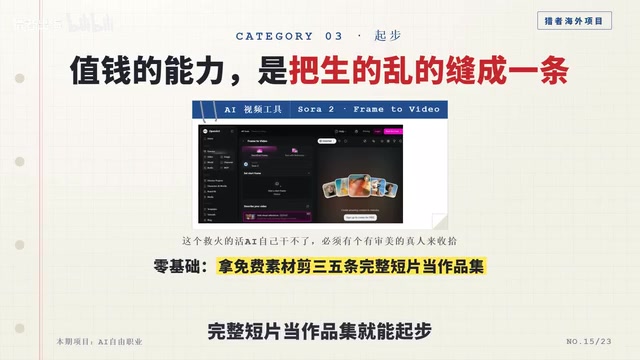
Supply can't keep up with demand because there are real technical challenges: raw clips from Sora and Runway often have mismatched styles, lighting, and character appearances. Hard-cutting them together looks jarring, the pacing is off, and there are artifacts like extra fingers and objects clipping through each other.
Sora is a text-to-video model released by OpenAI in 2024, while Runway is a startup focused on AI video tools — its Gen-3 Alpha model is one of the most mature AI video generation tools in the commercial space. These tools can generate video clips lasting several to over ten seconds based on text descriptions or reference images, with visual quality approaching professional standards. However, three core limitations remain: first, "consistency" issues — the same character may change in appearance or clothing across different clips; second, "physics" defects — extra fingers, object clipping, and physically impossible motion trajectories; third, "narrative coherence" — AI can only generate isolated clips and cannot automatically organize them into a logically complete narrative.
Your value is stitching this pile of "raw, chaotic" material into a coherent, polished final cut. This "firefighting" work is something AI simply can't do on its own. Beginners can start by editing three to five complete short videos using free stock footage as a portfolio — clients aren't looking for cinema-grade production. In practice, mastering DaVinci Resolve (free and professional-grade) or CapCut, plus understanding basic shot composition and narrative rhythm, is already enough to handle most entry-level orders.
Category 4: AI Voice Services (Voiceovers, Narration, Subtitle Translation)
AI voiceovers, narration, and subtitle translation. Chinese speakers have a hidden advantage here: Chinese is your native language, and international content looking to enter the Chinese market needs Chinese voiceovers, while domestic content going global also needs native language support. Current mainstream AI voice tools include ElevenLabs, Play.ht, and Microsoft Azure Speech, which can generate multi-language audio approaching real human quality. However, AI voices still fall short in handling emotional intonation, sentence rhythm, and professional terminology pronunciation, requiring manual adjustment and proofreading. The same red line applies — cloning celebrity or unauthorized real-person voices is strictly prohibited.
Category 5: Custom GPTs & AI Customer Service Bots (Highest Price Per Order)
Clients want an assistant that understands their specific business — fed with product manuals and FAQs. Custom GPTs are a feature OpenAI launched in November 2023, allowing users to create specialized AI assistants by uploading documents and setting instructions without any coding. Similar no-code platforms include Botpress, Voiceflow, and Dify, which offer drag-and-drop interfaces enabling non-technical users to build AI chatbots. Entry-level bots can be built with these no-code tools via drag-and-drop, pricing at tens to hundreds of dollars for simple versions; custom versions that can connect to systems and query real-time data can run into thousands of dollars, and few people can build them yet. Achieving more complex functionality — such as enabling a chatbot to query real-time inventory, automatically create tickets, or integrate with CRM systems — requires API endpoints and Webhooks, involving a certain level of technical skill. This is precisely where the price gap widens.
A note of honesty about AI data annotation (growing at +154%): the pay-per-task is low, the work is tedious, and it's pure manual labor — don't count on it for a career breakthrough. AI data annotation is a critical step in the machine learning pipeline — all AI models require large volumes of human-annotated data during training and optimization, such as drawing bounding boxes around pedestrians and vehicles in images (for autonomous driving), judging which of two text responses is better (for RLHF — Reinforcement Learning from Human Feedback, which is one of the core training methods behind what makes ChatGPT work so well), or adding text transcriptions to audio clips. This market is dominated by companies like Scale AI, Appen, and Toloka, which break annotation tasks into massive numbers of micro-tasks distributed to remote workers worldwide, with per-task compensation typically ranging from a few cents to a few dollars. Its real purpose is as a stepping stone — helping newcomers with no portfolio and no five-star reviews get their platform accounts off the ground. It's your entry ticket, not the seat you want to sit in.
Category 6: Bundling AI Into Professional Services (The Smartest Play)
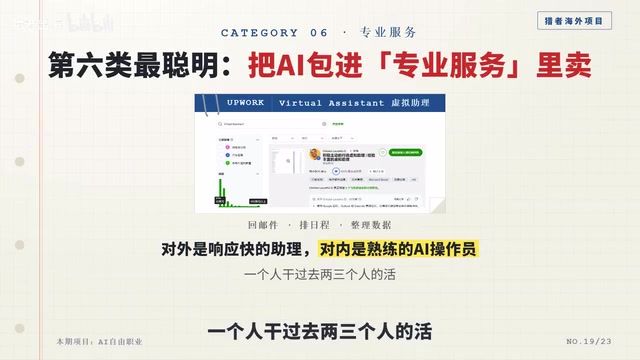
The classic example is virtual assistance: helping overseas business owners reply to emails, manage schedules, and organize data. Externally, you're a responsive assistant; internally, you're a skilled AI operator doing the work of two or three people. The advantage is monthly billing and long-term relationships — serve them well and you could work together for a year or two. This direction is called "the smartest play" because it packages AI capabilities as an ongoing service rather than a one-time deliverable, achieving a business model leap from "per-project billing" to "monthly subscription." Demand from overseas SMB owners for virtual assistants has been consistently strong — according to Statista, the global virtual assistant outsourcing market is expected to exceed $19 billion in 2025. The key is that once trust is established, the client's switching cost becomes extremely high, because you've already become familiar with their business processes and communication habits, which itself creates powerful customer stickiness.
Language Isn't a Barrier: Think in Chinese, English Is Just the Shell

Don't speak English? You actually only need it in two places:
- Understanding requirements: Drop the client's message into AI for translation, and have it also tell you what they actually want and whether there are any hidden traps
- Replying and quoting: Write in Chinese, have AI translate it into English that "sounds like a seasoned professional wrote it"
Think entirely in Chinese throughout — English is just a shell that AI wraps around your thoughts. This approach reduces the language barrier to virtually zero. A practical tip: don't have AI directly translate your Chinese. Instead, tell AI what you mean, then have it rewrite it in English "in the tone of an experienced freelancer on Upwork." Chinese and English business communication styles differ greatly — Chinese tends toward buildup and indirectness, while English business communication is more direct and results-oriented. Having AI do not just language conversion but "communication style conversion" produces much better results.
Getting Started & Three Pitfalls to Avoid
Where to start: Fiverr is ideal for beginners — package your services and list them for buyers to purchase; Upwork uses a bidding system, better suited for those who can handle custom projects.
Minimum viable action: Set up three pricing tiers, with the basic tier priced low and fast to deliver — use it to earn your first batch of reviews. In international freelancing, the snowball starts rolling with your first five-star review. This strategy is known as "Loss Leader" in freelancing circles. The core logic is: platform search algorithms heavily favor sellers with reviews — a zero-review new account is virtually invisible to clients. After quickly accumulating your first 5-10 good reviews through low pricing, your services will enter the platform's normal recommendation flow, and only then will you have room to raise prices.
Three pitfalls you must avoid:
- Delivering AI-generated output without any modification — best case you get a bad review, worst case a platform warning
- Trying to land big projects and charge high rates right away — with no reviews and no portfolio, why should clients trust you?
- Crossing red lines (Deepfakes, voice cloning) — zero tolerance; one violation can mean permanent account suspension and all reviews wiped clean
Also beware of "survivorship bias": those screenshots showing tens of thousands of dollars in earnings you see online? Just look and move on — don't treat them as your starting point. For the first month or two, you'll most likely just be taking small jobs to build reviews. Once your portfolio and platform account are established, the projects you can land will grow bigger and your rates will climb higher.
Conclusion: No Path Exists That Doesn't Require Work
All six directions share one thing in common — none of them let you skip the work. Every one requires you to use AI as a tool, meet a real overseas demand, do the job well, and deliver. You don't need followers, traffic, or capital — just the willingness to learn how to orchestrate AI and start with the smallest jobs.
In an era where AI capabilities are everywhere, what's scarce was never the ability to generate — it's always been "the person who takes responsibility for results." This may well be the window of opportunity that the international freelancing market has left open for ordinary people.
Related articles

Meta vs. Publishers: The AI Data Battle Over Terms of Service Changes and the Future of the Internet
Meta changed its business account terms to allow AI training on linked website data, sparking backlash from publishers and creators. Industry groups demanded negotiations, forcing Meta to remove 'training' wording and delay the effective date. The dispute reveals the deeper battle over data authorization and the future of the internet in the AI era.

When Outside Xbox Meets Blood on the Clocktower: A Legion Match in Minecraft
Outside Xbox guests Ellen and Mike play Minecraft Blood on the Clocktower in a Legion game. How can three good players fight an evil majority amid information noise? This article breaks down Legion mechanics, information-role mind games, and the endgame reversal.

Kimi K3.1 Hands-On Test: Open-Source Model Nears Opus, Video Generation Steals the Show
Kimi K3.1 completed motion graphics, 3D rendering, mini-games, and video generation in a live test. Analysis of its 2.8T MoE architecture, gap vs Opus/GPT, and hidden video generation.