Replit Agent Comes to Microsoft Teams: Conversation Becomes Development
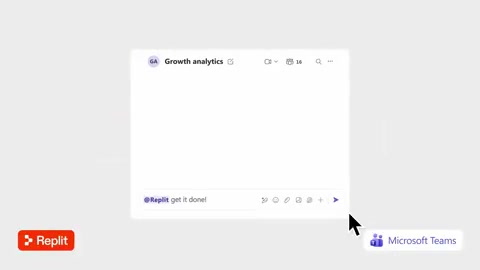
Replit Agent is now integrated into Microsoft Teams, embedding AI coding into everyday team conversations.
Replit officially announced that Replit Agent is now available in Microsoft Teams, where users can directly work on projects, ask questions, and turn team conversations into actionable operations. The core value lies in reducing context switching and repeated confirmation between chat tools and IDEs, enabling non-technical members to initiate requirements in natural language. The article notes that the integration's functional boundaries, permission controls, and governance details remain undisclosed, which will affect enterprise IT acceptance, while competition among AI coding tools shifts from model capability to collaboration platform entry points.
From Chat Window to Dev Environment: Replit Agent Lands in Microsoft Teams
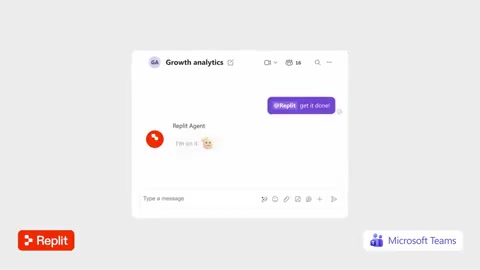
Replit officially announced on social media that Replit Agent is now available in Microsoft Teams. Users can call on Replit Agent directly within Teams to work on projects, ask questions, and turn team conversations into actionable operations. The company summed up the core value of this integration in one line: no more circling back—just get things done.
This move signals that AI coding tools are expanding from standalone IDEs or web sandboxes into the entry points of everyday team collaboration. By choosing Teams rather than staying solely on its own platform, Replit aims to embed "writing code" right where communication happens.
Replit Agent is an agentic coding tool launched by the Replit platform. Unlike traditional code completion tools, the Agent can understand high-level natural language goals, autonomously plan steps, create or modify multiple files, install dependencies, run code, and iterate through debugging—ultimately delivering a runnable project or feature. Replit itself is a browser-based cloud development environment (IDE) offering hosted runtime, databases, and deployment capabilities, so users can get started without any local setup. Launched in 2024, the Agent represents Replit's shift from an "online IDE" to an "AI-driven software creation platform," with its core selling point being that it hands the engineering steps between "describing a requirement" and "getting a runnable result" over to AI.
Microsoft Teams is Microsoft's enterprise team collaboration platform, integrating instant messaging, channel discussions, audio/video meetings, file sharing, and a third-party app marketplace. It serves as the primary daily workspace for a large number of enterprises. Teams supports embedding third-party tools and services as "apps," and third-party developers can use Microsoft's Bot Framework, Teams AI Library, and Microsoft 365 identity and permission systems to connect bots or agents into channels and group chats. It is precisely this open app ecosystem that allows Replit Agent to appear as a native app within team conversation flows, without requiring users to jump to an external web page.
Why Teams, and Not Another Code Editor
In a traditional development workflow, requirements are discussed in chat tools while code is written in an IDE—with a context switch in between. Once Replit Agent enters Teams, that switch is compressed: team members describe problems in conversation, and the Agent responds and advances the project within the same interface.
According to Replit's official tweet, users can "work on projects, ask questions, and start turning team conversations into action" in Teams. These three actions cover different levels from exploration to execution: asking questions is a low-barrier entry point, advancing projects is deeper collaboration, and turning conversations into action is the most differentiated selling point of this integration.
For Replit, Teams is a ready-made distribution channel covering a large number of enterprise teams. For Microsoft, bringing in a third-party AI coding Agent also aligns with its strategy of making Teams a hub for workflows. The motivations of both sides converge on "reducing tool switching."
Conversation as Development: The Real Impact on Team Workflows
Replit Agent's positioning in Teams is closer to an executor embedded in the collaboration flow than to a simple Q&A bot. The official emphasis on "No more circling back" points to the common cost of repeated confirmation in team collaboration: a question is raised in a group, waits for a reply, then gets handed off for execution—the longer the chain, the greater the loss.
When the Agent exists directly in the conversation, some of these steps can be skipped. Non-technical members can also propose requirements in natural language, with the Agent handling initial implementation or validation, while technical members focus on more complex judgments. This shift in division of labor is especially evident for small teams and cross-functional project groups—communication costs already consume a great deal of energy.
That said, the original information does not disclose the specific functional boundaries of this integration—for example, which project resources the Agent can access in Teams, how permissions are controlled, and whether it supports multi-turn complex tasks. These details will determine whether it is merely a "demo-level" convenience or a tool capable of handling real production collaboration.
Context switching is a common concept in software engineering and cognitive psychology, referring to the attentional drain and cost of re-entering a state when a person moves between different tasks, tools, or modes of thinking. In development scenarios, requirements are discussed in chat tools, code is written in IDEs, and tasks are tracked in project management tools—every cross-tool jump comes with re-finding information and rebuilding state. Research and practice generally agree that frequent context switching significantly reduces an individual's effective working time, with an especially pronounced impact on programming tasks that require sustained focus. The core logic behind Replit Agent's entry into Teams is precisely to move the "writing/advancing code" step into the same interface where communication happens, compressing the number of switches and thereby reducing hidden friction costs in collaboration.
Competitive Landscape: AI Coding Tools Vie for the Collaboration Entry Point
Replit's move is not an isolated event. AI coding assistants are migrating from "editor plugins" to "native capabilities of collaboration platforms," and whoever occupies the interface where teams spend the most time each day has a better chance of becoming the default choice. As the hub of enterprise communication, Teams is naturally a contested battleground.
Replit's differentiation lies in its Agent form: it doesn't just complete code but attempts to advance projects end to end. Putting this capability into Teams lowers the barrier to "initiating a project change" to a single conversation. For teams already using Replit, this is a natural extension; for Teams users who have not yet encountered Replit, it is a low-friction customer acquisition path.
However, AI coding entry points on collaboration platforms also face trust and governance issues. Enterprise environments have higher requirements for code changes, data access, and auditing, and the transparency and controllability of Agent operations within a chat interface will directly affect IT departments' acceptance.
AI coding assistants can currently be roughly divided into several forms: one is editor-based completion and chat tools represented by GitHub Copilot and Cursor, deeply tied to developers' local or cloud IDEs; another is autonomous agents represented by Replit Agent and Devin, emphasizing end-to-end task completion; and still another is conversational entry points embedded in collaboration and ticketing platforms (such as Slack, Teams, and Jira). The industry's "battle for the collaboration entry point" refers to these tools' attempts to occupy the interface where users spend the most time and where requirements are first raised. Because once AI can directly take on tasks where the conversation happens, it is more likely to become a team's default way of working rather than merely an auxiliary tool that must be actively opened. This trend also brings new governance challenges: enterprises typically require code changes to be traceable, data access to be controlled, and operations to have audit logs, while agents in chat interfaces inherently carry the risk of "black-box execution." Therefore, permission granularity, approval processes, and operational transparency are becoming key factors determining whether such integrations can be approved by IT departments.
Next Steps Worth Watching
Replit Agent's entry into Teams is a clear signal: the competitive focus of AI coding tools is shifting from model capability to the depth of workflow embedding. For developers, what's worth observing is the quality of task completion by the Agent in real team scenarios; for enterprise decision-makers, it is necessary to assess the permission and compliance implications of such integrations.
The official tweet closes with "Just get it done," a lighthearted tone—but what will truly determine the value of this integration is whether it can reliably get things done in complex team collaboration.
One-line Summary
Replit Agent is now integrated into Microsoft Teams, embedding AI coding capabilities into everyday team conversations.
Paragraph Summary
Replit officially announced that Replit Agent is now available in Microsoft Teams, where users can directly work on projects, ask questions, and turn team conversations into actionable operations. The core value of this move lies in compressing the context switching and repeated confirmation costs between chat tools and IDEs in traditional development workflows, enabling non-technical members to initiate requirements in natural language. For Replit, Teams is a ready-made distribution channel covering a large number of enterprise teams; for Microsoft, bringing in a third-party AI coding Agent aligns with its strategy of making Teams a workflow hub. The article also notes that the specific functional boundaries, permission controls, and governance details of this integration have not been disclosed, which will directly affect enterprise IT departments' acceptance, while the competitive focus of AI coding tools is shifting from model capability to the contest for collaboration platform entry points.
Related articles

ReelRoom: An Android Video Editor Powered by a 1M Token Context Window
ReelRoom is an Android video editor built on Gemini 4 Neon and a 1M token context window. It scans thousands of camera roll clips, categorizes them by scene, and generates publishable videos. This article breaks down its technical logic and impact on creator tools.

Sanders Talks AI: Billionaire Tax, Superintelligence Ban, and the Democracy Crisis
Bernie Sanders discusses the democracy crisis, a 5% annual billionaire tax, Medicare reform, and his support for banning superintelligence development.

Super-Hot Rock Geothermal: A New Solution to Data Centers' Energy Woes
Super-hot rock geothermal startups target data center power demand, claiming terawatt-scale delivery almost anywhere. We analyze the technology, its fit with data centers, and real-world challenges like drilling costs and regulation.