Replit CEO Predicts the Future of Work: The 'Self-Driving Company'

Replit CEO proposes the 'self-driving company' vision: AI agents execute daily work while humans steer direction and make key decisions.
Replit CEO Amjad Masad proposes the 'self-driving company' concept, likening company operations to autonomous driving: AI agents take over definable, repetitive work such as coding, testing, deployment, customer service, and data organization, while humans move up to define goals, set constraints, handle exceptions, and make value judgments. This aligns closely with Replit's AI programming product logic, serving as both industry prediction and product narrative. Realizing the vision requires three prerequisites: clearly definable tasks, reliable exception handling, and gradually accumulated human trust in AI. For professionals, execution-level skill premiums decline while judgment, problem decomposition, and defining 'what counts as done well' rise in value.
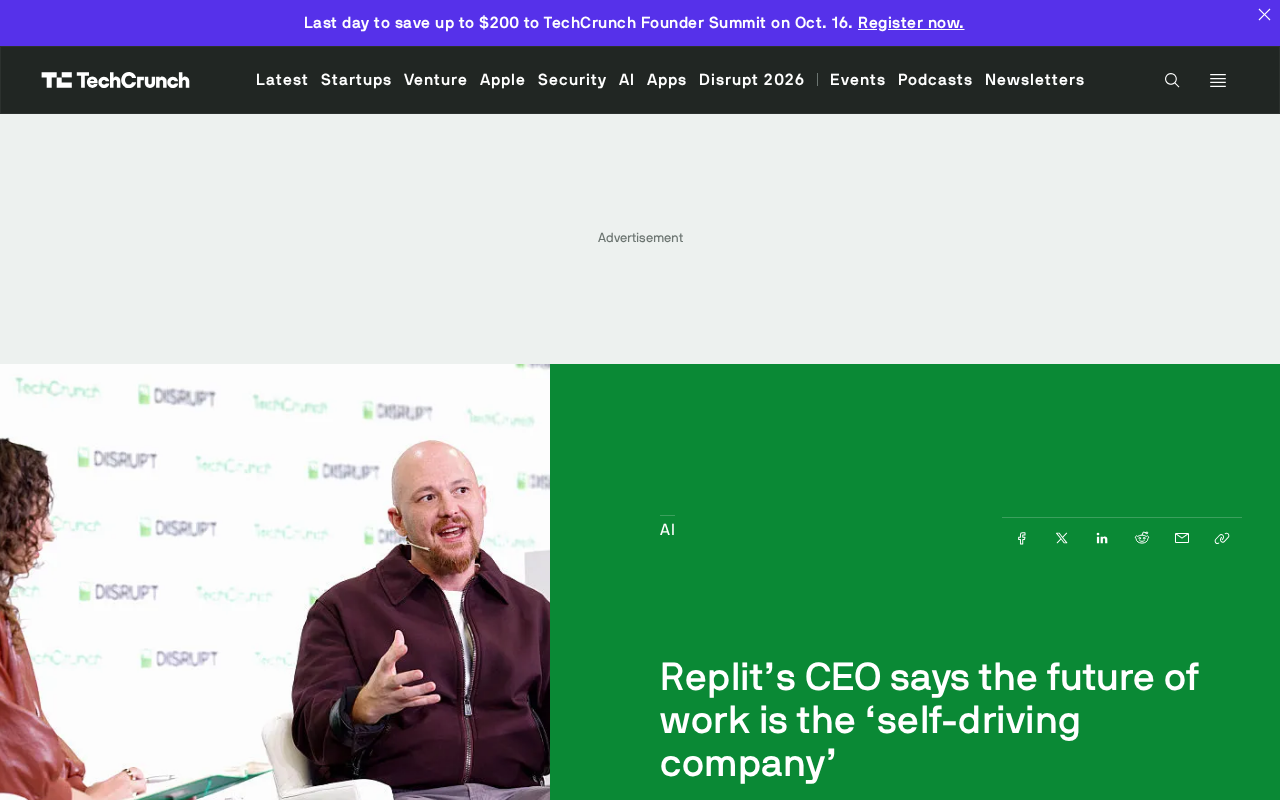
Replit CEO Amjad Masad recently offered a thought-provoking prediction: the way companies operate in the future will resemble self-driving cars — AI agents handle day-to-day execution, while humans focus on steering direction and making key decisions. He calls this organizational form the "self-driving company."
What Exactly Is a "Self-Driving Company"
Masad's analogy isn't complicated. Anyone who has driven a car with driver-assistance features knows you no longer need to grip the wheel at all times or stare at every inch of the road — but your role doesn't disappear. You set the destination, judge whether road conditions are abnormal, and take over when the system hesitates.
Applied to a company context, the same logic maps to this: AI agents take over repetitive, process-driven, clearly definable work — code generation, testing, deployment, customer service responses, data organization. Humans retreat to a higher level — defining goals, setting constraints, handling exceptions, making value judgments.
This isn't a simple "AI replaces humans" narrative. In Masad's description, the human position has shifted rather than been removed.
Why Replit Is Talking About This
Replit itself is an AI programming platform, and its core product logic aligns closely with this vision. If AI can automatically write code, run tests, and fix bugs on Replit, then "a large portion of engineering work inside companies being done by agents" is no longer a thought experiment — it's an extension of the product roadmap.
From this angle, Masad's statement is both an industry judgment and a product narrative. He needs users to believe that handing more work to AI agents is the natural next step.
AI agents differ fundamentally from traditional AI assistants. An assistant waits for each specific instruction from a human and remains essentially a tool; an agent, once given a goal, can autonomously plan steps, invoke tools, execute multi-turn operations, and decide whether to retry or ask for help when problems arise. In coding scenarios, for example, an agent can not only complete a line of code but also read requirements, break down tasks, modify multiple files, run tests, and iterate fixes based on error reports. This "goal-driven, multi-step autonomous" quality is precisely the technical foundation behind Masad's vision of AI taking over companies' day-to-day execution. Current mainstream agents are still limited by context length, tool-calling stability, and error accumulation, and remain far from fully unattended operation.
Prerequisites for This Vision to Hold
For a "self-driving company" to truly run, several conditions must be met simultaneously:
Tasks must be clearly definable. The premise of autonomous driving is that roads have rules. If goals are vague and responsibilities unclear inside a company, AI agents will also "get lost."
Exception-handling mechanisms must be reliable. What autonomous vehicles fear most is long-tail scenarios. Companies face even more exceptions in operations — whether humans can quickly take over when an agent gets stuck determines whether the system improves efficiency or creates chaos.
Trust takes time to build. No one hands over the steering wheel entirely on day one. Human trust in AI agents will most likely follow the same path as the adoption of driver assistance — gradually transitioning from "it watches the road for me" to "I'm comfortable letting it drive."
Long-tail scenarios refer to boundary cases that occur with extremely low frequency but come in enormous variety and are difficult to enumerate exhaustively. In autonomous driving, 99% of road conditions can be handled by the system; the remaining 1% may include rare combinations such as temporary construction, irregular obstacles, and extreme weather — yet these often determine the system's safety ceiling. Long tails in business operations are even trickier: customer complaints, compliance reviews, supply chain disruptions, personnel disputes. Each looks rare in isolation, but together they can consume the bulk of a manager's time. AI agents excel at high-frequency standardized tasks but are most likely to get stuck precisely in these low-frequency, complex scenarios. Therefore, whether mechanisms can be built for rapid human takeover and retroactive rule reinforcement is the key to whether the "self-driving company" can move from demo to production.
What It Means for Ordinary Professionals
If this direction holds, what matters most isn't "whether you can use AI tools" but whether you can clearly define "what needs to be done" and "what counts as done well." The premium on execution-level skills will decline, while the premium on judgment and problem decomposition will rise.
Masad's full judgment is this: AI agents handle routine tasks, humans focus on high-level decisions. It sounds like a distant vision, but for those already using AI for coding, customer service, and operations tools, it actually describes a process that is already underway.
Skill premium refers to the extra return a capability commands in the labor market due to its scarcity and irreplaceability. When AI agents can efficiently complete standardized tasks like writing code, producing reports, and responding to tickets, the scarcity of these execution skills declines, and the premium the market is willing to pay falls accordingly. Conversely, the ability to define problem boundaries, judge whether results meet standards, and make trade-offs in ambiguous situations becomes more scarce in the short term because it is difficult to specify through clear instructions. This doesn't mean execution skills become worthless; rather, their comparative advantage is shrinking. Professionals need to shift their skill mix from "doing things fast and doing a lot" toward "thinking clearly and judging accurately," and learn to manage AI agents as a deployable execution layer.
One-line Summary
Replit CEO proposes the "self-driving company" vision: AI agents execute daily work while humans steer direction and make key decisions.
Paragraph Summary
Replit CEO Amjad Masad proposes the concept of the "self-driving company," likening company operations to autonomous driving: AI agents take over clearly definable, repetitive work such as code generation, testing, deployment, customer service, and data organization, while humans retreat to a higher level to define goals, set constraints, handle exceptions, and make value judgments. This judgment aligns closely with Replit's AI programming product logic, serving as both an industry prediction and a product narrative. Realizing the vision requires three prerequisites: tasks must be clearly definable, exception-handling mechanisms must be reliable, and human trust in AI must accumulate gradually. For professionals, the core impact is that the skill premium at the execution level declines, while the premium on judgment, problem decomposition, and defining "what counts as done well" rises.
Related articles

Amphibious Transforming Drone: Beyond 100x Power Savings, What Are the Real Needs?
Is the amphibious transforming drone just a gimmick? Starting from the 100x power difference of the M4 Morphobot, explore real application scenarios and thesis topic ideas, analyzing boundary conditions where pure drones and pure ground robots both fail.

Warhound Raises $200 Million: Genetically Engineered "War Dogs" Paired with Anduril Gear
Warhound raises $200M, backed by Ben Lamm and Palmer Luckey, to genetically engineer dogs for military and law enforcement use and equip them with Anduril gear. This article analyzes its technology direction, funding logic, and ethical controversy.

Claude API Comes to Google Cloud: IAM Integration and SDK Access Guide
Anthropic hosts the full Claude API on Google Cloud with IAM-controlled permissions and unified billing. This guide covers the Vertex AI and Anthropic-hosted entry points, IAM role configuration, and SDK access.