Replit Launches Missions: A New Paradigm for Collaborative Coding with AI Agent Swarms
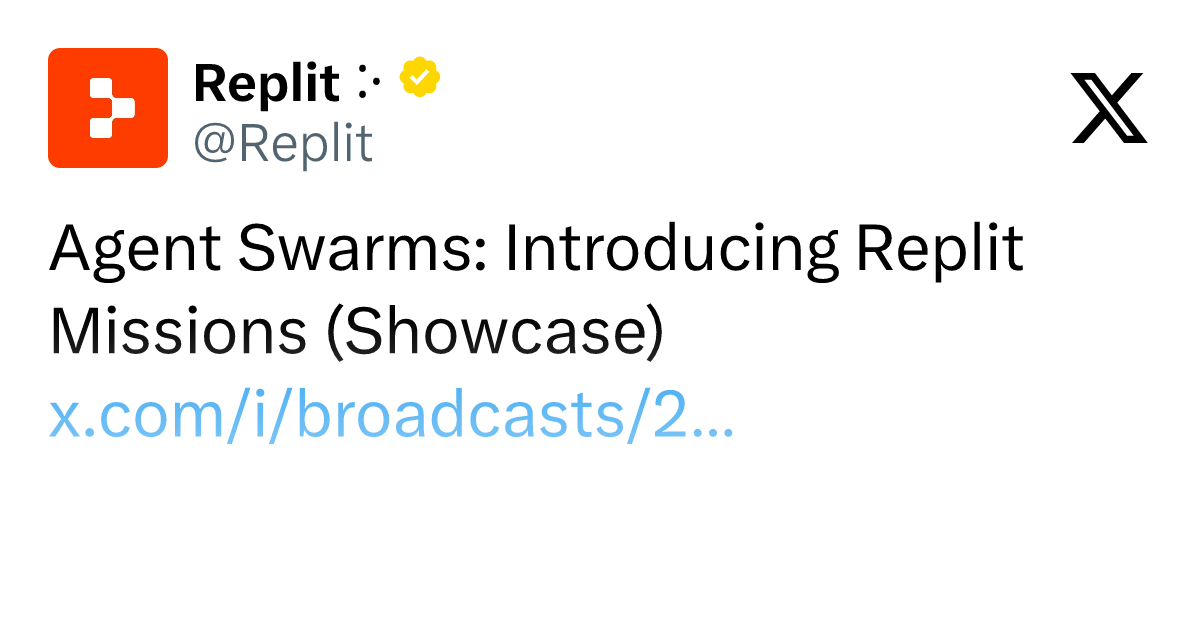
Replit teases Missions, using agent swarms to push AI coding toward multi-agent collaboration.
Replit teased its new Missions feature as a Showcase on social media, positioning it as "Agent Swarms" and signaling a shift in AI coding tools from single-agent assistance to multi-agent collaboration. Multi-agent setups mitigate long-context, unclear-responsibility, and error-accumulation issues through task splitting and a scheduling layer. If agent swarms can reliably close the loop from requirements to runnable code, they could lower the delivery barrier for indie developers and small teams. Only the name and positioning have been announced so far.
Replit recently teased a new feature called "Missions" on social media, positioning it as a showcase of "Agent Swarms." Behind this brief announcement lies a broader shift in AI coding tools: from single-agent assistance toward multi-agent collaboration.
From Single Agents to Agent Swarms
For a while now, the dominant form of AI coding assistants has been a single model in the IDE completing code, answering questions, or executing individual tasks. The "Agent Swarms" concept introduced by Replit Missions suggests that multiple AI agents can divide up work around a single goal—some break down requirements, some handle implementation, and some handle verification. This model attempts to upgrade "have an AI write a snippet of code" to "have a group of AIs complete a task."
Replit chose to release the news as a Showcase on social media, indicating the feature is more of a product capability demonstration than an official launch. The specific interaction model and availability have not yet been disclosed.
Agent in this context refers to an AI program capable of perceiving its environment, planning autonomously, and invoking tools (such as reading and writing files, running commands, and searching the web) to accomplish goals—not merely a chat model that handles single-turn Q&A. Unlike traditional code completion, agents typically feature a "think–act–observe" loop and can execute multiple steps in sequence. Agent Swarm borrows from the idea of swarm intelligence: multiple agents, each with their own role definition, tool permissions, and context, collaborate in parallel or in sequence, with an orchestration layer assigning subtasks, passing intermediate outputs, and resolving conflicts. Common role divisions include planner, executor, and reviewer. The advantage is that each agent has a shorter context and more focused responsibilities; the drawback is increased communication overhead and the cost of maintaining consistency.
Why Agent Swarms Are Worth Watching
A single AI agent can easily lose its way on long-chain tasks: context grows too long, responsibilities become unclear, and errors accumulate. The multi-agent approach is to split complex tasks so that each agent works within a smaller scope of responsibility, with a scheduling layer aggregating the results. This aligns with the industry's exploration of "agentic workflows," but Replit anchors it in the coding domain, directly targeting developers' daily workflows.
For indie developers and small teams, if agent swarms can reliably complete the loop from requirements to runnable code, the barrier to delivery drops further. However, the reliability, cost control, and verifiability of results in multi-agent systems remain the key factors determining whether such solutions can be adopted in practice.
Agentic workflow refers to handing multiple steps that were previously stitched together by humans—requirements understanding, solution design, coding, testing, and fixing—to AI agents that advance through a predetermined or dynamically generated process, with humans reviewing only at key checkpoints. What distinguishes it from "generate code from a single prompt" is its emphasis on state persistence, tool invocation, and failure retries. Common implementation paradigms in the industry include planning–execution separation, reflective self-correction (having agents inspect their own outputs and iterate), and multi-agent debate. The effectiveness of such workflows depends heavily on task decomposability and the availability of verification signals. The coding domain is considered one of the easiest to implement because it offers objective feedback such as compilers and test cases.
What We Know and What to Watch
The available information only confirms the feature name and its "agent swarms" positioning. The official details on the technology, launch timeline, and pricing have not been released. Whether Replit Missions is a standalone project-based workflow or an enhancement embedded in the existing editor will require further official clarification. Developers can watch for subsequent Showcase demos, focusing on the collaboration mechanisms between agents, how the system recovers from task failures, and how much control humans retain.
One-line Summary
Replit teases Missions, using agent swarms to push AI coding toward multi-agent collaboration.
Paragraph Summary
Replit teased its new Missions feature as a Showcase on social media, positioning it as "Agent Swarms" and signaling that AI coding tools are shifting from single-agent assistance to multi-agent collaboration. The article notes that single agents handling long-chain tasks struggle with overly long context, unclear responsibilities, and accumulating errors, while multi-agent collaboration mitigates these issues through task splitting and a scheduling layer that aggregates results. This aligns with the industry's exploration of agentic workflows but focuses more narrowly on developer workflows. If agent swarms can reliably complete the loop from requirements to runnable code, they will lower the delivery barrier for indie developers and small teams. Currently, only the name and positioning have been announced; technical details, launch timing, and pricing remain undisclosed, and reliability, cost, and human control are still key to adoption.
Related articles

The Gemini 4 Trio and 3.8 Flash: A Full Comparison of Positioning, Pricing, and Benchmarks
A comparison of Gemini 4 Neon, Carbon, Argon, and Gemini 3.8 Flash: positioning, context, API pricing, Artificial Analysis and Arena benchmark scores, and available entry points.

AI Coding Model Leaderboard: Opus 5.5 Crowned, Gemini Neon Stages a Comeback
Tech blogger Matthew Berman releases an AI coding model tier list: Claude Opus 5.5 holds S-tier, Gemini Neon surprises with A-tier, OpenAI Astra lands B-tier. How do open-source models like DeepSeek fare? We break down the scoring logic and practical takeaways.

New Jersey Joe Sandwich: Meat and Coleslaw on Triple-Decker Rye
New Jersey Sloppy Joe isn't a ground beef burger—it's triple-decker rye bread with meat, Swiss cheese, and coleslaw, plus Russian dressing. Learn the authentic Essex County method and family recipe.