Replit Missions Launches: Multi-Agent Collaboration Ushers in a New AI Programming Paradigm

Replit Missions lets users define goals in natural language, with a multi-agent swarm automating the entire process from planning to iteration.
Replit has released Missions, allowing developers to describe business goals in natural language while the system coordinates multiple agents to plan, build, test, and iterate under user-set budgets and boundaries. This marks AI programming's evolution from single-round code completion to goal-driven autonomous execution. Replit also announced deep Microsoft ecosystem integration: Fabric integration is generally available, it has entered Teams, and early access for publishing apps to Azure tenants is open. Desktop Local Work is now generally available on all three major OSes, with each build running in an isolated sandbox powered by Microsoft Execution Containers. Early cases show low-cost Missions can yield business returns, but a single case has limited representativeness, and reliability and cost controllability still require practical validation.
From Single-Point Generation to Goal-Driven: Replit Missions Redefines AI Programming
Replit this week released a new feature called Missions, which lets developers describe goals in natural language and the system coordinates multiple agents to automatically complete the entire process of planning, building, testing, and iterating. According to the official Twitter announcement, users only need to define the desired outcome and set a budget and boundaries, and Replit will dispatch a group of agents to work collaboratively. The official example is quite direct: "Help me land my first 10 customers" — the task isn't writing a particular function, but achieving a business outcome.
This marks the evolution of AI programming tools from "single-round code completion" toward "goal-driven autonomous execution." Traditional AI-assisted coding still relies primarily on developers issuing step-by-step instructions, whereas Missions partially delegates decision-making to a cluster of agents, with developers stepping back to become the definers of goals and setters of boundaries. This model places higher demands on task decomposition capability, cost-control mechanisms, and process explainability.
How the Agent Swarm Works
According to Replit's official program, the core of Missions lies in coordinating multiple agents responsible for planning, building, testing, and iterating respectively. The budget and boundaries set by users serve as constraints throughout the execution process, preventing tasks from expanding indefinitely. Early tester Deirdre Sommerkamp shared a case: she spent $35 to launch a Mission and facilitated a deal worth $25,000 within five days. This case was cited by the official team as evidence of Missions' business value.
You may not have noticed that Missions doesn't simply chain together multiple AI calls, but emphasizes "swarm"-style collaboration. This means there are task allocation, result aggregation, and feedback loops within the system, and agents need to share context and dynamically adjust strategies. For developers, understanding the boundaries of this black-box collaboration becomes especially important.
Swarm architecture is an organizational approach for multi-agent systems, distinct from the model of a single agent serially invoking tools. In a swarm, multiple agents with specific roles work in parallel or alternately, exchanging information through a shared message bus or context store, with scheduling logic determining task allocation and result merging. Its advantages lie in parallel processing of subtasks and improved specialized capabilities through role division; the challenges lie in maintaining context consistency, deadlock and loop risks, and costs growing non-linearly with the number of agents. Common industry implementation approaches include centralized orchestration (an orchestrator handling unified scheduling) and decentralized negotiation (agents passing tasks directly between each other). Understanding this architecture helps assess the observability and failure modes of black-box systems like Missions.
Deep Integration with the Microsoft Ecosystem
At Microsoft Ignite, Replit announced several integration advances with Microsoft. Among them, Replit's Microsoft Fabric integration is now generally available, allowing teams to turn governed data into usable tools and deploy them directly to their organization's Fabric tenant. In addition, Replit has entered Microsoft Teams and opened early access for publishing apps to enterprise Azure tenants.
This series of moves indicates that Replit is extending from a personal developer tool toward an enterprise-grade development platform. The Fabric integration bridges the gap between data governance and tool deployment, while the Teams integration lowers the barrier to entry for collaborative scenarios. For enterprises, this means AI-generated tools can integrate more smoothly into existing IT governance systems rather than existing outside them.
Microsoft Fabric is an integrated data analytics platform launched by Microsoft that consolidates data engineering, data warehousing, real-time analytics, data science, and business intelligence into a single SaaS environment, built on the unified OneLake storage. Its core selling point is "governed data" — through built-in permissions, lineage, and compliance policies, it ensures data is consumed securely within the organization. After Replit integrates with Fabric, AI-generated tools can directly read governed datasets and deploy outputs back to the organization's Fabric tenant, thereby avoiding repeated data movement between external tools and internal platforms and reducing compliance risks. For enterprises already invested in Fabric, this means AI programming tools can be embedded into existing data governance pipelines rather than building a separate, isolated development environment.
Desktop Local Work Now Generally Available
Replit Desktop's Local Work feature is now generally available on Windows, Mac, and Linux. Users can choose a folder accessible to Replit, describe what they want to build or modify, and review the results locally. Each build runs in an isolated sandbox powered by Microsoft Execution Containers.
The significance of localization capability lies in bridging the boundary between cloud development and local environments. Developers can leverage Replit's AI capabilities while keeping code and files local, meeting data privacy and compliance requirements. The sandbox mechanism, to some extent, alleviates security concerns brought by AI autonomous execution, allowing users to review each build result within a controllable scope.
Microsoft Execution Containers (MEC) is a sandboxed execution environment provided by Microsoft for isolating the execution of untrusted or automatically generated code. It confines each execution to an independent container, imposing policy constraints on file system, network, and process resources, thereby reducing risks to the host machine when AI autonomously executes builds. For Replit Desktop, adopting MEC means there is an auditable boundary between the local build process and the user's main environment: even if agent-generated code exhibits unexpected behavior, the scope of impact is confined within the container. This design addresses enterprises' core concerns about security and compliance when adopting AI autonomous execution, and also provides a technical foundation for the hybrid model of "keeping code local, invoking intelligence from the cloud."
Practical Impact on Developers
The emergence of Missions brings the vision of "the goal is the product" one step closer. Developers no longer need to manually decompose each subtask, but instead focus on goal setting, boundary constraints, and result acceptance. This doesn't mean the developer's role is diminished; on the contrary, the demands on task definition clarity and acceptance criteria are higher.
From a business perspective, launching Missions at low cost and quickly validating market feedback may become a new way of working for small teams and independent developers. But it's important to view this rationally: the success of a single case doesn't represent universal applicability, and the reliability, cost controllability, and result quality of agent collaboration still require more practical validation.
This Replit update covers multiple layers from goal-driven development and enterprise integration to localized execution, demonstrating its intent to embed AI programming capabilities into the complete development workflow. With the rollout of features like Missions, the focus of competition among AI programming tools is shifting from model capability to workflow integration and ecosystem collaboration.
One-line Summary
Replit Missions lets users define goals in natural language, with a multi-agent swarm automatically completing the entire process from planning to iteration.
Paragraph Summary
Replit has released the Missions feature, allowing developers to describe business goals in natural language, with the system coordinating multiple agents to complete planning, building, testing, and iteration, with execution constrained by user-set budgets and boundaries. This marks the evolution of AI programming from single-round code completion toward goal-driven autonomous execution. Meanwhile, Replit announced deep integration with the Microsoft ecosystem: Microsoft Fabric integration is now generally available, it has entered Microsoft Teams, and early access for publishing apps to Azure tenants is open. The desktop Local Work feature is now generally available on all three major operating systems, with each build running in an isolated sandbox powered by Microsoft Execution Containers. Early cases show that launching Missions at low cost can yield business returns, but a single case has limited representativeness, and reliability and cost controllability still require practical validation.
Related articles

Gemini 4 Trio Hands-On: Which Is Stronger — Hydrogen, Neon, or Carbon?
Bilibili creator ZP Studio tested Gemini 4's Hydrogen, Neon, and Carbon across five tasks, comparing speed and detail: Hydrogen fastest, Carbon most detailed, Neon in between.

Deep Dive: Uncovering the Capabilities of the Entire Gemini 4 Model Family — Why Does the Default Tier Rank Last?
Double-blind testing of Gemini 4's four models — Argon, Carbon, Hydrogen, Neon — reveals why the default Neon High ranks last, how X High overtakes Carbon, and how Orchestrator sweeps 3-0, plus cost breakdown and four selection tips.
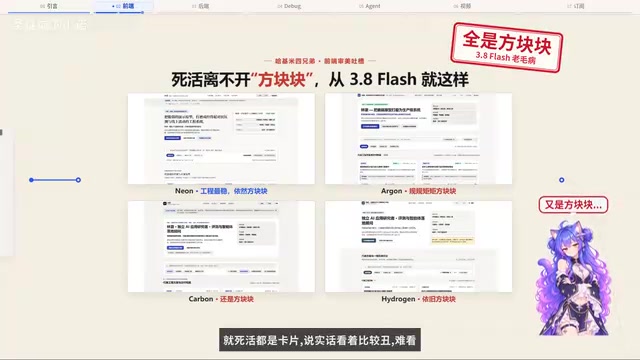
One Week with the Gemini 4 Family: Four Models Each Take a Crown on the Private Leaderboard, Carbon's Speed Polarizes
Bilibili creator tests the Gemini 4 family for a week: Neo, Argon, Carbon, and Hydrogen each top a private leaderboard, frontend aesthetics are weak, Carbon is strongest but slow.