Replit Missions Recreates Enterprise E-Signature Platform, a Free Alternative to $10K Annual Fees

Replit Missions crawled 1,000+ workflows via browser automation and rebuilt Ternsign 1:1 as a free open-source e-signature product.
Replit's Missions feature used browser automation to crawl 1,000+ operation workflows from a leading enterprise e-signature platform and rebuilt Ternsign 1:1 for free, directly challenging $10K+ annual subscription fees. The demo compresses reverse engineering and code generation into one automated task, showing a new paradigm of "crawl workflows, then generate the product," especially effective for standardized SaaS tools. However, free replicas lag in compliance, legal validity, security auditing, and support, making them better suited short-term as learning samples or lightweight tools. It also signals AI coding tools evolving from assisting with code to completing product-level tasks.
Enterprise-grade e-signature tools are often expensive, with subscription fees running into thousands or tens of thousands of dollars per year, deterring many teams. But recently, AI coding platform Replit's Missions feature demonstrated a new possibility: using browser automation to crawl all the workflows of an existing product, then rebuilding it 1:1 and releasing it for free as open source.
What Did Replit Missions Do?
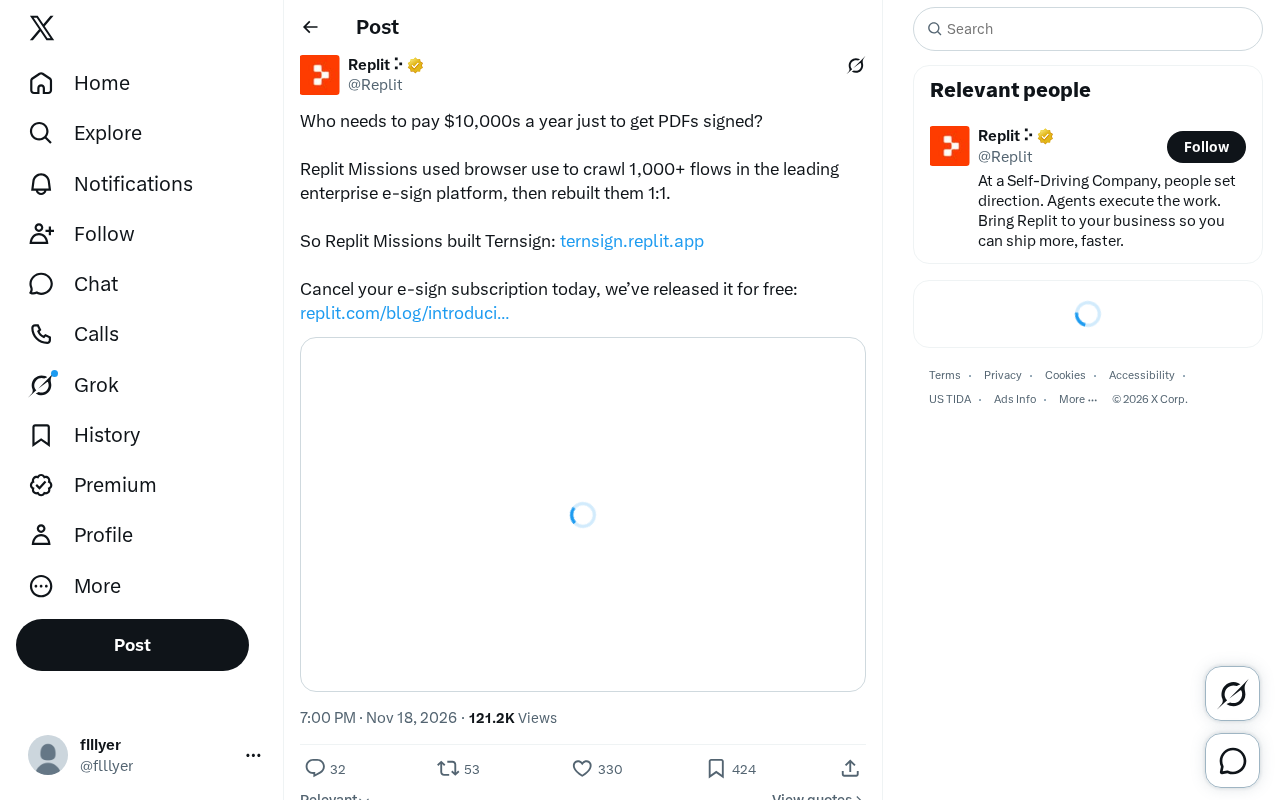
According to a message Replit posted on Twitter, its Missions feature used browser automation (browser use) to crawl over 1,000 operation workflows from a leading enterprise e-signature platform, and then, based on this workflow data, rebuilt the entire product 1:1, naming it Ternsign.
In other words, Replit Missions didn't simply clone the interface; it simulated real user operations to fully walk through core workflows such as signing, sending, and management, then translated this workflow logic into runnable code. The final product, Ternsign, was released for free, with the official message saying: "You can cancel your e-signature subscription today."
The impact of this demo lies in compressing the chain of "reverse engineering + code generation" into a single automated task. Traditionally, replicating an enterprise-grade SaaS product requires weeks of collaboration among product managers, designers, and front-end/back-end engineers. Missions dramatically cuts time and labor costs using crawlers plus AI generation.
Replit is a browser-based cloud integrated development environment (IDE) known for supporting multilingual online coding, real-time collaboration, and one-click deployment, and in recent years it has made AI code generation a core strategy. Missions is its intelligent agent feature, emphasizing "task orientation": users only need to describe goals in natural language, and the AI agent can autonomously break down steps, invoke tools (including browser automation), execute operations, and deliver runnable results rather than merely generating code snippets. This paradigm is fundamentally different from traditional code completion tools; it elevates AI programming from "writing functions" to "completing product-level tasks."
Browser Automation Becomes a New Lever for Product Replication
The core technical approach of Replit Missions is browser use—letting the AI agent operate the browser like a human, traversing the target product's various feature entry points and interaction paths. Compared with statically scraping page HTML, this dynamic crawling can capture complete business flows such as form submission, state changes, and file uploads/downloads.
The more than 1,000 crawled workflows constitute a high-density behavioral dataset. Missions then converts these workflows into product structure and code implementation, completing the 1:1 rebuild. This paradigm of "crawl workflows first, then generate the product" is especially effective for SaaS tools with a high degree of workflow standardization, and e-signature is a typical example: its core chain is relatively fixed, including initiating signing, filling in fields, multi-party signing, and archiving for evidence.
However, this replication approach also has boundaries. E-signature involves deep capabilities such as legal compliance, identity authentication, and audit logs, and front-end workflow crawling alone cannot automatically obtain these back-end guarantees. Whether Ternsign, as a free alternative, can meet enterprises' compliance requirements remains unknown.
Browser use refers to AI agents programmatically controlling a real browser (such as through frameworks like Playwright and Puppeteer) to simulate human clicks, input, scrolling, and page navigation, thereby interacting end-to-end with a target website. Unlike statically scraping HTML source code, it can trigger JavaScript rendering, submit forms, handle pop-ups and login sessions, and capture dynamic state changes and complete business flows. In recent years, the combination of large language models and visual understanding capabilities has enabled agents to "understand" page elements and autonomously decide the next operation, making it a powerful means for workflow discovery, automated testing, and competitive analysis.
The Allure and Concerns of Free Alternatives
In its tweet, Replit directly compared costs: "Who needs to spend tens of thousands of dollars a year just to sign PDFs?" Ternsign's free release is undoubtedly attractive to price-sensitive small and medium-sized teams and individual developers.
But it should be viewed calmly: the gap between free replicas and commercial products often lies not in the feature list but in reliability, security, and support systems. The high pricing of enterprise e-signature platforms includes hidden value such as compliance certification, legal validity guarantees, and service-level agreements (SLAs). An open-source alternative generated by AI after crawling workflows is, in the short term, more suitable as a learning sample or a tool for lightweight scenarios rather than a direct replacement for critical business systems in production environments.
In addition, this practice of "crawling a competitor's workflows and rebuilding 1:1" may also spark discussion about intellectual property and the boundaries of competitor replication. Replit publicly presents it as a technical demo, but if similar automated replication capabilities become widely used, the impact on the SaaS ecosystem is worth continued observation.
Behind the high pricing of enterprise-grade e-signature products, there is usually a series of compliance and legal assurance capabilities: e-signature law compliance (such as the U.S. ESIGN Act, the EU eIDAS, and China's Electronic Signature Law), identity authentication and digital certificates (CA issuance, real-name verification), audit logs and evidence preservation (recording signing time, IP, device fingerprints, and ensuring immutability), as well as security certifications such as SOC 2 and ISO 27001 and service-level agreements (SLAs). These back-end capabilities cannot be automatically obtained through front-end workflow crawling; they require independent trust infrastructure and legal liability. Therefore, even if a free replica has an identical feature interface, it may still have significant gaps in court evidentiary validity, data security, and liability attribution.
What It Means for AI Coding Tools
This Replit Missions demo shows the evolution of AI coding tools from "assisting with code writing" to "automatically completing product-level tasks." The name Missions itself implies task orientation: the user gives a goal, and the AI agent autonomously plans, executes, verifies, and ultimately delivers a runnable product.
For developers, this means the speed of prototype validation may increase further. Work that previously required manually sorting out competitor features, drawing flowcharts, and setting up scaffolding can now be largely completed by AI agents. At the same time, however, developers' roles will shift more toward requirement definition, quality control, and compliance assessment rather than pure code implementation.
Replit has released a free usage link for Ternsign and encourages users to cancel their existing e-signature subscriptions. Whether this move can truly shake the high-pricing model of enterprise software still depends on the maturity of subsequent products and community feedback.
One-line Summary
Replit Missions used browser automation to crawl over a thousand workflows and rebuilt the e-signature product Ternsign 1:1 as free open source.
Paragraph Summary
Replit's Missions feature used browser automation to crawl more than 1,000 operation workflows from a leading enterprise e-signature platform and, based on them, rebuilt the free open-source product Ternsign 1:1, directly targeting subscription fees of tens of thousands of dollars per year. This demo compresses reverse engineering and code generation into a single automated task, showcasing a new paradigm of "crawl workflows first, then generate the product," which is especially effective for SaaS tools with standardized workflows. However, free replicas have obvious shortcomings in compliance certification, legal validity, security auditing, and service guarantees, making them more suitable in the short term as learning samples or tools for lightweight scenarios. The case also marks AI coding tools evolving from assisting with code writing to automatically completing product-level tasks.
Related articles

The Gemini 4 Trio and 3.8 Flash: A Full Comparison of Positioning, Pricing, and Benchmarks
A comparison of Gemini 4 Neon, Carbon, Argon, and Gemini 3.8 Flash: positioning, context, API pricing, Artificial Analysis and Arena benchmark scores, and available entry points.

AI Coding Model Leaderboard: Opus 5.5 Crowned, Gemini Neon Stages a Comeback
Tech blogger Matthew Berman releases an AI coding model tier list: Claude Opus 5.5 holds S-tier, Gemini Neon surprises with A-tier, OpenAI Astra lands B-tier. How do open-source models like DeepSeek fare? We break down the scoring logic and practical takeaways.

New Jersey Joe Sandwich: Meat and Coleslaw on Triple-Decker Rye
New Jersey Sloppy Joe isn't a ground beef burger—it's triple-decker rye bread with meat, Swiss cheese, and coleslaw, plus Russian dressing. Learn the authentic Essex County method and family recipe.