Replit's Deep Slack Integration: Letting Code and Data Flow Through Conversation
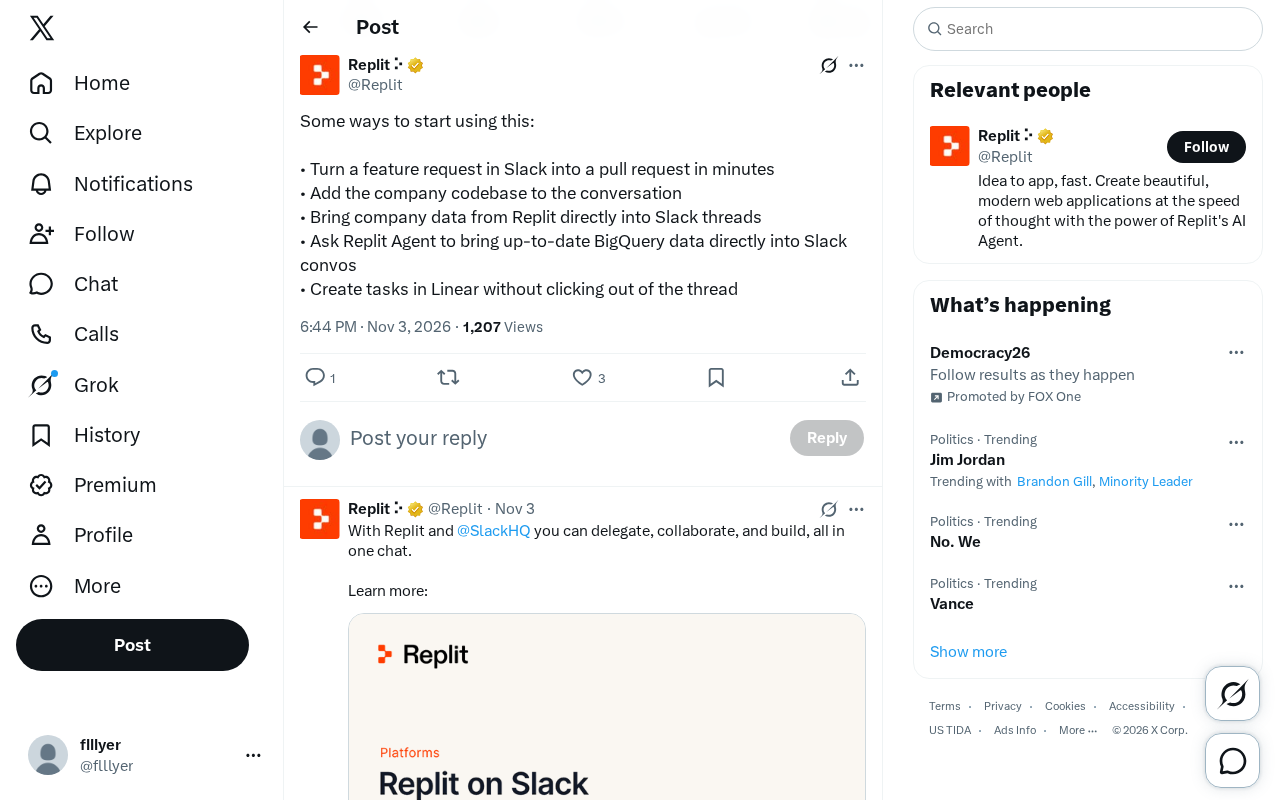
Replit unveils five Slack integrations that bring codebases, data, and task management into conversation threads.
Replit's new Slack integration embeds codebases, data, and task management directly into chat. It covers five scenarios: turning Slack feature requests into Pull Requests in minutes, connecting the company codebase to conversation context, bringing Replit data into threads, pulling BigQuery data via Agent, and creating Linear tasks without leaving the thread. It points to AI coding tools evolving from standalone editors into an intelligent workflow layer, while raising governance questions around thread-level permissions, PR review, and BigQuery access boundaries.
When the Codebase Enters the Chat Window
Developers spend a huge amount of time on Slack every day communicating requirements and discussing problems, yet the actual act of writing code requires switching to an IDE or terminal. Replit's newly announced integration direction attempts to bridge this gap—bringing codebases, data, and task management directly into Slack conversations.
According to information Replit shared officially on Twitter, this integration centers on five specific scenarios: turning feature requests in Slack into Pull Requests within minutes, connecting the company codebase to conversation context, bringing company data on Replit into Slack threads, letting Replit Agent pull the latest BigQuery data directly into Slack discussions, and creating Linear tasks without leaving the thread.
These capabilities all point to the same trend: AI coding tools are evolving from "standalone editors" into "an intelligent layer embedded in the workflow."
Breaking Down the Five Scenarios: A Closed Loop from Requirement to Code
Minute-Level Conversion from Feature Request to Pull Request
In the traditional process, a product manager raises a requirement on Slack, a developer understands it, switches to a local environment to write code, and submits a PR—involving multiple context switches along the way. Replit's integration lets the Agent directly read the requirement description in the thread, generate changes combined with codebase context, and submit a PR. The timeframe officially described is "within minutes," meaning the delay between requirement clarification and code output is dramatically compressed.
This model is especially effective for small feature iterations and bug fixes, but complex business logic still requires human review—the integration lowers the cost of mechanical conversion, not replaces engineering judgment.
Pull Request (PR) is a core collaboration mechanism in distributed version control systems (such as Git). After a developer commits code changes to a separate branch, they initiate a merge request to the main repository through a PR, triggering code review, automated testing, and discussion workflows. A PR is not only the entry point for technical merging but also a key checkpoint for team quality control—reviewers can comment line by line within a PR and request changes, while the CI system automatically runs tests. The ability to "generate a PR within minutes" in Replit's integration essentially lets an AI Agent complete the entire process from requirement understanding to code writing to branch submission, but the PR itself still retains the human review gate, which is why this process can balance efficiency and quality.
The Codebase as Conversation Context
Adding the company codebase to the conversation means the Agent, when answering technical questions, no longer relies on general knowledge but gives suggestions based on the real project structure. This solves a long-standing pain point: AI assistants that don't understand project conventions, dependency versions, and internal abstractions often produce code that "looks right but doesn't run."
Once context is connected, discussing how a specific module is implemented, diagnosing the root cause of errors, and assessing the impact of changes will all be closer to reality. Of course, this also places higher demands on code permission management and data boundaries.
Data and Tasks: Breaking Down Tool Silos
Access to BigQuery data means data discussions no longer require jumping back and forth between Slack and the query console. The Agent presents the latest query results directly in the thread, letting the team discuss the same data instantly. Creating Linear tasks is likewise embedded in the thread, so discussion conclusions can be directly converted into trackable work items, avoiding the "discuss it and forget it" problem.
Together, these five scenarios form a closed loop: requirements arise in Slack, code is generated in conversation, data is verified in discussion, and tasks are landed in conclusions.
BigQuery is a fully managed, serverless data warehouse provided by Google Cloud, designed for large-scale data analytics. It supports standard SQL queries and can handle petabyte-scale data, and is commonly used for business metric analysis, log processing, and machine learning feature engineering. Connecting BigQuery to Slack threads means the Agent can execute queries on behalf of users and present the results directly in the conversation, eliminating the need to switch consoles and copy-paste. But this also raises permission management issues: BigQuery's IAM permissions are usually controlled at the project, dataset, or table level, while Slack threads have coarser access control granularity—how to align the two is a key challenge for implementation.
Linear is a project management tool designed specifically for software development teams, known for being fast, keyboard-friendly, and Git-integrated. It tracks tasks with Issues, supports views such as Cycles, Projects, and Roadmaps, and integrates deeply with code hosting platforms like GitHub and GitLab—Issue numbers in commit messages can automatically link to task status. Replit's integration lets users create Linear tasks without leaving the Slack thread, essentially solidifying "discussion conclusions" directly into "trackable work items" to prevent information from being lost in chat history. This model is especially valuable for agile teams, because the low friction of task creation directly affects the completeness of the backlog.
What It Means for Development Workflows
The most noteworthy thing about this set of Replit integrations is not the strength of any single feature, but its choice of Slack as the entry point. Slack is the communication hub for most teams, and placing AI coding capabilities here means code generation happens where information density is highest.
For teams using Replit, the potential benefit lies in reducing the attention drain caused by tool switching. Developers no longer need to jump repeatedly between chat tools, editors, database consoles, and project management tools—the Agent takes on the work of moving information across tools.
However, this deep integration also brings trade-offs that need to be weighed: once codebases and company data enter conversation threads, how access control is refined to the thread level, how the review process for Agent-generated PRs is designed, and where the permission boundaries for BigQuery queries lie are all questions that must be answered during implementation. What the official announcement currently shows is a capability list, not a complete governance plan.
From an industry perspective, this aligns with the evolution direction of several AI coding tools before it—moving from assistants that autocomplete code toward collaborators that participate in the entire workflow. Replit enters the collaboration scenario through Slack, taking a path "from communication to output" rather than the reverse path "from editor to communication."
Getting Started Advice
The official starting approach is straightforward: begin with a single high-frequency scenario, such as first letting the Agent handle simple feature requests in Slack to validate the quality of generated PRs and the review cost; then gradually introduce codebase context and BigQuery data to observe the Agent's performance with real data.
For teams with mature task management processes, the Linear integration can serve as a low-risk first step—the benefit of creating tasks is clear, and the cost of errors is low. Once the team has built trust in the Agent's output, they can move on to the code generation stage.
The value of this integration depends on the team's existing Slack usage density. If daily communication is already concentrated in Slack, the benefits will be more obvious; if the team mainly collaborates asynchronously through documents, the entry point needs to be re-evaluated.
One-line Summary
Replit announced five Slack integration capabilities, bringing codebases, data, and task management into conversation threads and pushing AI coding from standalone editors toward an intelligent workflow layer.
Paragraph Summary
Replit's newly announced Slack integration direction attempts to embed codebases, data, and task management directly into the chat window. The integration centers on five scenarios: feature requests in Slack can be turned into Pull Requests within minutes, the company codebase is connected to conversation context, Replit data is brought into Slack threads, BigQuery data is pulled into discussions by the Agent, and Linear tasks are created without leaving the thread. Together these capabilities point to one trend: AI coding tools are evolving from standalone editors into an intelligent layer embedded in the workflow. The article analyzes its impact on development workflows—reducing tool switching and letting code generation happen at the communication hub with the highest information density—while also pointing out that thread-level permission control, PR review processes, and BigQuery permission boundaries are governance questions that must be answered during implementation. Finally, it offers getting-started advice on beginning with a single scenario.
Related articles

Ring Launches $999 Autonomous Patrol Robot RoverCam
Ring launches RoverCam, an autonomous mobile security camera with a 4K periscope camera, two-way talk, and built-in siren. Priced at $999.99, it targets commercial use and is seen as a de-personified rebirth of the Astro robot.
Weight-Space Programming: A New Paradigm Where LLMs Directly Rewrite Neural Network Weights
What is weight-space programming? This article explains this new paradigm: LLMs directly reason about, modify, and even generate neural network weights from scratch—without loss functions or gradient descent—and analyzes its dual significance for optimization efficiency and explainability.

Ring Drone Cam Hands-On: The Indoor Security Camera That Flies
Ring Drone Cam hands-on: this 2K indoor security drone flies preset routes for 5 to 8 minutes and auto-returns to its base to charge, but needs 8 minutes of charging per 1 minute of flight and runs noticeably loud. Priced at $249.99, with shipping planned for January 2027.