Replit Updates Last Week: Local Execution, Multi-Project Collaboration, and TikTok Ad Management

Replit updates add Windows local execution, multi-project management via chat, and TikTok ad integration, expanding toward hybrid and commercial use.
Replit recently launched three updates that blur the boundary between cloud IDE and local development. First, with Microsoft and NVIDIA, users can build and run apps locally on Windows PCs, addressing the cloud's shortcomings in GPU acceleration and system API calls. Second, the chat interface adds multi-project management, allowing developers to switch and operate across projects, extending the AI Agent from code writing to workflow hub. Third, it integrates TikTok ad creation and management, targeting non-developer creators and operators on the platform. Together, these updates point to a shift in Replit's product boundaries: moving from pure cloud toward a hybrid model, unifying the development console around the chat interface, and penetrating commercialization scenarios. Execution quality will determine user acceptance.
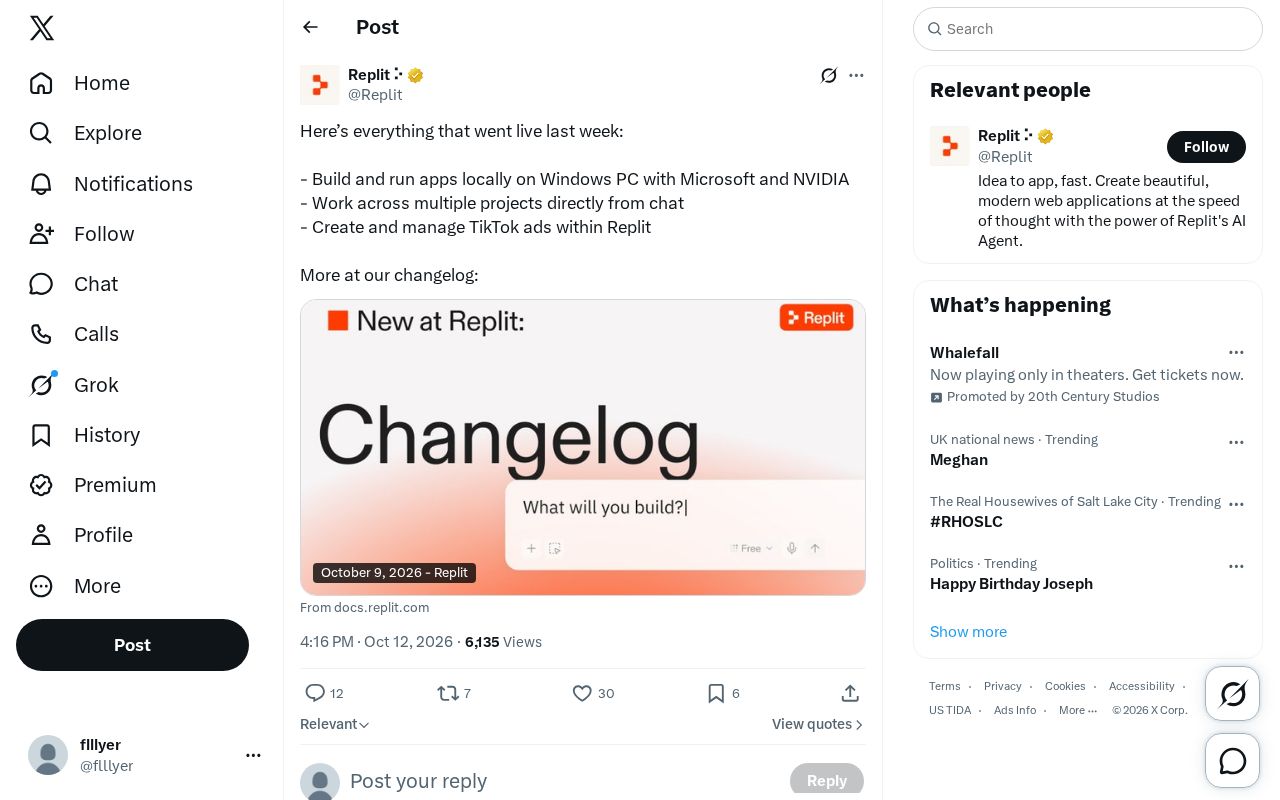
Replit recently rolled out a series of updates that further blur the line between cloud IDEs and local development environments. According to the official changelog and Twitter announcements, the main features launched last week include: building and running apps locally on Windows PCs with support from Microsoft and NVIDIA, switching and managing multiple projects directly from the chat interface, and creating and managing TikTok ads within Replit.
Local Execution: Windows PCs Get Microsoft and NVIDIA Boost
Replit has long positioned itself as a cloud development environment in the browser, letting developers write, run, and deploy code without configuring a local setup. This update explicitly points toward local capabilities: users can build and run apps on Windows PCs, backed by technical support from Microsoft and NVIDIA.
This shift is worth noting. The inherent weakness of cloud IDEs is limited access to local hardware resources—especially in scenarios involving GPU acceleration, local large model inference, or specific system APIs, where pure browser solutions often fall short. Bringing in NVIDIA suggests Replit may be opening a local channel for GPU compute tasks—a substantial capability expansion for developers running machine learning models or graphics-intensive applications. Microsoft's involvement could involve Windows system integration, developer toolchains, or Azure service collaboration.
Official details on the technical implementation are not yet disclosed—whether it's a local runtime environment, remote GPU calls, or deep integration with Windows Subsystem for Linux. But the direction is clear: Replit is no longer content to be just an "IDE in the browser" and is trying to cover local development scenarios.
Background on GPU Acceleration and Local Inference: When running machine learning models or graphics-intensive applications locally, developers typically rely on the parallel computing power of GPUs. NVIDIA's CUDA platform is currently the most mainstream GPU acceleration solution, allowing developers to call graphics cards via APIs for matrix operations, deep learning inference, and other tasks. If Replit can connect its build and run workflow with local NVIDIA GPUs, users could leverage RTX-series cards on Windows to accelerate model inference or rendering without uploading data to the cloud. Compared with pure cloud IDEs, this offers potential advantages in data privacy, latency, and cost.
Windows Subsystem for Linux (WSL): WSL is a compatibility layer built into Windows 10/11 that allows users to run Linux binaries directly without a virtual machine or dual-boot setup. Many development toolchains (such as Node.js, Python environments, Docker) offer a more consistent experience under Linux. If Replit integrates deeply with WSL, developers could get a Linux-like build environment on Windows while retaining the Windows desktop ecosystem. The Microsoft-Replit partnership may be centered around WSL, Windows Terminal, or Dev Home and other developer tools.
Multi-Project Collaboration: Switch Directly from the Chat Interface
The second update focuses on workflow efficiency: users can work across multiple projects directly from the chat interface. In Replit's product evolution in recent years, the AI chat interface (Agent) has gradually become the core interaction entry point. This update embeds project management capabilities into the chat interface, meaning developers can switch between and operate on different projects without jumping between multiple windows or tabs.
For developers maintaining multiple codebases simultaneously, this "single entry point for multi-project management" model reduces context-switching costs. Especially when using Replit Agent to automatically generate or modify code, being able to quickly specify the target project and view the status of different projects makes the whole process more coherent.
The specific interaction details—such as whether it supports cross-project code references, shared environment variables, or dependency isolation—remain to be verified through hands-on experience. But from a product logic standpoint, Replit is turning the chat interface into a unified development console.
Context-Switching Cost: In software development, frequently switching between projects or tools leads to attention residue and reduced efficiency. Traditionally, developers need to jump between IDE, terminal, browser tabs, and project management tools. By embedding multi-project management into the chat interface, Replit essentially merges "intent expression" and "project operations" into a single conversation flow. Users only need to type the target project name or description in the chat box, and the Agent can locate and execute operations, reducing manual navigation.
AI Agent as Workflow Hub: Replit Agent was initially used to generate code from natural language. Once it gains cross-project access, it can take on more advanced tasks, such as: modifying an API interface in project A while updating the caller in project B; or comparing dependency versions across multiple projects and unifying upgrades. This requires the Agent to have project isolation, environment variable management, and permission control capabilities. If implemented well, the chat interface will evolve from a "code generator" to a "development console," but cross-project dependency isolation and security remain challenges.
TikTok Ad Management: Replit's Commercialization Foray
The third update surprised many developers: creating and managing TikTok ads within Replit. This is clearly not a traditional developer tool feature but points to the large community of non-professional developers on the Replit platform—they use Replit to build small apps, prototypes, or automation tools, and many of them are themselves in e-commerce, marketing, or content creation.
Integrating the TikTok ad creation process into Replit essentially places "development tools" and "business operations tools" in the same interface. This strategy is not without precedent: platforms like Shopify and Notion have expanded their use cases by integrating third-party services. Replit's choice to enter the specific segment of ad placement may be driven by the link demand of some users who "finish building an app with Replit and then need to promote it."
However, information on the depth and usability of this feature is currently limited. Does it provide a complete ad management panel, or only basic ad creation? Is there data integration with apps deployed on Replit? These questions determine whether it's a true workflow integration or just a simple API wrapper.
TikTok Ads API and Placement Chain: TikTok provides developers with a Marketing API that allows third-party platforms to create ad campaigns, manage budgets, and retrieve placement data. Replit's integration of this feature means users can complete ad creation via API calls without leaving the development environment. Such integration typically requires OAuth authorization, ad account binding, and real-time data feedback. For creators building e-commerce tools or content apps with Replit, this can shorten the "develop-promote" chain.
Convergence Trend of Development Tools and Business Operations Tools: Shopify integrating ad placement in its backend, Notion integrating forms and databases—both embed business operations capabilities into the tool itself. What makes Replit unique is that its users are themselves building applications, and the ad feature could potentially integrate directly with user-deployed app data (e.g., triggering ads based on in-app events). But it's unclear whether Replit provides a complete ad management panel or just wraps a basic creation interface. If it's merely a simple API wrapper, its value may be limited; if it can form a closed loop with deployment and analytics, it could become a key differentiating feature to attract non-developer users.
Product Strategy Behind the Updates
Looking at these three updates together, Replit's product boundaries are clearly shifting:
At the environment level, the introduction of local execution capability shows Replit acknowledges that the cloud isn't a panacea and is moving toward a hybrid model; at the interaction level, the chat interface becomes the hub for multi-project management, with the AI Agent's role extending from "writing code" to "managing projects"; at the scenario level, the addition of TikTok ad functionality indicates Replit no longer serves only developers but is penetrating a broader group of creators and operators.
Whether users will accept these changes depends on execution quality. The actual performance and compatibility of local execution, the smoothness of multi-project management via the chat interface, and the gap between the TikTok ad tool and professional ad platforms are all key points to watch. Replit's changelog provides more details, and interested developers can check it directly.
One-line Summary
Replit updates support Windows local execution, multi-project management via chat interface, and TikTok ad integration, expanding product boundaries toward hybrid models and commercialization.
Paragraph Summary
Replit recently launched three updates that blur the boundary between cloud IDE and local development. First, with Microsoft and NVIDIA, users can build and run apps locally on Windows PCs, addressing the cloud's shortcomings in GPU acceleration and system API calls. Second, the chat interface adds multi-project management, allowing developers to switch and operate across projects, extending the AI Agent from code writing to workflow hub. Third, it integrates TikTok ad creation and management, targeting non-developer creators and operators on the platform. Together, these three updates point to a shift in Replit's product boundaries: moving from pure cloud toward a hybrid model, unifying the development console around the chat interface, and penetrating commercialization scenarios. Execution quality will determine user acceptance.
Related articles

JobRunner MCP Server: AI Agents Can Now Fix Failed Java Jobs
JobRunner launches an open-source MCP server enabling AI agents to view cluster status, diagnose failures, and recover Java jobs—incident response from any cloud coding environment or existing agent.

MLAI Digital Launches 9 Security Agents: MCP Server Safeguards the Full Lifecycle of Agentic AI
MLAI Digital launches Security MCP Server with nine built-in specialized security agents covering vulnerability discovery, attack simulation, prompt injection detection, API and infrastructure assessment, and accelerated remediation—embedding security validation across the full Agentic AI lifecycle from development to production.

Running Isaac Lab on H100 GPUs: Exploring Better Approaches
Exploring optimization methods for running Isaac Lab on NVIDIA H100 GPUs, including MIG configuration, mixed precision, TensorRT acceleration, and community experience to improve robotics simulation and reinforcement learning efficiency.