RepoPilot: An Open-Source GitHub Code Analysis and Issue Fixing Tool

RepoPilot is an open-source codebase analysis tool built with FastAPI and LangChain, supporting architecture diagrams, vulnerability scanning, and AI fixes.
RepoPilot is an open-source project being built by a developer on Reddit, based on FastAPI and LangChain, aiming to help developers quickly understand unfamiliar GitHub repositories, investigate dependency vulnerabilities, and let AI agents generate fix proposals for issues. It offers three core capabilities: scanning any repository to generate architecture diagrams, checking known dependency vulnerabilities using the free Google OSV data source, and locating code through an AI agent with a scoped toolset and providing fixes. One pragmatic design of the project is its caching mechanism: results are cached by commit SHA, and repeated requests for the same commit return in about 1 second without consuming LLM tokens, balancing cost and consistency. At present, the backend and complete test suite have been completed and open-sourced. The author is developing the frontend and inviting community feedback on the design.
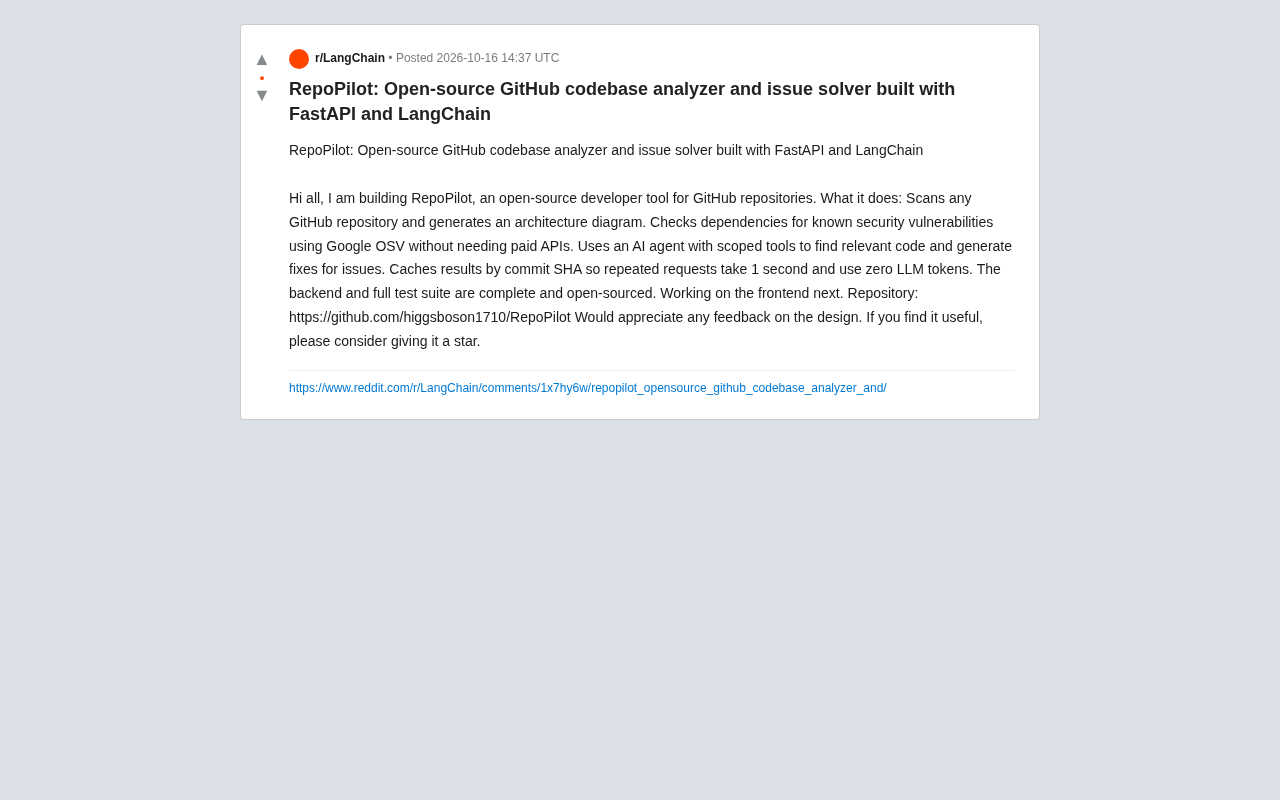
In the open-source community, quickly understanding the architecture of an unfamiliar codebase, investigating dependency security issues, and getting AI agents to actually be useful has long been a pain point for developers. Recently on Reddit, a developer showcased a project they are building called RepoPilot — an open-source GitHub codebase analysis and issue-solving tool built with FastAPI and LangChain.
What RepoPilot Can Do
According to the author, RepoPilot currently revolves around three core capabilities.
First, it can scan any GitHub repository and generate architecture diagrams. For developers who have just taken over a project and need to quickly build a global understanding, this is far more efficient than going through files one by one.
Second, it checks for known security vulnerabilities in project dependencies, using Google OSV as a free data source with no need for any paid API. This is especially friendly to individual developers and small teams, lowering the barrier to security scanning.
Third, RepoPilot uses an AI agent with scoped tools to locate relevant code and generate fix proposals for issues. The author specifically emphasized "scoped tools," meaning the agent does not have unbounded access to the entire repository but is restricted to specific tools and scope. This is more controllable from an engineering standpoint and helps reduce noise from irrelevant calls.
LangChain is an open-source orchestration framework for building large language model applications. Its core value lies in chaining together components such as model calls, prompt templates, external tools, memory, and retrieval into reusable chains or agents. In scenarios like RepoPilot, LangChain is responsible for organizing steps such as "reading the repository," "searching code," and "generating fixes" for the model to orchestrate. Its advantages are a mature ecosystem and many integrations, but its abstraction layer is thick, and when errors occur, stack traces often point inside the framework rather than to business logic, making debugging costly. Therefore, projects like RepoPilot that choose LangChain usually impose extra constraints on tool boundaries to reduce uncertainty.
Google OSV (Open Source Vulnerabilities) is an open-source vulnerability database maintained by Google. It aggregates security advisories from multiple ecosystems such as GitHub Advisory, PyPA, and npm, and provides a free API for queries. Unlike commercial solutions such as Snyk and GitHub Advanced Security, OSV does not limit query volume and requires no paid key, making it suitable for basic dependency scanning by individual developers and small teams. Developers only need to submit the package name and version to obtain the corresponding CVE number, affected range, and remediation suggestions, but it usually does not include automatic fix patches, so manual judgment of the upgrade path is required.
Cache Design: Repeated Requests Return in 1 Second with Zero Token Consumption
One notable design in RepoPilot is its caching mechanism. The author mentions that results are cached by commit SHA, so repeated requests for the same commit can respond in about 1 second and consume zero LLM tokens.
This design approach is very pragmatic. Code analysis tasks often require calling large models to process large amounts of text, which is costly and high-latency. Binding the cache key to the commit SHA means that as long as the code has not changed, there is no need to repeatedly call the model. For scenarios such as continuous integration and team collaboration, where the same version of code is queried repeatedly, this can significantly save costs.
From an architectural perspective, this approach of "using a content hash as the cache key" also ensures consistency of results — the analysis result corresponding to the same commit is stable and reusable, and will not differ due to repeated requests.
A commit SHA is the content hash generated by Git for each commit, calculated via SHA-1 (or SHA-256 in newer versions) from information such as the commit content, author, and timestamp. As long as the code content and commit history remain unchanged, the SHA is completely identical; any change produces a new SHA. Precisely because of this, binding the cache key to the commit SHA is equivalent to "using code content as the key," naturally ensuring that analysis results for the same version of code are reusable and do not get mixed up. For scenarios where a fixed version of the same branch is frequently viewed, such as locking a specific commit in CI, this caching strategy avoids repeated calls to the large model, thereby minimizing latency and cost.
Backend Complete, Frontend on the Way
At present, RepoPilot's backend and complete test suite have been completed and open-sourced. The author says they will next begin frontend development.
The author disclosed the repository address in the post (github.com/higgsboson1710/RepoPilot) and invited the community to provide feedback on the design, with a request to star it if they find it useful. This open development approach itself fits the rhythm of open-source collaboration: first open-source the core capabilities, then iterate based on feedback.
Interpreting the Technology Choices
RepoPilot chose the combination of FastAPI plus LangChain. FastAPI provides a type-friendly Python web framework with good performance, suitable for building API services that require clear interface definitions; LangChain is used to orchestrate AI agents and tool-calling logic.
This combination is quite common in current AI tool development, with the advantage of a mature ecosystem and fast onboarding. However, as project complexity increases, LangChain's abstraction layer may also bring certain debugging costs, depending on how subsequent features are expanded.
RepoPilot puts "code understanding" and "AI fixing" in the same tool and controls costs through a free security data source and caching mechanism. It is an open-source attempt with a clear direction. For developers interested in AI coding assistants and codebase analysis tools, it is worth watching how its frontend lands later.
If you are interested in this kind of tool, you can check out the backend implementation and test cases in the repository, or directly give the author feedback on design ideas.
One-line Summary
RepoPilot is an open-source codebase analysis tool built with FastAPI and LangChain, supporting architecture diagrams, vulnerability scanning, and AI fixes.
Paragraph Summary
RepoPilot is an open-source project being built by a developer on Reddit, based on FastAPI and LangChain, aiming to help developers quickly understand unfamiliar GitHub repositories, investigate dependency vulnerabilities, and let AI agents generate fix proposals for issues. It offers three core capabilities: scanning any repository to generate architecture diagrams, checking known dependency vulnerabilities using the free Google OSV data source, and locating code through an AI agent with a scoped toolset and providing fixes. One pragmatic design of the project is its caching mechanism: results are cached by commit SHA, and repeated requests for the same commit return in about 1 second without consuming LLM tokens, balancing cost and consistency. At present, the backend and complete test suite have been completed and open-sourced. The author is developing the frontend and inviting community feedback on the design.
Related articles

Claude Code v2.1.304 Update Explained: Auto Mode and Permission Security Upgrades
Claude Code v2.1.304 explained: new /auto-mode-setup guidance, decider and isReadOnly permission fields for tool.check, plus dozens of fixes for multi-agent, plugin hot-reload, and context management.

How Tariffs Pushed Japan into War: A Historian Explains the Geopolitical Consequences of Trade Wars
Historian Sarah Paine explains how the 1930s U.S. Smoot-Hawley Tariff triggered global trade collapse, pushing trade-dependent Japan toward expansion in Manchuria, full-scale invasion of China, and ultimately Pearl Harbor. Reveals the geopolitical chain reactions of trade protectionism.

A New Benchmark for the Open Lakehouse: How Unity Catalog Redefines the Open Catalog
Open formats don't equal an open catalog. This article analyzes how Unity Catalog advances the open lakehouse across metadata, interfaces, and governance, helping data platform teams judge the true standards of catalog openness.