RepoWise: A Code Cognition Middleware Layer for AI Coding Assistants

RepoWise builds a code cognition middleware layer so AI coding assistants truly understand your codebase.
Open-source project RepoWise constructs a structured "code intelligence layer" between codebases and AI assistants, featuring dependency graphs, Git history analysis, automatic documentation, and architecture decision records. It transforms AI from a line-by-line code reader into an intelligent assistant that understands the full project picture. Benchmarks show 89% fewer file reads, 36% lower token costs, with no loss in answer quality.
The "Illiteracy" Problem of AI Coding Assistants
Have you ever had this experience: every time you ask AI why a particular module is designed a certain way, it just reads back the contents of the corresponding file to you. Files keep multiplying, context windows get more expensive, but the quality of answers doesn't improve.

This isn't a problem with the AI model itself — your codebase is missing a critical "cognition layer." Current AI coding assistants can only read code line by line. They don't know which files are always modified together, which code hasn't been touched in ages, or why a particular architectural decision was made in the first place. In other words, their understanding of a codebase is flat and fragmented.

What Is RepoWise: Four Layers of Code Understanding for AI
An open-source project called RepoWise is tackling this problem head-on. Its core approach is to build a layer of structured "code intelligence" between your codebase and your AI assistant, transforming it from a line-by-line reader into a truly intelligent assistant that understands the full picture of your project.
RepoWise provides AI coding assistants with four layers of understanding:
Dependency Graph: Mapping Module Relationships
Through static analysis, it constructs a dependency relationship graph between modules, letting AI clearly know which other modules might be affected by changes to a file and which components are tightly coupled.
Git History Analysis: Identifying Dead Code and Related Files
By analyzing Git history, it assesses code activity levels, identifies long-unmaintained "dead code," and discovers which files are frequently modified together (implying logical connections between them).
Automatic Documentation Generation: Filling in Context
It automatically generates structured documentation for the codebase, including module responsibilities, interface descriptions, and more — giving AI richer contextual references when answering questions.
Architecture Decision Records: Answering "Why"
It records and tracks architecture-level design decisions, enabling AI to answer deep questions like "why was it designed this way."
Real-World Results: 89% Fewer File Reads, 36% Cost Reduction

On the integration side, RepoWise supports connecting to AI coding tools like Claude Code through a single MCP (Model Context Protocol) configuration, giving AI assistants direct access to codebase intelligence.
According to official benchmark data across 48 tasks, the performance after integrating RepoWise is impressive:
- Tool calls cut in half: AI no longer needs to repeatedly invoke tools to piece together information
- File reads reduced by 89%: Dramatically fewer unnecessary file read operations
- Token costs reduced by 36%: Significant decrease in context consumption
- Response speed improved by ~20%: Tasks completed faster
- Answer quality maintained: Resource savings didn't come at the cost of answer quality
These numbers demonstrate that the key isn't giving AI more raw code — it's giving it more structured information.
Usage: PIP Install + Unified Multi-Repo Indexing
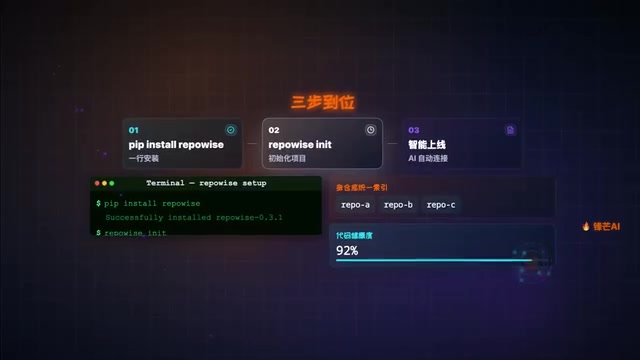
RepoWise's workflow is remarkably simple: install via PIP, initialize the project, and your AI assistant connects automatically. Notably, it supports unified indexing across multiple repositories — particularly important for microservice architectures. You can trace dependencies and changes across services, with codebase health visible at a glance.
Going further, AI can proactively offer refactoring suggestions based on this structured information, rather than passively waiting for you to ask.
Reflection: Code Cognition Middleware Is the Next Step for AI Programming
The philosophy behind this project deserves serious consideration: a codebase shouldn't just be a pile of files. It should have memory (Git history), understanding (dependency relationships), and vitality (activity analysis).
The current bottleneck of AI coding tools is largely not about model capability — it's about the lack of structure in the information we feed to models. RepoWise's approach — adding a "cognition middleware" layer between raw code and AI — may represent the next evolutionary direction for AI-assisted programming.
Of course, official benchmark data needs further validation in real-world projects, and results may vary across codebases of different scales and types. But the direction itself is undoubtedly worth watching.
Related articles
 Product Reviews
The Programmer's Desk Setup Guide: Building a Workspace That Feels Like Home
Discover how programmers build productive, comfortable workspaces. From multi-monitor setups to ergonomic design, explore the desk philosophy that drives focus and flow.
 Product Reviews
Qoder vs Cursor Real-World Comparison: Which $20/Month AI IDE Is Better?
Hands-on comparison of Qoder vs Cursor AI IDEs: Agent autonomy, human interaction count, and architecture decisions. Qoder needed only 2 interactions vs Cursor's 8.
 Product Reviews
Cursor Cloud Agent Demo: Eliminating Bottlenecks Across the Entire Software Development Lifecycle
Deep analysis of Cursor's Cloud Agent demo showing how cloud VMs, automated test artifacts, and a full-chain control plane systematically eliminate human bottlenecks across the software development lifecycle.