Rescuing a 2012 Mac Mini from E-Waste: A Complete Self-Hosted Home Server Setup
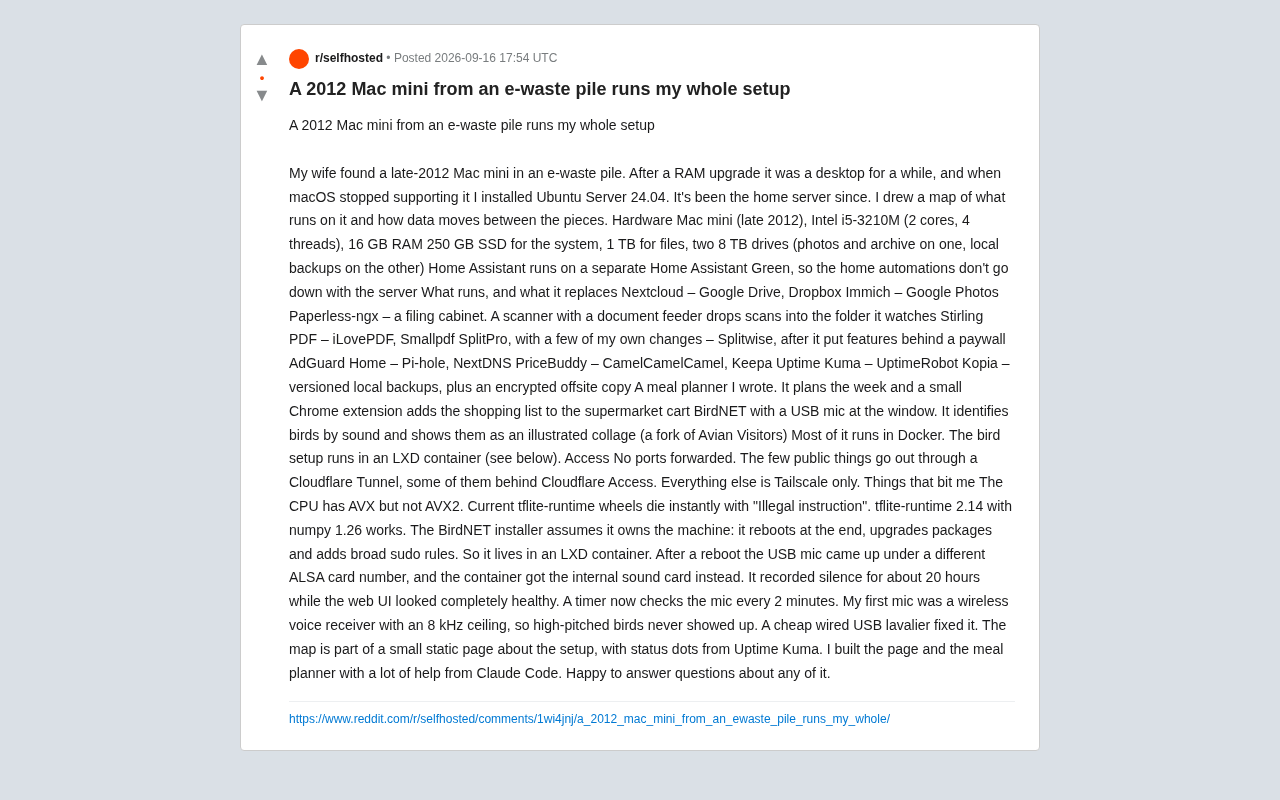
A salvaged 2012 Mac mini running Ubuntu replaces a dozen subscriptions with a full self-hosted service stack.
A 2012 Mac mini pulled from an e-waste pile was flashed with Ubuntu Server 24.04 and turned into a home server running Nextcloud, Immich, Paperless-ngx, and a dozen other services via Docker — replacing Google Drive, Google Photos, Splitwise, and more. The standout feature is a BirdNET-powered window-side bird sound recognizer, which also produced the most technical headaches: AVX2 instruction set incompatibility crashing tflite, an invasive install script requiring LXD container isolation, and a USB mic silently recording 20 hours of nothing after a reboot changed its ALSA card number. Security follows a zero-port-forwarding model using Cloudflare Tunnel and Tailscale, with Home Assistant on a separate device to ensure smart home reliability.
A late-2012 Mac mini salvaged from an e-waste pile, upgraded with more RAM and a fresh OS install, now powers an entire family's self-hosted service stack. This Reddit community share demonstrates how aging hardware can find a second life in the self-hosting wave — and serves as a highly practical reference guide for building your own home server.
From E-Waste to Home Server
The story starts simply enough: the author's wife spotted this late-2012 Mac mini in an e-waste pile. Equipped with an Intel i5-3210M processor (2 cores, 4 threads) and 16GB of RAM, it served as a regular desktop for a while. When macOS dropped support for the aging device, rather than retiring it, the author flashed Ubuntu Server 24.04 and turned it into the household's core server.
The storage setup is equally pragmatic: a 250GB SSD handles the OS, 1TB covers everyday files, and two 8TB drives handle photo archiving and local backups respectively. This hot/cold data separation approach lets decade-old hardware shoulder a surprisingly substantial storage load.
Notably, the author deliberately deployed Home Assistant on a separate Home Assistant Green device rather than cramming it into this server. That way, even if the server goes down, home automation keeps running — an easily overlooked but critically important high-availability design decision.
How Many Subscriptions Can One Salvaged Machine Replace?
The most compelling aspect of this setup is how much commercial software it replaces with a single piece of rescued hardware. The author's service list covers nearly every corner of personal digital life:
- Nextcloud replaces Google Drive and Dropbox for file sync and cloud storage
- Immich replaces Google Photos for photo and video management
- Paperless-ngx serves as a digital filing cabinet — paired with an auto-feed scanner, scanned documents automatically land in a watched folder
- Stirling PDF replaces online tools like iLovePDF and Smallpdf
- SplitPro replaces Splitwise (which moved key features behind a paywall) for bill splitting
- AdGuard Home replaces Pi-hole and NextDNS for network-wide ad filtering
- PriceBuddy replaces CamelCamelCamel and Keepa for product price tracking
- Uptime Kuma replaces UptimeRobot for service status monitoring
- Kopia handles versioned local backups plus an encrypted off-site copy
Beyond that, the author built a custom meal planning tool that plans a weekly menu and uses a Chrome extension to add the shopping list directly to a supermarket cart. This kind of highly customized, self-built tooling is exactly where self-hosting outshines commercial SaaS.
Almost all services run in Docker — with one exception: the bird-watching system runs in an LXD container, for reasons explained below.
Recognizing Birds Outside the Window by Sound
The most delightful part of the whole setup is BirdNET. The author placed a USB microphone by the window; the system identifies bird species by sound and displays them as illustrated collages (a fork of the Avian Visitors project). Running a machine learning model on an aging home server for something like this adds a charming quality-of-life dimension to home self-hosting.
That said, this bird-watching feature also caused the most technical headaches — and offers the most honest look at the real-world challenges of running AI inference on old hardware.
BirdNET is an open-source bird sound recognition neural network jointly developed by the Cornell Lab of Ornithology and Chemnitz University of Technology. It can identify thousands of bird species worldwide from ambient recordings. Its inference pipeline slices recordings into fixed-length time windows, extracts mel-spectrogram features, and feeds them into a convolutional neural network classifier that outputs confidence scores per species. BirdNET-Analyzer is the official command-line tool; BirdNET-Pi is an all-in-one deployment solution aimed at Raspberry Pi, including the invasive install script mentioned below. Microphone sample rate is critical for recognition quality: bird calls typically fall in the 1–8 kHz range, with some high-pitched species reaching above 10 kHz. An 8 kHz sample rate is limited by the Nyquist theorem to reproducing frequencies below 4 kHz, causing the characteristic harmonics of high-pitched species to be completely lost and making it impossible for the model to match them.
The Pitfalls of Running AI Inference on Old Hardware
The author honestly documented a series of thorny problems — invaluable reading for anyone looking to deploy machine learning inference on an aging CPU.
Missing AVX instruction set support: The i5-3210M supports AVX but not AVX2. Current tflite-runtime wheel packages crash immediately with an "Illegal instruction" error. The author eventually found a working combination: tflite-runtime 2.14 paired with numpy 1.26. This detail is a reminder that instruction set compatibility is often the first roadblock when running modern AI libraries on old hardware.
Installer overreach: BirdNET's install script assumes it owns the entire machine — it reboots the system at the end, upgrades packages, and adds overly broad sudo permissions. To isolate this invasive behavior, the author confined it inside an LXD container.
Silent USB microphone failure: After a reboot, the USB microphone's ALSA card number changed, and the container mistakenly bound to the built-in sound card — resulting in roughly 20 hours of silence being recorded while the web interface showed everything as healthy. This is one of the most dangerous failure modes in self-hosting: the service appears fine while producing garbage data. The fix was a timer that checks the microphone every 2 minutes.
Microphone hardware selection: The original wireless voice receiver had a maximum sample rate of only 8 kHz, which meant high-pitched bird species could never be identified. Switching to an inexpensive wired USB lavalier microphone solved the problem.
AVX (Advanced Vector Extensions) is a SIMD instruction set extension Intel introduced with the Sandy Bridge architecture in 2011, enabling the CPU to perform parallel operations on 256-bit-wide vector data in a single instruction. AVX2 is a further extension introduced with the Haswell architecture in 2013, adding integer vector operations and additional data shuffle instructions. The i5-3210M belongs to the Ivy Bridge microarchitecture — it supports AVX but not AVX2. Modern deep learning frameworks (including TensorFlow Lite) typically compile their pre-built binary packages targeting AVX2 or even AVX-512 for maximum throughput. Executing these on a CPU that lacks those instructions causes the OS to raise an "Illegal instruction" exception and terminate the process. There are generally two solutions: find a legacy wheel package compiled for older instruction sets (as with tflite-runtime 2.14 here), or recompile from source targeting the actual instruction set of the CPU — though the latter is time-consuming and requires solid build environment experience.
Security Design: Zero Port Forwarding
The network security approach here is worth borrowing: no port forwarding whatsoever. The small number of services that need public access are exposed via Cloudflare Tunnel, with some of those further wrapped in Cloudflare Access for authentication. Everything else is accessible only over the Tailscale private network.
This "zero exposure by default, minimal opening on demand" design both reduces the security risk of running an old device and preserves the convenience of remote access — a best practice that deserves wider adoption in home self-hosting.
Cloudflare Tunnel works by running a
cloudflareddaemon on the server that initiates outbound connections to Cloudflare's edge nodes; traffic is then reverse-proxied back through this tunnel. Because the entire process requires no inbound ports to be opened on the router, home broadband dynamic IPs and NAT are bypassed entirely. Cloudflare Access adds an authentication gateway on top of Tunnel, requiring visitors to log in via Google/GitHub SSO or a one-time email code — ideal for services shared with family or used occasionally from outside the home. Tailscale builds a peer-to-peer encrypted mesh network on top of WireGuard; all devices registered to the same account automatically join the network with low latency and no central relay required. The three together form a clear layered access control system: fully private services go through Tailscale, externally shared services go through Tunnel, and high-risk services get an additional Access authentication layer.
A Real-World Snapshot of AI-Assisted Development
The author mentions that the static page displaying the entire architecture (complete with live status indicators from Uptime Kuma) and the meal planning tool were both built with substantial help from Claude Code. This reflects a broader trend: AI coding assistants are lowering the barrier for individual developers to build custom tools, making "write a small utility to solve my specific problem" easier than ever before.
From a salvaged Mac mini to a full self-hosted service ecosystem, this case proves that old hardware still has plenty of value to offer. It's not just about saving money — it's a hands-on exercise in data sovereignty, privacy, and technical ownership. For anyone considering building a home server, this service list and collection of hard-won lessons makes for a rare and practical real-world reference.
Related articles
Automattic Executives Signed Reciprocal Severance Agreements During Mullenweg's Brief Ouster
Automattic's CFO and General Counsel signed reciprocal severance agreements during Matt Mullenweg's brief ouster, covering one year's salary and accelerated equity vesting, raising corporate governance concerns.
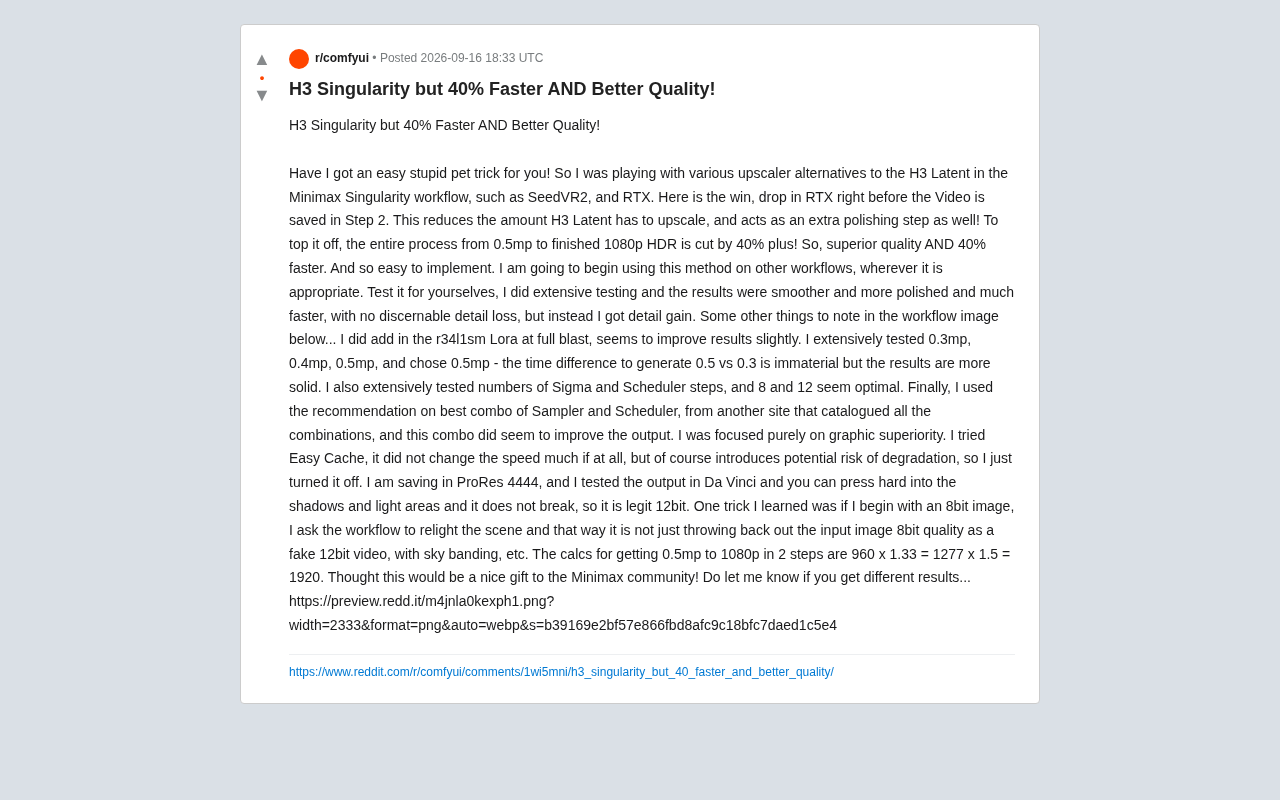
H3 Singularity Optimization: 40% Speed Boost With Better Image Quality
A Reddit user's Minimax Singularity workflow tip: insert an RTX upsampler before H3 Latent for 40%+ speed gains and better quality. Covers parameters, 12-bit output, and more.
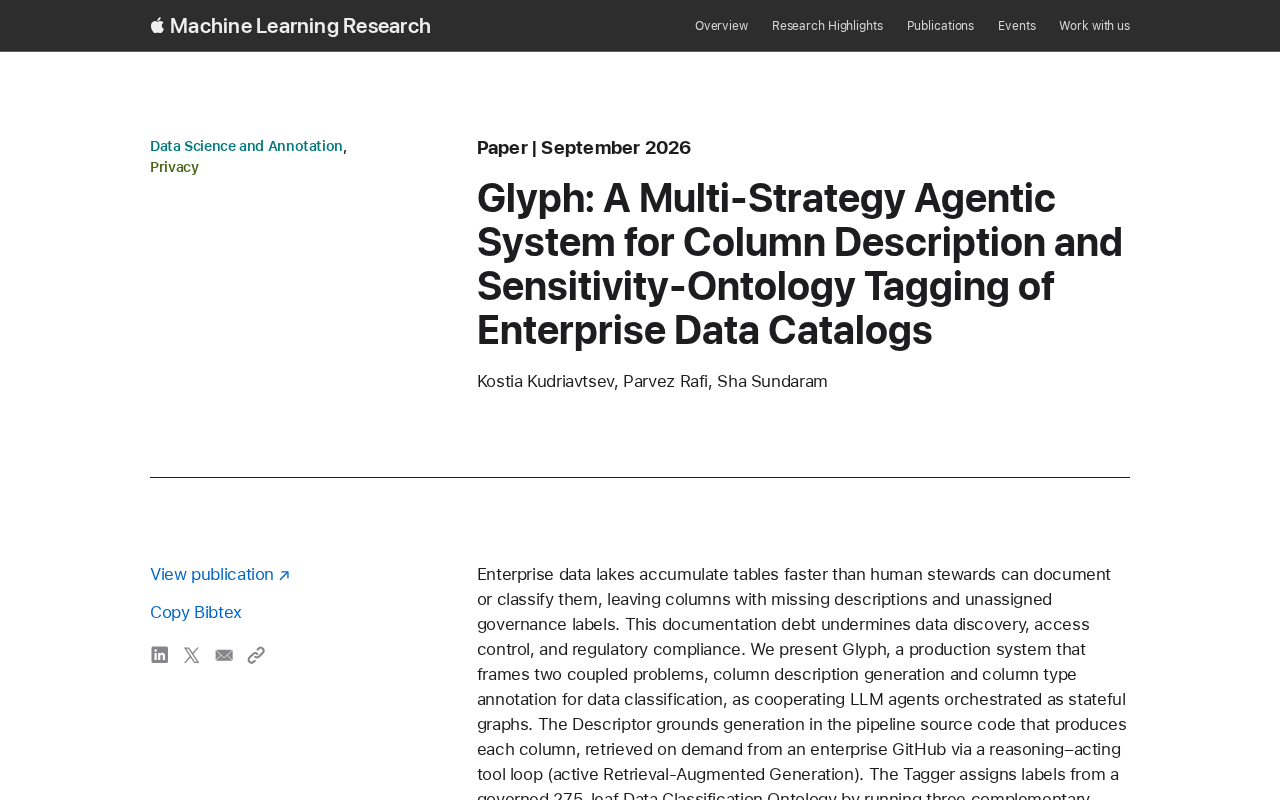
Glyph: A Multi-Strategy Agent System for Automated Enterprise Data Catalog Annotation
Glyph is a multi-strategy LLM agent system for enterprise data catalogs that automates column description generation and sensitivity ontology tagging, grounding outputs in pipeline source code to improve accuracy.