Researchers Surpass OpenAI's Math Results with Lean-Verified Proofs, Reigniting AI Proof Value Debate
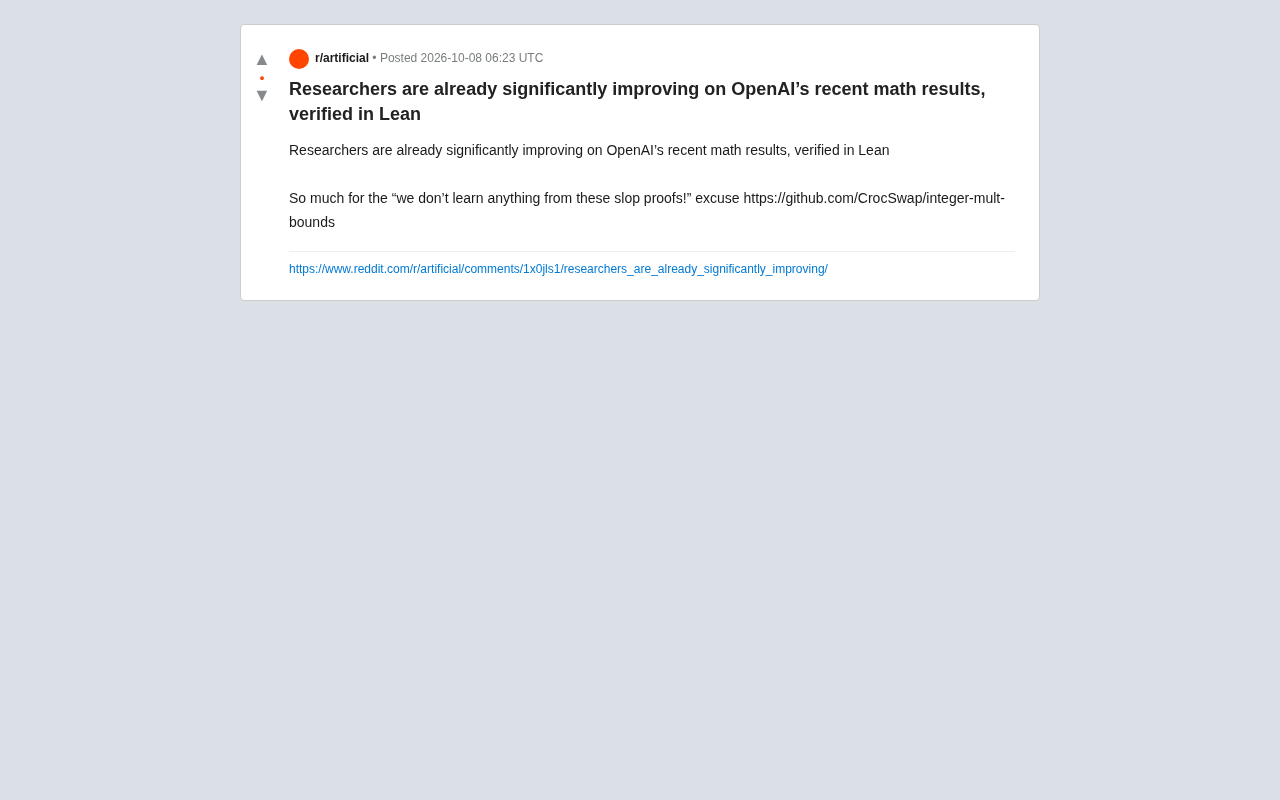
Researchers improved on OpenAI's math results and formally verified them in Lean, validating AI-assisted mathematical research.
A Reddit discussion has drawn attention after researchers claimed to have significantly improved on OpenAI's integer multiplication bounds results and formally verified those improvements using the Lean theorem prover. The key significance lies in Lean's role: it elevates proofs from "probably correct" to machine-confirmed mathematical fact, directly countering criticism that AI-generated proofs are worthless "slop." The episode points to an emerging paradigm where AI generates, formal tools verify, and humans refine — suggesting that verifiability, not elegance, is the right metric for evaluating AI math contributions.
Background: From OpenAI's Math Results to Lean Formal Verification
A Reddit discussion has recently sparked attention at the intersection of AI and mathematics: researchers claim to have made significant improvements on a mathematical result recently published by OpenAI, with those improvements formally verified using the Lean theorem prover.
The relevant code and proofs are hosted in the GitHub repository integer-mult-bounds, centered on the specific mathematical problem of integer multiplication bounds. The original poster remarked with a touch of sarcasm: "The excuse of 'we can't learn anything from these garbage proofs' can finally be put to rest."
Why Lean Verification Is the Critical Piece
To appreciate the weight of this development, the role of Lean is central. Lean is an interactive theorem prover that requires every reasoning step to strictly conform to formal logic rules. A machine can check the correctness of a proof line by line — there is no fuzzy "looks about right" margin.
This is precisely the crux of the ongoing debate around AI-generated mathematical proofs. Many critics have argued that proofs produced by large language models are "slop proofs" — bloated, low-quality, and untrustworthy — that, even when they appear to reach a conclusion, lack verifiability and contribute little to real mathematical research.
When researchers fully formalize their improved results in Lean and pass verification, it means those results are no longer "probably correct" — they become rigorously established mathematical facts that a machine can confirm. This fundamentally addresses the "nothing to learn here" criticism: if verifiably improved results can be built on top of these foundations, the original work clearly provided a valuable starting point.
Lean was developed by Leonardo de Moura at Microsoft Research, and the widely used version today is Lean 4. Unlike traditional mathematical writing, every proof step in Lean must correspond to a machine-checkable inference rule. The entire proof is essentially compilable code — a successful compilation means the proof is correct; a failure indicates a logical gap. This property places Lean alongside Coq, Isabelle, and similar systems as representatives of the Interactive Theorem Prover (ITP) family. Landmark milestones in mathematics — such as the formal verification of the Feit-Thompson Theorem and the Liquid Tensor Experiment — were completed using tools of this kind, demonstrating their real-world capability for research-level mathematics. It is also worth noting that formalizing a proof itself requires considerable expertise. When a researcher can verify an improvement in Lean, that alone signals deep understanding of the problem — not mere mechanical transcription.
The Core Debate: Do AI Proofs Have Real Value?
The genuine tension in this discussion lies in how we judge the value of AI-assisted mathematical research.
One camp holds that even if an AI-generated proof is inelegant or verbose, as long as it can be verified by formal tools and picked up, improved upon, and surpassed by human researchers, it constitutes a valid link in the research chain. The case cited in the original post supports exactly this position: the researchers not only understood OpenAI's result but built upon it to produce a verifiably substantial improvement.
The reservations of the opposing camp are not entirely without merit, either. Their concern is that the sheer volume of AI-generated proofs — lacking insight and difficult to read — could pollute the mathematical literature and waste reviewers' time. But the counterexample here suggests: the real standard of judgment is not whether a proof looks elegant, but whether it can be verified and further advanced.
The term "slop proofs" reflects a specific class of criticism from the mathematical community regarding AI-generated content: large language models, when generating proofs, tend to pile up symbols and steps to fill space rather than finding a truly concise, insightful path. Even when such proofs are logically valid, they may be so verbose and poorly structured that human mathematicians cannot absorb them as new knowledge. Some researchers worry that if large numbers of such proofs flood preprint servers and journals, they will drain peer review resources and dilute genuinely valuable mathematical insight. Problems like integer multiplication bounds — falling within combinatorics and number theory — are precisely the ideal testing ground for the question of whether AI proofs can be picked up and improved upon: compared to open-ended conjectures, the room for improvement and the degree of improvement in such problems are far easier to measure objectively.
Implications for AI–Mathematics Collaboration
This seemingly brief Reddit post reflects an important emerging trend in the application of AI to serious scientific domains: formal verification is becoming the "trust anchor" for AI-generated mathematical results.
When AI output can be automatically checked by tools like Lean, a reliable collaborative paradigm emerges between human researchers and AI: AI handles exploration and generation, formal tools handle quality control, and human researchers take over to refine, improve, and advance the work. Within such a workflow, the question of whether a proof originated from AI becomes less important — what matters is the reliability and extensibility of the result itself.
It should be noted that the current information stems primarily from a single Reddit post and the GitHub repository it links to. The specific extent of the improvement and a detailed comparison with OpenAI's original results still await more systematic technical documentation and peer review. But the core discussion it has sparked — that the value of AI mathematical proofs should be measured by verifiability rather than surface form — is undoubtedly worth sustained attention from the entire research community.
Summary
Whatever technical details ultimately emerge, this episode provides at least one compelling data point: mathematical results produced by AI are being picked up by human researchers, verified within rigorous formal frameworks, and surpassed. This may signal that AI–mathematics collaboration is entering a more pragmatic and trustworthy phase.
Related articles

WorkBuddy Full Tutorial: Build an AI Office Automation Agent from Scratch
A complete WorkBuddy tutorial: installation, three working modes, multimodal picture book video practice, expert team agent building, and workflow configuration for low-cost AI office automation.

WorkBuddy Agent Complete Guide: From Beginner to Automation in 7 Days
Based on Bilibili's 256-episode WorkBuddy masterclass, this systematically breaks down Tencent's AI office workbench core capabilities: Agent principles, Skill encapsulation, cross-platform connectors, scheduled automation, knowledge bases, and zero-code development, with learning path recommendations.

8 AI Accounts, 7 Failed: An Honest Review of Using AI to Get Work Done
Only 1 of 8 AI-run Bilibili accounts succeeded. We break down the real difference between "performing AI" and "using AI to get work done."