Restoring a Soviet ES-4001 Mainframe Control Panel: A Field Report
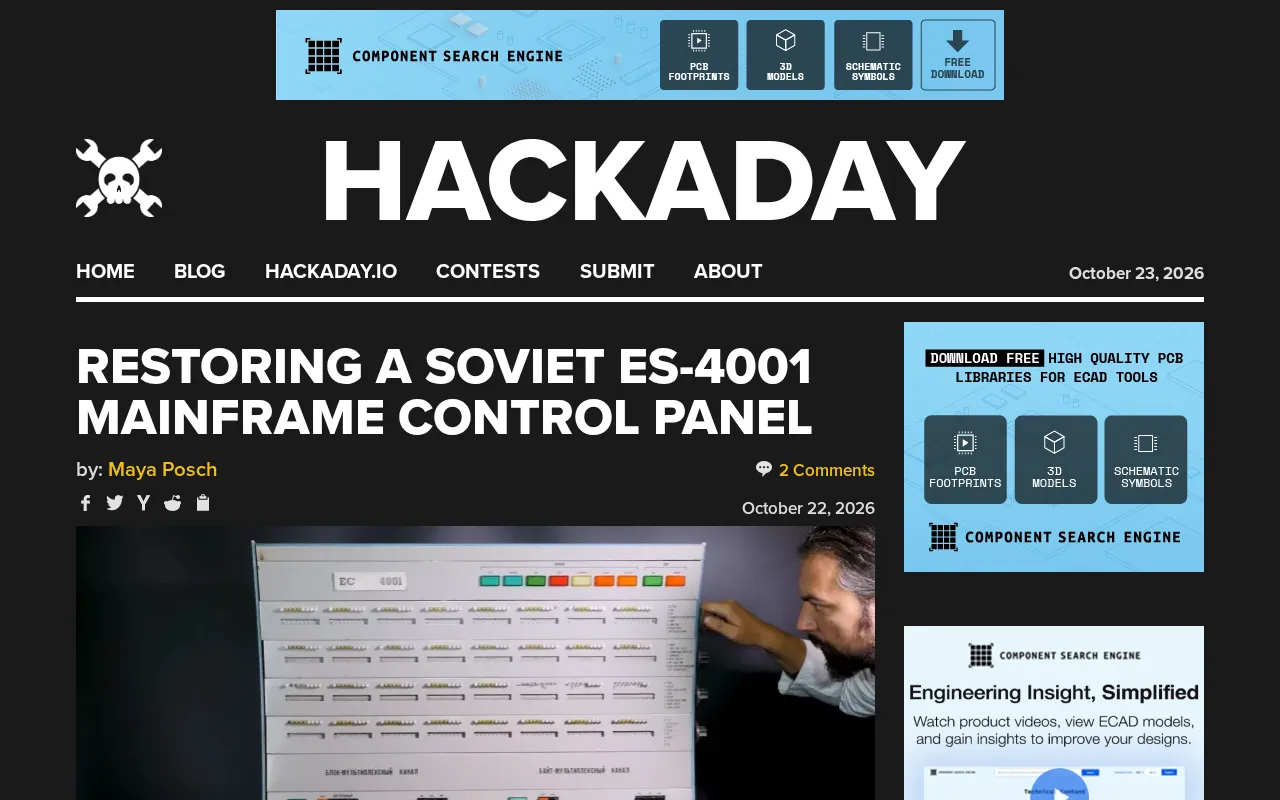
A Hacker News share about restoring a Soviet ES-4001 mainframe control panel reveals the technical challenges and historical value of retro computing.
The article centers on a brief Hacker News share about restoring a Soviet ES-4001 mainframe control panel. The ES-4001 belongs to the ES EVM computer family jointly developed by Comecon countries during the Cold War, and its control panel restoration faces interdisciplinary challenges such as component substitution, circuit reverse engineering, mechanical restoration, and cleaning and corrosion prevention. The article notes that such retro hardware restoration not only preserves the history of a non-mainstream branch of computing technology but also forms a unique mode of archival research through knowledge transfer in community forums. The physical interaction mode of the control panel contrasts with modern remote management interfaces, providing a physical reference for embedded system and debugging tool design. Ultimately, it emphasizes that restoration projects are a rescue of forgotten technological history and recommends that enthusiasts start by consulting ES EVM documentation and participating in retro computing forums.
In the retro computing enthusiast community, a notable project appeared on Hacker News: restoring the control panel of a Soviet-era ES-4001 mainframe. The original post had only a title and 5 upvotes, with no details, but the topic itself is enough to pique the interest of hardware archaeology hobbyists. The ES-4001 is a member of the ES EVM series of computers jointly developed by Comecon countries during the Cold War, and its control panel is not just an operator interface but a forgotten slice of technological history.
ES-4001 and ES EVM: An Underappreciated Chapter in Computing History
The ES-4001 belongs to the ES EVM (Unified System of Electronic Computers) family, a mainframe initiative led by the Soviet Union in the 1970s with participation from multiple Eastern European countries. It was not a simple copy of the IBM System/360 but rather developed an independent hardware ecosystem while maintaining instruction-set compatibility. The control panel, as the core component for operator interaction with the mainframe, was typically covered with indicator lights, toggle switches, and buttons, its design blending pragmatism with industrial aesthetics. Restoring such a device means dealing with long-discontinued components, undocumented circuit logic, and possibly brittle plastic parts.
For today's developers, the value of such restoration projects lies not in getting the machine to run programs again but in understanding the physical interaction methods of early computing systems. Each switch corresponds to a microinstruction, each light reflects the state of a register—this "what you see is what you get" debugging experience stands in stark contrast to the modern software stack with its layers of abstraction.
ES EVM (Единая система ЭВМ) was a joint computer manufacturing program launched in 1969 by Comecon countries to establish a unified-architecture, software-compatible computer series to counter the monopoly of the American IBM System/360. Led by the Soviet Union, the program involved East Germany, Poland, Czechoslovakia, Hungary, Bulgaria, Romania, and Cuba, which divided production among different models to cover needs from small and medium systems to mainframes. ES EVM was not a simple copy of the System/360 but maintained compatibility at the instruction-set level while developing independent hardware implementations, peripheral interfaces, and operating systems (such as DOS/ES and OS/ES). This series provided critical infrastructure for industrial control, scientific computing, and administrative data processing in Eastern Europe during the 1970s and 1980s, but due to Cold War technology embargoes and coordination issues within Comecon, its development gradually fell behind the West and eventually exited the stage of history with the revolutions of 1989. Understanding the multinational collaboration background of ES EVM helps explain why its control panels featured multilingual labels and components from diverse sources.
Core Challenges of the Restoration
Although the original post did not detail the restoration process, several common difficulties can be inferred from similar retro mainframe restoration cases:
- Component substitution: Soviet-era electronic components (such as К155 series logic chips and specialized indicator lights) had specifications different from Western standards, and finding substitutes requires consulting large amounts of Russian-language documentation or salvaging parts from other discarded equipment.
- Circuit reverse engineering: The wiring of control panels often lacks complete schematics, and restorers must measure point by point with a multimeter, or even infer signal definitions from the panel silkscreen.
- Mechanical restoration: The springs of toggle switches, the keycaps of buttons, and the metal frame of the panel—wear on these mechanical parts is often more troublesome than circuit issues.
- Cleaning and corrosion prevention: Long-term storage leads to oxidized connectors and leaking capacitors, which must be cleaned without damaging the original paint and silkscreen.
These challenges make control panel restoration an interdisciplinary endeavor involving electronic engineering, materials science, and archival research.
The К155 series logic chips are a Soviet clone line of the 7400 series TTL logic chips, born in the 1970s and widely used in domestic computers such as ES EVM and peripherals. The series includes basic logic gates, flip-flops, counters, decoders, etc., in DIP packages with pinouts largely compatible with the Western 7400 series, though electrical parameters (such as switching speed and power consumption) and temperature ranges may differ. Due to the high degree of standardization in the Soviet electronics industry, the К155 series was produced in large quantities in Comecon countries but has been out of production for many years. Restorers unable to find original К155 chips usually need to consult Russian-language datasheets (such as the 《Интегральные микросхемы》 series manuals) to compare parameters before choosing modern 74LS or 74HC series substitutes, while paying attention to level compatibility and timing changes. In addition, Soviet-era indicator lights and connectors often used unique specifications (such as TH-3 series incandescent lamps), and replacements must also consider panel hole dimensions and supply voltage.
Why Retro Computing Deserves Attention
Today, with AI and cloud computing dominating headlines, restoring a Soviet mainframe control panel may seem trivial. But it is precisely such projects that remind us: the evolution of computing technology is not a single narrative. The ES EVM series once supported enormous industrial and scientific computing demands in the Soviet Union and Eastern Europe, and its architectural choices, peripheral designs, and software ecosystem all have independent research value. Restoring the control panel is essentially preserving material evidence for this history.
Moreover, the retro hardware restoration community (such as the enthusiasts gathered on Hacker News) has formed a unique mode of knowledge transfer: restorers often post detailed reverse-engineering notes, component substitution solutions, and lessons from failures on forums, and this content is practically helpful for museum digital preservation and industrial heritage research.
The knowledge transfer model of the retro hardware restoration community shares similarities with open-source software communities but relies more on physical clues and transnational collaboration. Restorers typically post reverse-engineering notes on Hacker News, VCF (Vintage Computer Federation) forums, Russian Computers, and other specialized communities, including: high-resolution photos documenting silkscreen and component layout, logic analyzer captures of signal timing, partial circuit schematics, and component substitution cross-reference tables. Because many Soviet computers lack public documentation, these notes often become the only reference for subsequent restorers. This "crowdsourced archival research" not only preserves technical details but also forms a cross-language (Russian, English, German, etc.) collaborative network. Museums and industrial heritage institutions (such as the Polytechnic Museum in Moscow) also often obtain restoration solutions from these communities for exhibit maintenance. Therefore, participating in retro computing restoration is not only a personal hobby but also a contribution to public technological memory.
The Evolution of Human-Computer Interaction as Seen Through the Control Panel
Every physical control on the ES-4001 control panel corresponds to a clear function, and operators directly perceive machine status through indicator lights and switches. This interaction mode has disappeared from today's data centers, replaced by remote management interfaces and automated monitoring. However, when modern systems fail, engineers still long for the intuitive "spot it at a glance" quality of physical indicator lights.
One of the significances of restoring such equipment is to preserve a physical reference for this intuitive interaction. For engineers designing embedded systems or debugging tools, observing how early control panels organized information density and used color and position to encode status can still provide inspiration.
Conclusion
This brief share on Hacker News belies a restoration project requiring patience and interdisciplinary knowledge. The restoration of the ES-4001 control panel is not only a rescue of an old device but also a renewed attention to a non-mainstream branch of computing history. For readers interested in getting started, it is recommended to begin by looking up ES EVM technical documentation and participating in retro computing forums—every reverse-engineering note is a missing piece of the puzzle being filled in for this history.
Related articles

Building an AI Agent with Claude Code from Scratch: From Workspace to Cloud Autonomy
No coding required: build an AI Agent in four steps with the Claude Code desktop app—from workspace setup and Agent Designer to Skills, Memory, and cloud autonomy.

No Python Required: How Cursor AI Coding Is Reshaping Automated Testing and Test Development
Test engineers can do automated testing without learning Python? This article examines how Cursor and other AI coding tools empower functional testing, automation scripts, test platform development, and performance tuning, compares the cost and access restrictions of mainstream domestic and foreign tools, and offers capability transformation advice for testers.

Nearly 5,000 Affected! AI Coding Plugin Found with Backdoor, Officials Urgently Remove It
Claude Code's VS Code extension version 2.1.313 was maliciously tampered with, implanting a backdoor for remote login and persistent control, potentially affecting up to 5,000 users. Officials have removed the malicious version; this article details the attack method and cleanup steps.