Reticket: How Zero-Knowledge Proofs Eliminate Fake Tickets and Rebuild Trust in Ticket Resale

Reticket uses zero-knowledge proofs and escrow to make fake ticket resale listings technically impossible.
Reticket is a ticket resale platform that leverages zero-knowledge proofs (ZKP) to cryptographically verify every listing against original booking records, making fake tickets impossible. Combined with price caps at face value, mandatory KYC seller verification with non-revocable security deposits, and delayed fund release until after events conclude, it creates a comprehensive trust framework that eliminates scalping and fraud in secondary ticket markets.
The Persistent Problem of Ticket Resale: Fake Tickets and Price Gouging
Whenever a hot concert or sporting event comes around, the ticket resale market inevitably falls prey to two chronic issues: rampant fake tickets and malicious price inflation. Buyers on the secondary market often have no way to verify whether the seller actually holds a real ticket, nor can they confirm the seller won't disappear after receiving payment. Meanwhile, scalpers hoard tickets and resell them at several times face value, further distorting market order.
The root cause lies in information asymmetry: in traditional ticket resale processes, buyers rely almost entirely on the seller's "good faith promise," with no independent technical means to verify ticket authenticity. Even well-known secondary ticket platforms (such as StubHub and Viagogo) primarily rely on post-incident complaints and manual reviews rather than pre-transaction technical verification. According to estimates, the global secondary ticket market exceeds $15 billion, yet consumer losses from fake tickets and fraud run into hundreds of millions of dollars annually.
Recently launched on Product Hunt, Reticket offers a "verification-first" solution targeting this exact pain point. Its tagline is straightforward — "Ticket resale where fake listings are impossible." The product currently ranks 19th, with 15 upvotes and 3 comments, built by Rishabh Bansal and team, spanning the Events, Fintech, and Ticketing categories.
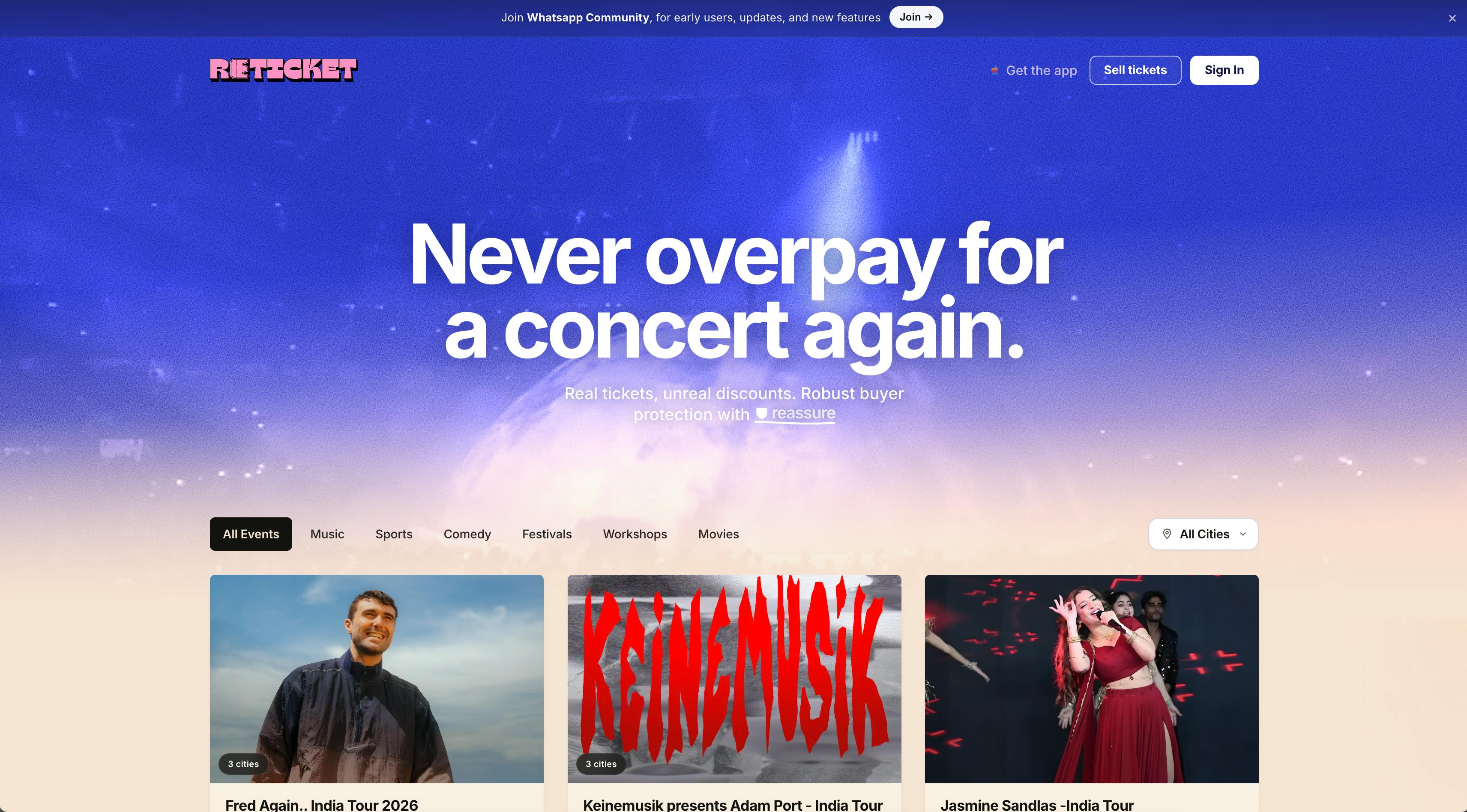
How Zero-Knowledge Proofs Ensure Every Resold Ticket Is Genuine
Every Listing Is Cryptographically Verified
Reticket's most fundamental innovation is its integration of Zero-Knowledge Proof (ZKP) technology. Every ticket listing on the platform undergoes cryptographic verification against the seller's original booking records.
Zero-knowledge proofs are a core concept in modern cryptography, first proposed by Shafi Goldwasser, Silvio Micali, and Charles Rackoff in their 1985 academic paper. The central idea is that a Prover can convince a Verifier that a statement is true without revealing any additional information. A classic layman's analogy is the "Ali Baba cave" — you can prove to someone that you know the password to a secret door without ever revealing the password itself. ZKP has already seen widespread adoption in blockchain, such as Zcash using zk-SNARKs for private transactions, and Ethereum Layer 2 solutions like zkSync and StarkNet leveraging ZK-Rollups to boost network throughput. In recent years, ZKP has been expanding from pure cryptocurrency use cases into physical-world domains like identity verification, supply chain traceability, and ticketing — Reticket is a prime example of this trend.
Specifically, sellers can prove at the cryptographic level that "I genuinely hold a real ticket purchased through official channels" without exposing complete order privacy information (such as account details, payment information, etc.) to the platform or buyers. This mechanism eliminates fabricated fake listings at the technical root — because listings without genuine booking records simply cannot pass the verification process.
Compared to traditional resale platforms that rely on manual review or user reports as "after-the-fact remedies," Reticket moves verification upstream to the listing stage. This is the essence of its "verification-first" positioning.
Price Cap Mechanism: Curbing Scalper Markup by Design
Beyond using zero-knowledge proofs for authentication, Reticket also imposes a hard limit on resale pricing: the resale price cannot exceed the original purchase price.
This design directly eliminates scalpers' profit margins. For ordinary consumers, the secondary market is no longer a place to "pay premium prices for admission" but returns to its healthy function — facilitating flow between those who can't attend and those who genuinely want to go. This price-capping approach aligns with anti-scalping legislation being promoted by various countries and platforms in recent years.
In fact, ticket resale price controls have seen multiple legislative attempts globally. The UK passed the "Banning of Unfair Ticket Practices" legislation in 2018, prohibiting the use of automated software (bots) for bulk ticket purchases and requiring secondary market sellers to disclose seat information and face value. Multiple Australian states have legislated that resale prices cannot exceed 10% above face value. France has classified for-profit ticket resale as illegal since 2012. US regulations vary significantly by state — New York lifted price cap restrictions in 2017, while other states maintain markup limits. Japan's 2019 "Act on Prevention of Unauthorized Ticket Resale" directly criminalized above-face-value resale of tickets for specific events. Reticket's technology-driven price cap complements these legislative trends — enforcing policy intent through code, making rules impossible to circumvent.
The Trust Assurance System: KYC Identity Verification and Security Deposits
Seller Identity Verification with Non-Revocable Security Deposits
To further constrain seller behavior, Reticket requires all sellers to complete KYC (Know Your Customer) identity verification and lock up a non-revocable security deposit.
KYC originates from financial regulation, initially used by banks and securities institutions to prevent money laundering, terrorist financing, and other risks. Based on FATF (Financial Action Task Force) recommendations, financial institutions in all countries must verify customer identity information during account opening. With the development of the digital economy, KYC processes have extended to cryptocurrency exchanges, P2P lending platforms, and the sharing economy. A typical KYC process includes document upload, liveness detection, and address verification. Introducing KYC into ticket resale means every seller has a traceable real identity — a fundamental paradigm shift from the traditionally anonymous scalper market.
The logic of this combination is clear: identity verification solves the "who is the seller" problem, making fraud traceable; the security deposit provides economic deterrence — if a seller defaults or provides problematic tickets, the deposit serves as a safety net for buyer rights. This mirrors trust deposit designs common in the sharing economy and financial trading, such as Airbnb host security deposits and futures trading margin systems, all following the same game theory logic: reducing the probability of default by raising the cost of default.
Escrow and Delayed Payout: Settlement Only After the Event
Reticket employs a delayed payout mechanism: seller payments are only released after the event has actually taken place.
In other words, the platform acts as an Escrow agent. Escrow mechanisms have a long history in e-commerce and financial transactions, with the basic principle being the introduction of a trusted third party that holds funds on behalf of both parties until obligations are fulfilled. Alipay's early guaranteed transactions, Upwork's freelancer payment protection, and third-party escrow accounts in real estate transactions are all classic applications of escrow. In the blockchain domain, smart contracts can serve as decentralized escrow agents, automatically releasing funds based on preset conditions without trusting any intermediary.
After the buyer pays, funds don't immediately enter the seller's account but are held until the event concludes and ticket usage is confirmed valid. Reticket's delayed payout is essentially time-anchored escrow — using whether the event actually took place as the trigger condition for fund release. This is stricter than traditional e-commerce's "release funds after confirming receipt," because a ticket's true value can only be redeemed at the actual event. This design effectively prevents common disputes such as "collecting payment and disappearing" and "seller not refunding after event cancellation," compressing transaction risk for both parties to a minimum.
Reticket's Industry Significance: Web3 Cryptography Landing in Physical-World Scenarios
Reticket's value lies not in any single feature but in its integration of cryptographic verification, price controls, identity authentication, and fund escrow into a complete closed loop. Any single mechanism alone is insufficient to thoroughly solve trust issues in ticket resale, but combined they form a relatively comprehensive protective net.
From an industry perspective, this is also a quintessential case of Web3 cryptographic technologies like zero-knowledge proofs moving beyond the cryptocurrency circle and landing in physical consumer scenarios. ZKP provides verifiability while protecting user privacy, perfectly addressing the contradictory demand in ticket resale — "needing to prove authenticity while unwilling to expose privacy."
Notably, ZKP's expansion from cryptocurrency into physical-world scenarios has become an important direction in Web3 technology development. Beyond ticketing, ZKP has shown potential in multiple real-world applications: Worldcoin uses zero-knowledge proofs for "Proof of Personhood," allowing users to prove they are unique humans after iris scanning without exposing biometric features; Polygon ID has launched a ZKP-based decentralized identity verification solution, allowing users to selectively disclose information like age and nationality; in supply chain management, ZKP can let enterprises prove product origin compliance without exposing supplier trade secrets. Gartner's 2024 Hype Cycle has already listed privacy-enhancing computation (including ZKP) as a key technology that will have significant impact within 2-5 years. Reticket's practice demonstrates that ZKP is moving from theoretical concept to consumer-perceptible product experience.
Of course, as an early-stage product, Reticket still faces practical challenges: how to integrate with major ticketing systems to access original booking data — this involves API integration or data protocol cooperation with dominant ticketing platforms like Ticketmaster and Damai, which tend to be conservative about data openness; how to implement price caps under different countries' regulations — vast regulatory differences in ticket resale across nations mean a unified pricing mechanism may face compliance challenges; and cold-start supply-demand balance issues — as a two-sided marketplace, Reticket needs to simultaneously attract sufficient buyers and sellers to form a transaction loop. These will be critical tests of its ability to scale. Regardless, it offers a noteworthy approach — rebuilding the trust foundation of the secondary ticket market through technical means rather than relying solely on platform rules.
Conclusion
With "making fake ticket listings impossible" as its entry point, Reticket attempts to fundamentally reconstruct the trust model for ticket resale through its four-layer mechanism of zero-knowledge proofs, price caps, KYC security deposits, and delayed payouts. It represents a pragmatic exploration of cryptographic technology at the intersection of ticketing and finance. For consumers long plagued by fake tickets and scalpers, this type of "verification-first" ticket resale platform may point to a possible future form for the secondary ticket market. More broadly, Reticket's emergence also validates a trend: the true value of Web3 technology may lie not in creating new financial speculation tools, but in solving long-standing trust problems in the real world.
Related articles

DeepSeek's Open-Source Inference Framework: The Compute Economics Behind $330K Annual Revenue Per GPU
DeepSeek's open-source inference framework reveals a $38/GPU/hour floor price—how the $330K/year per-GPU math works, plus prefill-decode disaggregation and KV cache.

Leaked DeepSeek Internal Chat Screenshot: Open Source Doesn't Mean Giving Away the Whole Empire
Leaked DeepSeek internal chat screenshot goes viral, with netizens joking about what's left after open-sourcing. This article analyzes the difference between open-source models and giving away all assets, explaining why computing clusters, engineering teams, and business channels can't be replicated, and the ecosystem positioning logic behind open source as a business strategy.

Open-Source Skill Tested: One Sentence Lets AI Auto-Dub and Animate a Video
Bilibili creator Ali's open-source Animation Machine Skill lets AI Agents auto-write scripts, dub, create Remotion animations, and export videos. This article breaks down installation, Doubao TTS configuration, the two-confirmation mechanism, and performance differences across models.