Retiring Long-Lived Static Credentials: Only 8.4% of SaaS Vendors Support Secure Authentication

A survey shows only 8.4% of SaaS vendors support secure authentication, calling for the retirement of long-lived static credentials.
A security survey covering more than 1,000 SaaS vendors shows that only 8.4% support secure authentication, exposing a systemic weakness across the SaaS ecosystem. The article notes that long-lived API keys, fixed passwords, and never-expiring access tokens became the default because they are the least effort for both vendors and users, but the cost is long-term accumulation of risk—once a key leaks, attackers gain an almost permanent entry point, and automated rotation is widely missing in practice. Core secure authentication capabilities include short-lived tokens with automatic expiration, authorization frameworks such as OAuth, key rotation and revocation, and least privilege. The article frames this data as a call to action, emphasizing that retiring static credentials requires a three-way effort from vendors, users, and the tooling ecosystem, and offers practical advice for developers and enterprises, treating 8.4% as a trackable baseline for industry security maturity.
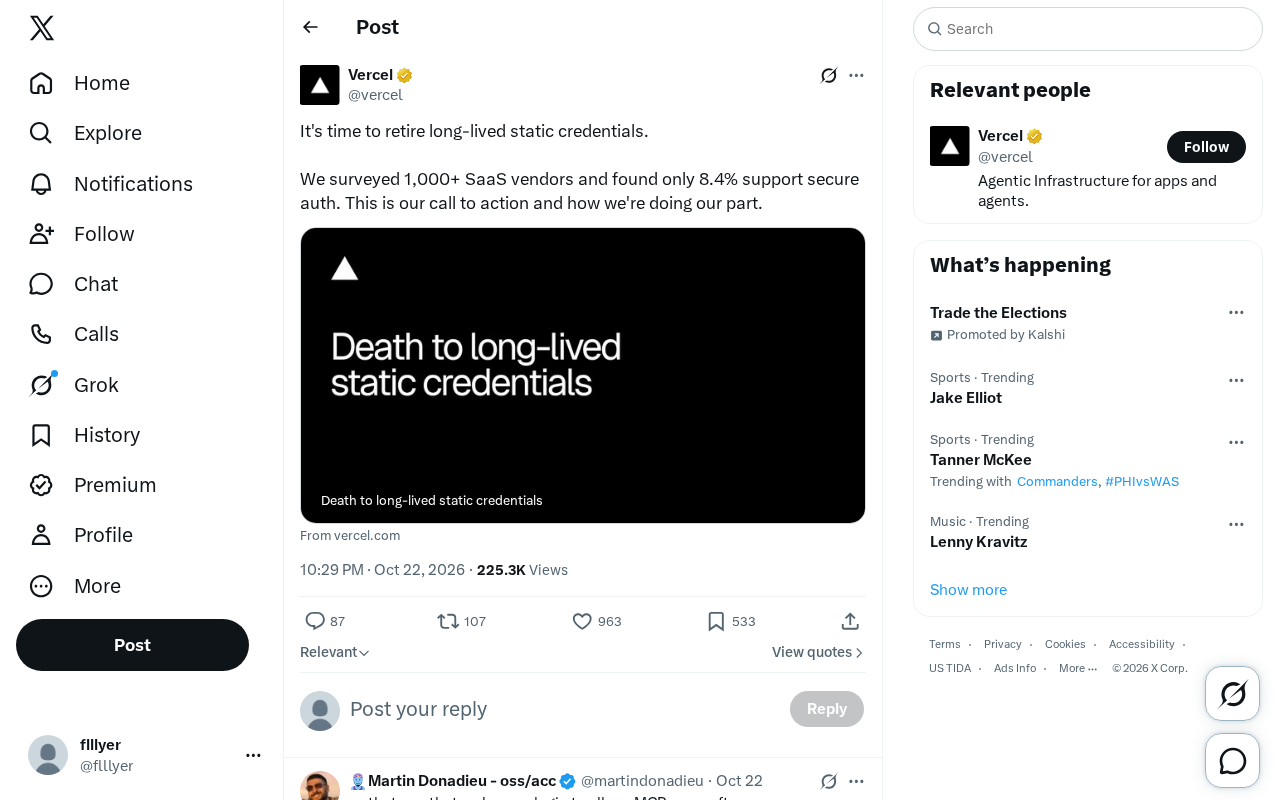
After surveying more than 1,000 SaaS vendors, a security team surfaced a striking figure: only 8.4% of vendors support secure authentication methods. Their conclusion: it's time to retire long-lived static credentials.
This isn't just another vague security appeal. It points to a specific, quantifiable industry practice that has long been tolerated.
The Truth Behind 8.4%: Why Static Credentials Became the Default
Static credentials (long-lived API keys, fixed passwords, access tokens that never expire) are popular for a simple reason: they're the least effort for both vendors and users. Vendors don't need to build OAuth flows or handle short-lived token refresh and revocation; users just copy and paste a string to integrate.
The price of that convenience is long-term accumulation of risk. Once a never-expiring key leaks—whether in a code repository, logs, screenshots, or third-party tools—attackers gain an almost permanently valid entry point. Rotation can mitigate this in theory, but in practice, many teams have no automated rotation mechanism at all.
According to the survey team's conclusion, the low share of vendors supporting secure authentication shows this is no longer an individual vendor's oversight but a systemic weakness across the entire SaaS ecosystem.
The difference between API keys and access tokens deserves clarification: API keys are typically long-lived strings that identify the caller, often lack fine-grained permission control, and are hard to revoke individually. Access tokens, by contrast, are short-lived credentials issued in an OAuth flow, usually with an explicit expiration time and scope, and can be revoked at any time by the authorization server. The "static credentials" discussed here mainly refer to the former, as well as fixed tokens used as long-term passwords. The blast radius after a leak differs enormously: a leaked static credential lets an attacker maintain access until someone manually discovers it and rotates it, whereas a short-lived token's exposure window is typically measured in minutes or hours.
Credential rotation refers to the mechanism of changing keys/tokens periodically or on an event trigger. Ideally, rotation is automated: a key management system generates new credentials, updates all relying parties, and invalidates old ones without human intervention. In practice, rotation is hard to implement because credentials are often hardcoded across multiple applications, scripts, and CI configurations, with no unified reference point—so "changing it once means editing dozens of places." This is why key management infrastructure (such as HashiCorp Vault or cloud providers' Secrets Manager) is advocated: it extracts credentials from code and turns rotation into a centralized operation.
Where the Secure Authentication Gap Lies
"Secure authentication" here is not mysticism; it corresponds to a set of relatively mature, standards-based mechanisms:
- Short-lived tokens and automatic expiration: credentials have an explicit lifecycle and become invalid on expiry, narrowing the exposure window.
- Authorization frameworks such as OAuth: authorization replaces password sharing, and permissions can be finely controlled and revoked at any time.
- Key rotation and revocation capabilities: the system supports batch, automated replacement and invalidation of credentials.
- Principle of least privilege: credentials grant only the minimum scope needed to complete a specific task.
The 8.4% figure means the vast majority of vendors still have clear gaps in supporting these capabilities. For users, this means that when integrating multiple SaaS services, they are often forced to accept the status quo of "one long-lived key opens all doors."
OAuth 2.0 is the mainstream standard for authorization frameworks today, and its core idea is "authorization instead of password sharing": users or systems don't hand passwords to third-party apps but instead obtain an access token with a limited scope and validity period from an authorization server. OAuth also defines a Refresh Token mechanism, allowing short-lived tokens to be renewed without repeating the full authorization flow, and a Token Revocation endpoint, allowing the authorizer to invalidate tokens at any time. For SaaS vendors, supporting OAuth means bearing engineering costs such as an authorization server, token lifecycle management, and scope design—which is precisely why many vendors choose to "just issue a permanent API key and be done with it."
The principle of least privilege requires every credential to hold only the minimal set of permissions necessary for its intended task. Under the static credential model, this principle is hard to implement: a long-lived API key is often granted account-level full permissions because the vendor offers no finer-grained permission model. Once leaked, the attacker gains all capabilities of that account. By contrast, OAuth's scope mechanism naturally supports on-demand authorization, turning least privilege from a "recommendation" into something "achievable."
Why "Retire Static Credentials" Is a Call to Action, Not a Slogan
The team framed this survey result as a call to action and emphasized "how we're doing our part"—they are leading by example. This is worth noting: security initiatives most easily stop at blaming vendors, but what truly drives change is pressure from the demand side and leading by example on the usage side.
From an industry analysis perspective, retiring static credentials requires a three-way effort:
- Vendors: make short-lived tokens, OAuth, and automated rotation default capabilities rather than paid add-ons.
- Users: make authentication security a hard requirement in procurement and integration evaluations, not an afterthought.
- Tooling ecosystem: make key management, scanning, and rotation tools easy enough to use, reducing the friction cost of "security = hassle."
The value of this survey lies in providing a trackable baseline. 8.4% is a starting point; whether it rises will become an intuitive indicator of the SaaS ecosystem's security maturity.
In the context of security research, a call to action usually means researchers go beyond disclosing a problem to clearly stating demands and providing actionable paths. The effectiveness of such initiatives depends on a "quantifiable baseline"—a specific percentage or count that turns the problem from a vague "many vendors are insecure" into a comparable, trackable metric. The 8.4% figure has传播力 (reach) precisely because it is a reproducible survey result; any organization can re-measure it using the same methodology, creating a yardstick for industry progress.
Demand-side pressure is a common lever in the evolution of security ecosystems: when buyers list "does it support OAuth/short-lived tokens" as a hard requirement in contracts and vendor selection evaluations, vendors' motivation to change is far stronger than with mere security appeals. Historically, the adoption of TLS and the promotion of multi-factor authentication both went through a transition from "optional bonus" to "mandatory entry requirement," and the retirement of static credentials will likely follow the same path.
Practical Advice for Developers and Enterprises
Before the ecosystem improves as a whole, users are not without options:
- Inventory long-lived credentials in existing integrations, prioritizing those with excessive permissions and no long-term rotation.
- Search code repositories and logs for hardcoded keys, and move credentials into dedicated key management infrastructure.
- When selecting vendors, proactively ask whether they support short-lived tokens and OAuth, and factor the answer into the decision.
- Establish processes for automatable rotation to reduce reliance on manual operations.
The普及 (widespread adoption) of secure authentication won't be achieved by a single survey, but putting a figure like "only 8.4%" on the table is the first step toward making the industry unable to keep pretending the problem doesn't exist.
One-line Summary
A survey shows only 8.4% of SaaS vendors support secure authentication, calling for the retirement of long-lived static credentials.
Paragraph Summary
A security survey covering more than 1,000 SaaS vendors shows that only 8.4% support secure authentication methods, exposing a systemic weakness across the entire SaaS ecosystem. The article points out that long-lived API keys, fixed passwords, and never-expiring access tokens became the default because they are the least effort for both vendors and users, but the cost is long-term accumulation of risk—once a key leaks, attackers gain an almost permanent entry point, while automated rotation is widely missing in practice. The core capabilities of secure authentication include short-lived tokens with automatic expiration, authorization frameworks such as OAuth, key rotation and revocation, and the principle of least privilege. The article frames this data as a call to action, emphasizing that retiring static credentials requires a three-way effort from vendors, users, and the tooling ecosystem, and offers developers and enterprises practical advice such as inventorying long-lived credentials, hunting hardcoded keys, and making authentication security a selection criterion, while treating 8.4% as a trackable baseline for industry security maturity.
Related articles
 Tech Frontiers
Google Omni 1.2 Flash: 15-Second AI Video at Just $0.07 per Second
Google DeepMind releases Gemini Omni 1.2 Flash: 15-second video, 720p at $0.07/sec (30% cheaper), multi-turn editing without regeneration, draft upscaling to 4K.
 Tech Frontiers
No AI Ghostwriting: Writer's Quarter Reinvents Novel Writing with a Visual Workbench
The Writer's Quarter is an AI-free novel writing and planning tool that unifies character building, story planning, and manuscript writing in one visual workbench. This article analyzes its positioning, target users, and differentiated value amid the rise of AI writing tools.
 Tech Frontiers
Fleeep: A Unified Inspiration Collection Notes App for Creatives
Fleeep is a notes app for creatives that unifies screenshots, bookmarks, saved posts, and inspiration into one calm, cross-device, offline-capable space. This article analyzes its positioning, differentiation, and target users.