Retro IBM Punch Card Inspiration: How Open-Source DUMEdb Solves the 100K Token Context Replay Problem

DUMEdb replaces hundred-thousand-token context replay with a sub-220-token wake handshake, giving agents deterministic memory.
The article covers DUMEdb (Deterministic Unit-Record Memory Engine), a memory engine shared by developer MadBradSmith on Reddit to address "conversational amnesia" in long-running agents. Standard frameworks recover context by replaying 80K–120K tokens of chat history—costly, slow, and prone to hallucination past ~75% context saturation. DUMEdb borrows 1959 IBM 1401 punch card accounting, replacing replay with immutable state records. Core mechanisms: a cabinet_wake zero-turn handshake consuming under 220 tokens while preserving 99.8% clean context runway; a deterministic LMDB engine with sub-microsecond zero-copy reads; a disk odometer auditing transcript.jsonl to trigger clean handoffs before auto-compression causes amnesia; and native MCP support for Claude Desktop, Cursor, and more. The author sees it as potentially better than simply expanding context windows for long-running, frequently restarting agents, though it remains early-stage.
When AI Agents Suffer from "Conversational Amnesia"
If you've built long-running autonomous agents or pair-programming tools, you're certainly familiar with conversational amnesia. Whenever an agent restarts or switches tasks, standard frameworks try to rebuild context by replaying 80,000 to 120,000 tokens of chat history. This not only burns through budget and slows down local inference, but also causes the model to start hallucinating once it passes the 75% threshold of the context window.
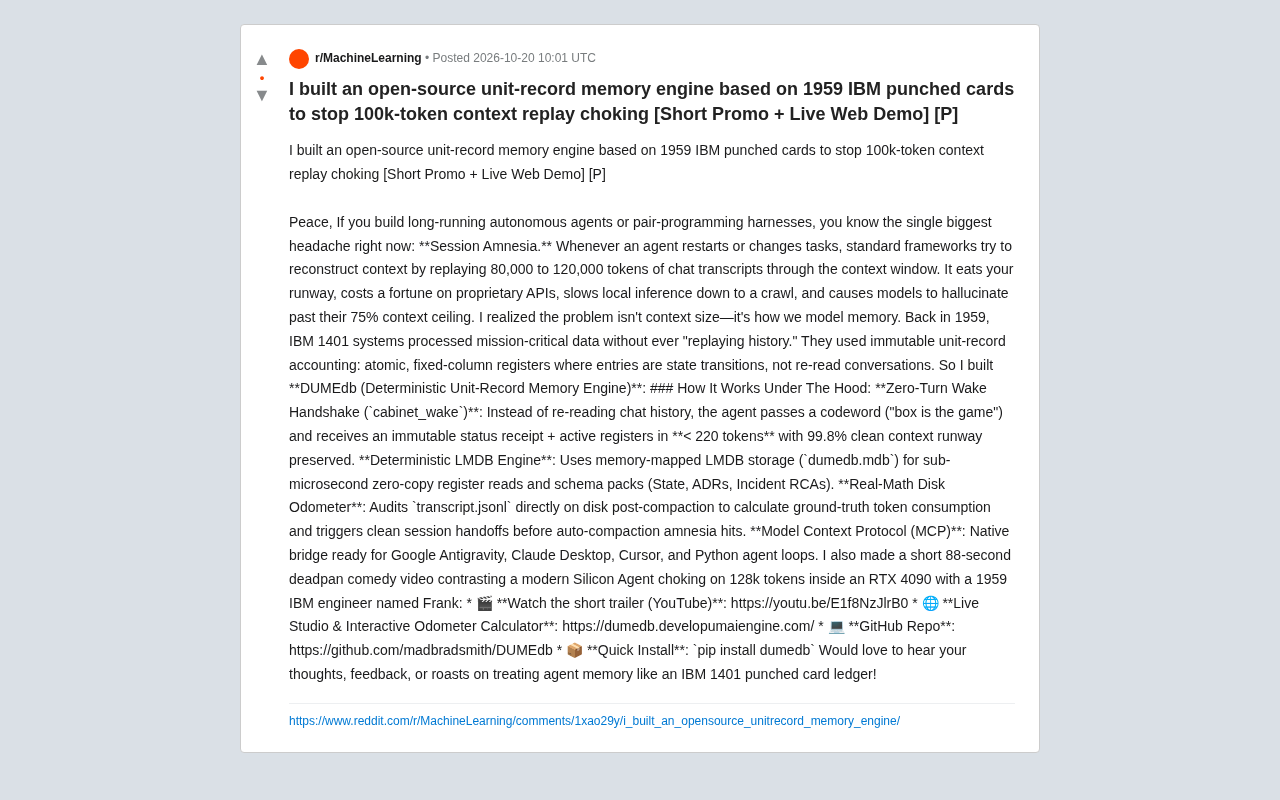
A developer shared his solution on Reddit: DUMEdb (Deterministic Unit-Record Memory Engine). Interestingly, this engine was inspired by the 1959 IBM 1401 punch card system—back in that era, mission-critical data processing never "replayed history," but instead relied on immutable unit-record accounting: atomic fixed-column registers that record state transitions rather than re-reading conversations.
Conversational amnesia is not a strict academic term, but rather a vivid description of a typical failure mode for long-running agents: when conversation history is truncated, compressed, or exceeds the model's context window, the agent loses previously accumulated task state, constraints, and confirmed facts—leading to repeated questions, self-contradictions, or fabricated details. The root cause is that mainstream agent frameworks equate "memory" with "full replay of chat logs," while the context window is a limited and expensive resource. The industry commonly uses "context rot" to describe a similar phenomenon: as input grows longer, the model's recall of mid-section information declines, and output quality noticeably degrades as the window approaches saturation. Therefore, how to preserve structured state rather than raw conversation within a limited window has become one of the core questions in long-running agent design.
DUMEdb's Core Mechanisms
Zero-Turn Wake Handshake (cabinet_wake)
Traditional methods re-read chat history, whereas DUMEdb requires the agent to pass a passphrase (e.g., "box is the game") and then receive an immutable state receipt and active register information. The entire process consumes less than 220 tokens while preserving 99.8% of the clean context runway. This means agents can recover precise state at extremely low overhead, avoiding information overload.
Deterministic LMDB Engine
The engine is built on memory-mapped LMDB storage (dumedb.mdb), achieving sub-microsecond zero-copy register reads and supporting schema packs (State, ADRs, Incident RCAs). This design ensures deterministic and high-speed state reads, suitable for latency-sensitive agent loops.
LMDB (Lightning Memory-Mapped Database) is an embedded key-value store organized as a B+ tree, originally developed by Symas for OpenLDAP. Its key feature is memory mapping: the database file is directly mapped into the process address space via mmap, so reads require no system calls or data copying—pointers directly reference the page cache, enabling microsecond or even sub-microsecond read latency. LMDB uses a single-writer, multi-reader MVCC concurrency model; read transactions are lock-free and see consistent snapshots, while write transactions commit serially, guaranteeing ACID semantics. Its data file format and byte order remain stable across platforms, making it suitable for local state storage scenarios that require determinism, auditability, and low latency—exactly why DUMEdb chose it as the underlying engine.
Real Math Disk Odometer
DUMEdb directly audits the on-disk transcript.jsonl file, computing real token consumption after compression, and triggers a clean session handoff before auto-compression causes amnesia. This is essentially installing an "odometer" on context usage, letting developers precisely track consumption.
Model Context Protocol (MCP) Support
The engine natively supports MCP bridging, seamlessly integrating with Google Antigravity, Claude Desktop, Cursor, and Python agent loops. This greatly lowers the integration barrier.
Model Context Protocol (MCP) is an open standard proposed and open-sourced by Anthropic in late 2024, designed to let LLM applications connect to external data sources and tools in a unified way. It uses a client-server architecture: host applications (such as Claude Desktop and Cursor) have built-in MCP clients, while external capabilities expose resources, prompt templates, and tools as MCP servers, communicating via JSON-RPC. MCP's value lies in transforming "a private integration for every tool" into reusable standard interfaces, allowing the same memory or data service to be called directly by different agent frontends. DUMEdb natively provides MCP bridging, meaning any MCP-compatible client can connect to it as a memory backend without needing separate adapters for each framework.
From Punch Cards to Modern Agents
The developer also produced an 88-second deadpan comedy video contrasting the modern silicon-based agent choking on 128k tokens on an RTX 4090 with the composure of 1959 IBM engineer Frank. Both the video and the online demo are now live:
- 🎬 YouTube short: https://youtu.be/E1f8NzJlrB0
- 🌐 Online studio and interactive calculator: https://dumedb.developumaiengine.com/
- 💻 GitHub repository: https://github.com/madbradsmith/DUMEdb
- 📦 Quick install:
pip install dumedb
IBM 1401 was a mid-range commercial computer launched in 1959 and one of the workhorses of early large-scale data processing, often paired with the IBM 1402 card reader/punch. Its data processing paradigm contrasts sharply with today's conversation replay: data was organized as fixed-format 80-column punch cards, each card being an atomic record. Jobs completed state transitions by reading records, updating accumulators or ledger registers, and outputting new cards—the system never "re-read the entire history" to recover state. This accounting-style design, centered on immutable unit records and deterministic state transitions, is precisely the conceptual prototype DUMEdb borrows from—modeling agent memory as a set of fixed-schema registers and state receipts rather than an infinitely growing conversation log.
Why It's Worth Watching
Current LLM context windows keep expanding, but simply increasing window size is no panacea. Replaying history is not only costly but also introduces noise and hallucinations. DUMEdb offers a lightweight, deterministic alternative by modeling memory as immutable state records. Especially for agent scenarios that need to run long-term and restart frequently, this approach may be more promising than simply stacking more context.
Of course, the solution is still in its early stages, and its actual effectiveness requires more testing and validation. But applying 1959 accounting concepts to AI memory management—this cross-era thought experiment alone is worth developers' attention.
(This article is based on a Reddit post; views are for reference only.)
One-line Summary
DUMEdb replaces hundred-thousand-token context replay with a sub-220-token wake handshake, giving agents deterministic memory.
Paragraph Summary
The article introduces DUMEdb (Deterministic Unit-Record Memory Engine), a memory engine shared by developer MadBradSmith on Reddit, targeting "conversational amnesia" in long-running agents: standard frameworks recover context by replaying 80,000 to 120,000 tokens of chat history, which is costly, slow, and prone to hallucination once the context window passes roughly 75% saturation. DUMEdb borrows the 1959 IBM 1401 punch card accounting concept, replacing history replay with immutable state records. Its core mechanisms include: the cabinet_wake zero-turn wake handshake, trading a passphrase for a state receipt while consuming under 220 tokens and preserving 99.8% clean context runway; a deterministic engine based on memory-mapped LMDB enabling sub-microsecond zero-copy reads; a disk odometer that audits transcript.jsonl and triggers a clean handoff before auto-compression causes amnesia; and native MCP support for integration with Claude Desktop, Cursor, and more. The author believes this approach may outperform simply expanding context windows for long-running, frequently restarting agents, but the solution is still early-stage and needs more validation.
Related articles

Chain of Thought Isn't Just for AI: How Humans Can Use CoT to Improve Thinking Quality
Chain of Thought isn't just a prompt trick for large models. Starting from a Hacker News discussion, this article analyzes why CoT works for human thinking too, breaks down actionable ways to transfer it, and highlights the key differences between human CoT and machine CoT.
Cloudflare Teams Up with OpenAI: Closi…
Cloudflare Teams Up with OpenAI: Closing the Loop from Vulnerability Discovery to Defense with AI
Cloudflare uses OpenAI Daybreak to investigate security vulnerabilities and generate reviewable remediation plans, while developers use Codex to boost coding efficiency and quality.

Orca Multi-Agent Orchestration in Practice: A Guide to Parallel Collaboration with Claude and Codex
Orca is Stable AI's free open-source agent workbench supporting 34 agents like Claude Code and Codex in parallel. Learn its Git worktree isolation, multi-model orchestration, and mobile management.