Reversed IRT Model: Cracking the Sparse Data Problem in Cancer Drug Response Analysis

IRT from educational testing is reversed to rank cancer drug resistance robustly under sparse, fragmented data.
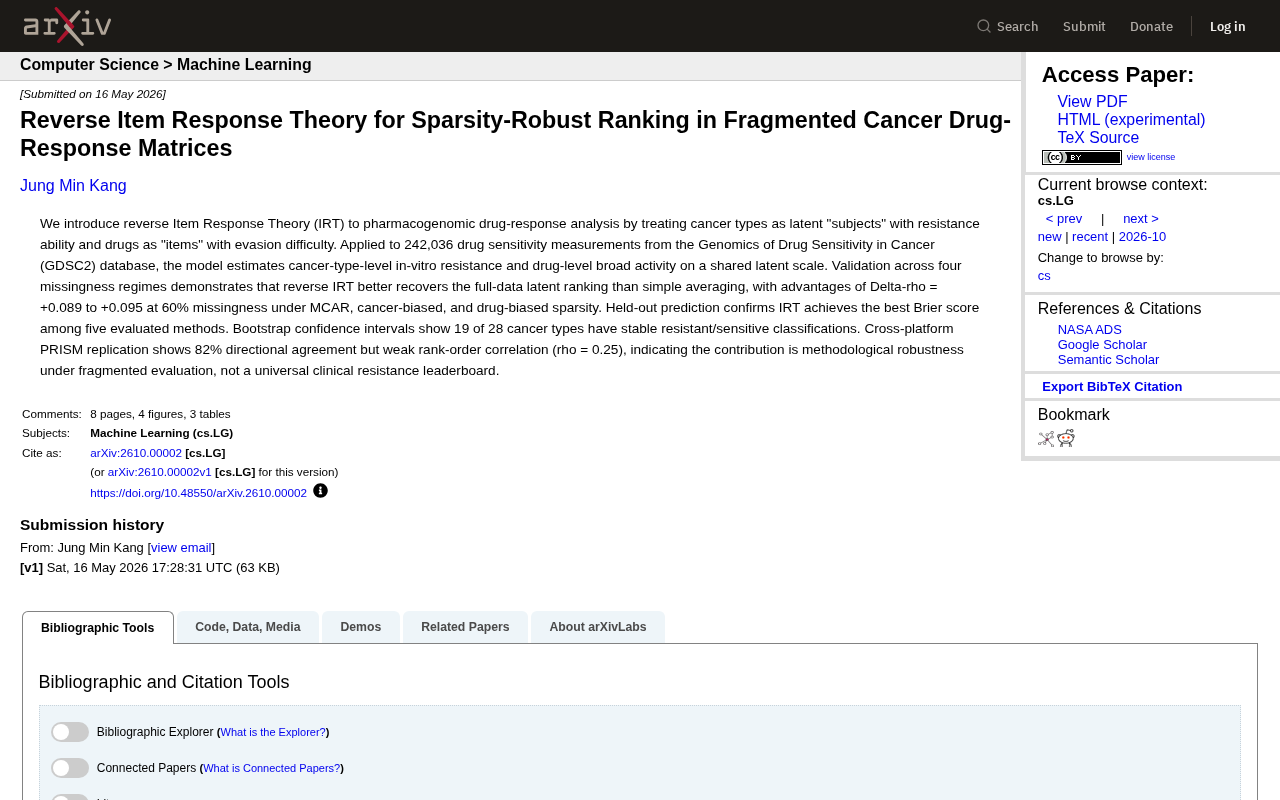
This arXiv study creatively applies Item Response Theory (IRT) — a classic psychometric model — in reverse to cancer drug sensitivity analysis: cancer types serve as "test-takers" (resistance ability) and drugs as "items" (evasion difficulty), mapped onto a shared latent scale for comparable ranking. Using over 242,000 GDSC2 measurements, the study shows that at 60% missingness, reversed IRT improves ranking recovery by Delta-rho ~0.09 over simple averaging, achieves the best Brier score among five methods, and yields stable classifications for 19 of 28 cancer types. Cross-platform PRISM replication shows 82% directional consistency but only rho = 0.25 rank correlation, leading the authors to position the contribution as methodological robustness under fragmented assessment — not a universal clinical resistance ranking.
When Cancer Drug Screening Meets Missing Data
Cancer drug sensitivity databases are a cornerstone of precision medicine, but they face a persistent challenge: highly sparse, fragmented matrices. Measurement coverage varies widely across different cancer type–drug combinations, and massive amounts of missing data cause traditional ranking methods (such as simple averaging) to produce distorted results when missingness is severe.
A newly published arXiv preprint (arXiv:2610.00002) proposes an elegant solution — applying Item Response Theory (IRT), a model from psychometrics, in reverse to pharmacogenomics analysis, with the goal of improving ranking robustness under fragmented data conditions.
Treating Cancer Types as "Test-Takers" and Drugs as "Test Questions"
IRT was originally developed as a classic model in educational assessment, used to estimate a test-taker's latent ability (e.g., proficiency level) and item difficulty based on response patterns. This study makes an intriguing role swap:
- Cancer types are treated as latent "subjects," with a corresponding parameter representing their "resistance ability";
- Drugs are treated as "items," with a corresponding parameter representing their "evasion difficulty" — i.e., a drug's broad-spectrum activity.
With this framing, the model maps in vitro drug resistance at the cancer type level and drug activity at the drug level onto a shared latent scale, enabling comparable rankings. The value of this "reversed" approach lies in its natural suitability for handling incomplete, sparse observation matrices — just as IRT can still estimate ability and difficulty even when test-takers haven't answered every question.
Item Response Theory (IRT) originated in educational psychology in the 1950s and was systematically developed by Frederic Lord and others. Its core idea is that observed response outcomes (correct/incorrect) are driven by an underlying latent ability dimension that cannot be measured directly; the "difficulty" and "discrimination" of each item determine the probability that a test-taker of a given ability level answers it correctly. The most widely used Rasch model (1-parameter IRT) assumes that the probability of a correct response depends only on the difference between the test-taker's ability and the item difficulty, expressed as a logistic function: P(correct) = 1 / (1 + exp(-(θ - b))), where θ is the test-taker's ability and b is the item difficulty. IRT's key advantage is parameter invariance: as long as model fit is adequate, estimates of a test-taker's ability do not depend on which specific items they answered, and estimates of item difficulty do not depend on which specific test-takers were assessed — this is precisely why IRT is mathematically well-suited to sparse matrices. In this study's analogy, "answering correctly" corresponds to a cancer type showing sensitivity to a drug, while the latent scale simultaneously encodes a cancer type's resistance tendency and a drug's broad-spectrum activity.
Large-Scale Validation: Clear Advantages Under Sparse Conditions
The study used 242,036 drug sensitivity measurements from the GDSC2 (Genomics of Drug Sensitivity in Cancer) database for modeling and validation, encompassing robustness tests across multiple missingness mechanisms.
Four missing data scenarios were designed for comparison, including missing completely at random (MCAR), cancer type–biased missingness, and drug-biased missingness. Key findings include:
- Under a 60% missing rate, reversed IRT showed a clear advantage over simple averaging in recovering the latent ranking of complete data, with Delta-rho improvements of +0.089 to +0.095;
- In held-out prediction tasks, IRT achieved the best Brier score among the five methods evaluated, indicating superior probability calibration;
- Bootstrap confidence interval analysis showed that 19 out of 28 cancer types had stable resistant/sensitive classifications.
These results collectively point to a core conclusion: when assessment data is fragmented and heavily incomplete, reversed IRT more faithfully recovers the true underlying structure of the data than traditional averaging methods.
GDSC2 (Genomics of Drug Sensitivity in Cancer, version 2) is a large-scale public database jointly maintained by the Wellcome Sanger Institute and Massachusetts General Hospital, recording in vitro drug sensitivity metrics such as IC50 or area under the curve (AUC) for hundreds of human cancer cell lines against hundreds of candidate anticancer compounds. It is one of the standard benchmarks in pharmacogenomics research, but its matrix is inherently sparse — not all drugs have been tested on all cell lines, and coverage depth varies substantially across cancer types. The Brier score is a classic metric for evaluating probabilistic prediction quality, defined as the mean squared difference between predicted probabilities and actual binary outcomes, ranging from 0 to 1 (lower is better). It penalizes both overconfident wrong predictions and poorly calibrated ambiguous ones, making it a more informative measure of a probabilistic model's practical utility than simple accuracy.
Cross-Platform Replication Reveals the Limits of the Method
One of the most instructive aspects of this study is its self-critical examination. The authors attempted cross-platform replication using PRISM, an independent data platform, and the results were two-sided:
- Directional consistency was 82% — i.e., the broad classification of resistant vs. sensitive remained consistent between the two platforms;
- But rank correlation was weak (rho = 0.25), meaning the specific ordering of cancer types was not stable across platforms.
Based on this, the authors offer an honest positioning: the contribution of this work lies in methodological robustness under fragmented assessment conditions, not in providing a universally applicable "clinical drug resistance leaderboard." This measured conclusion actually strengthens the study's credibility — it avoids overclaiming clinical value and instead precisely delineates the method's applicable scope.
PRISM (Profiling Relative Inhibition Simultaneously in Mixtures) is a high-throughput drug screening platform developed at the Broad Institute. It uses barcoded cell lines mixed together in culture, simultaneously measuring the response of multiple cell lines to the same drug, dramatically reducing the cost of large-scale screening. Unlike GDSC2's IC50 measurements based on single cell line cultures, PRISM uses a different readout system, experimental conditions, and data processing pipeline, so the absolute values from the two platforms are not directly comparable by design. Platform-to-platform discrepancies in pharmacogenomics are well-documented — multiple studies have found that major databases such as CCLE and GDSC show lower-than-expected correlations in measurements for the same cell lines and drug combinations. The coexistence of 82% directional consistency and rho = 0.25 rank correlation observed in this study aligns with known cross-platform reproducibility limitations in the field, suggesting that evaluations of methodological robustness themselves need to be interpreted within a multi-platform consensus framework.
Implications for AI Method Transfer
The significance of this research extends beyond pharmacogenomics. It presents a compelling case study in how mature statistical models from established fields can be transplanted to new problems with similar data structures through role reconceptualization.
IRT's core strength — estimating latent parameters under partial observation — maps naturally onto the pervasive sparsity challenge in biomedical data. For teams working at the intersection of AI and life sciences, this offers a transferable lesson: when faced with experimental matrices with severe missingness, probabilistic frameworks with latent variable modeling capacity are worth considering over simple statistical summaries.
That said, the weak cross-platform rank correlation is a timely reminder that methodological robustness and the generalizability of conclusions are two different things. Before deploying such models in real clinical decision-making, more cross-source consistency validation remains necessary.
Related articles

Gaussian Process Bandit Optimization: Exploration Strategies and Inference Regret Guarantees
Cumulative regret guarantees in Bayesian optimization fail to reflect final recommendation quality. This article examines a new study that provides inference regret guarantees for Gaussian process bandit optimization through exploration query strategies and fill distance analysis, validated on hyperparameter optimization and control tasks.

The Most Detailed Codex Guide on Bilibili: From Installation to Real-World Practice
The most detailed Codex guide on Bilibili: from app store installation to daily work mode configuration, with a real coffee shop project demonstrating file organization, data extraction, dashboard creation, and other practical tasks. Learn to use Plan Mode and desktop pets to leverage Codex efficiently.

Appearance Compensation in Volume Rendering: Why RGB Accuracy Cannot Guarantee Density Correctness
Volume rendering research reveals that volumetric data perfectly reproducing external RGB views may still contain density errors: appearance compensation can double central density and keep external rays unchanged even when L2 error exceeds 14.52%. Density recovery depends on appearance capacity, spatial resolution, and measurement design.