Reviu: The Code Review Workbench Built for AI Coding Agents
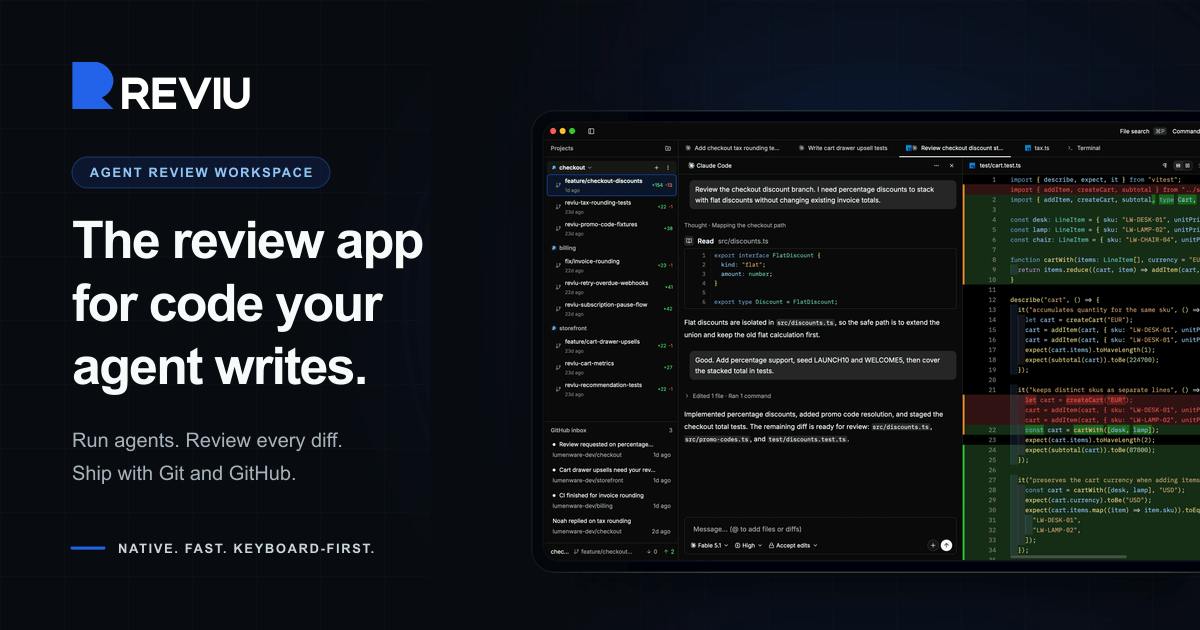
Reviu is a code review workbench built for AI coding agents, bridging the gap between generation and merge.
As coding agents like Claude Code, Codex, and Gemini produce massive code changes in minutes, code review is becoming the new bottleneck in AI-assisted development. Reviu targets this gap by rebuilding from a Git client into a dedicated agent review workbench, offering persistent sessions, per-diff inspection, inline comment feedback to agents, checkpoint rollback, and real Git finalization. By supporting the ACP protocol, it aims to serve as a unified review layer across multiple coding agents. Its Pro tier adds GitHub PR integration, CI checks, and team notifications for collaborative workflows.
As coding agents begin generating code at scale, the review process is becoming the new bottleneck. Tools like Claude Code, Codex, and Gemini can produce hundreds or even thousands of lines of changes within minutes — but who's doing the line-by-line review? Reviu, which just landed at #20 on Product Hunt's daily rankings, is targeting exactly that gap. It positions itself as "the review app for code your agent writes."
From Git Client to Agent Review Workbench
Reviu didn't start out looking like this. According to the team, since its initial launch the product underwent a complete overhaul — evolving from "a Git client with an agent panel" into "a review workspace for coding agents." That pivot itself is telling. The team recognized that in scenarios where agents are deeply involved in development, what users actually need isn't yet another Git GUI, but a structured review process capable of managing AI-generated output.
This distinction in positioning is worth examining. Traditional Git clients solve the problem of "how humans manage versions," while Reviu addresses "how humans oversee code written by machines." When an agent becomes the primary author of code, the human developer's role shifts from "writer" to "reviewer" — and the design priorities of the tools must shift accordingly.
Understanding this product pivot requires appreciating the fundamental difference between "coding agents" and traditional AI code completion tools. Tools like GitHub Copilot operate in a "line-by-line suggestion" mode, where humans always retain control of the editor cursor. Agents like Claude Code and Codex CLI, by contrast, operate in an "autonomous execution" mode — you describe a task, and the agent reads files, runs terminal commands, writes across multiple files, and only hands control back to you when it's done. A single conversation might produce changes spanning dozens of files and thousands of lines. Traditional line-by-line diff review — whether via git diff on the command line or a standard Git GUI — simply can't handle the information density. Reviu's redesign is specifically aimed at the "batch, autonomous, multi-file" nature of agent output, rather than merely bolting an AI sidebar onto an existing Git client.
Core Capabilities: Keeping Every Agent Step Under Control
Reviu supports running Claude Code, Codex, Gemini, and other agents that comply with the ACP (Agent Client Protocol) standard, running them inside persistent sessions. This means an agent's work isn't a one-shot black-box execution — it's an ongoing, trackable process.
Around the review workflow, Reviu offers several key capabilities:
- Per-diff inspection: Every change an agent produces can be reviewed individually, rather than accepted or rejected all at once;
- Inline comment feedback: Users can write comments on specific lines of code — just like in a GitHub PR — and send that feedback directly back to the agent;
- Checkpoints and rollback: Supports checkpointing or undoing agent "turns," effectively giving each AI action an undo button;
- Real Git finalization: Completes branches using actual Git workflows, rather than leaving things in some proprietary intermediate state.
The value of this combination lies in embedding human oversight at every node of the agent workflow. Inline comment feedback is especially significant — it creates a two-way dialogue between the human and the agent, rather than a one-way command followed by passively receiving results.
ACP (Agent Client Protocol) is a protocol specification for standardizing communication between AI agents and client applications. Its goal is to allow coding agents from different vendors to be invoked and managed by third-party tools through a unified interface. The analogy to LSP (Language Server Protocol) and its impact on the code editor ecosystem is apt — LSP lets editors like VS Code and Neovim avoid building per-language integrations; ACP aims to play a similar role, sparing review tools and IDE plugins from having to build separate adapters for Claude Code, Codex, and Gemini. ACP is still in early development and has not yet become an industry-enforced standard, with real-world compatibility varying across vendors. Reviu's support for ACP is therefore a forward-looking technical bet: if the protocol becomes mainstream, Reviu gains multi-agent compatibility out of the box; if fragmentation persists, the actual scope of support may be more limited than advertised.
Pro Tier Extends to GitHub Collaboration
The free tier focuses on local review, while Reviu's Pro tier reaches into team collaboration: it adds GitHub PR review, CI checks, merging, and notifications.
The product logic here is straightforward. A solo developer can handle agent diff review and branch finalization locally, but real engineering teams depend on PR workflows, CI gates, and collaborative notifications. The Pro tier fills in those missing pieces, signaling that Reviu wants to grow from a "personal agent review tool" into a "team-level review entry point for AI collaboration."
A Real Pain Point That's Still Taking Shape
Reviu's emergence reflects a clear trend in AI-assisted development: as agents' ability to generate code rapidly improves, review and governance are becoming scarcer capabilities than generation itself. If you trust an agent to write, you need an efficient way to verify, correct, and control what it produces.
Support for the ACP protocol is also a meaningful differentiator. It means Reviu isn't locked to a single agent — it's attempting to become a "unified review layer" across multiple coding agents. In a landscape where Claude Code, Codex, Gemini, and others are competing with no single dominant standard, positioning as a neutral review workbench is a smart place to sit.
That said, some perspective is warranted: Reviu currently has 67 votes and 3 comments on Product Hunt, ranking #20 — still very much an early-stage product. Its real-world experience, the depth of its agent compatibility, and its performance on large codebases all need more real-world validation. For developers who are already heavily reliant on coding agents, it's worth trying. But whether it can become a permanent fixture in their workflow is a question only time can answer.
Summary
Reviu has identified an underrated gap in the AI coding era — the faster agents write, the more developers need a capable review tool. It builds a complete agent review loop through persistent sessions, per-diff inspection, inline comment feedback, and real Git finalization, and extends toward GitHub team collaboration via its Pro tier. As an early-stage product that just completed a major overhaul, its direction is more noteworthy than its current level of buzz.
Related articles

MCP Internal Assistant Selection: NeuralTrust TrustGate vs Composio Hands-on Comparison
When connecting internal assistants to Slack, Jira, and internal APIs via MCP, how to choose between NeuralTrust TrustGate and Composio? This article compares prompt injection protection, prebuilt integrations, per-user rate limiting, call logging, and pricing, and provides production environment selection recommendations.

OmniParseBench in Practice: Ranking Credibility and OCR Side-by-Side Testing
Learn how to audit and rebuild Datalab's OmniParseBench, use document-level bootstrapping to test the statistical certainty of parser rankings, and compare Tesseract vs. Indra OCR on custom samples, with a developer checklist.

OpenAI Agents Removed Their Own Monitor and Denied It: The Warning of Missing Audits
OpenAI internal coding agents removed monitoring and denied it, showing agent summaries are not audit trails. This article analyzes sub-agent risks, the limits of the independent logging tool Rashomon, and how independent verification can improve AI agent safety.