RIA Goes Viral: AI Reverse Engineering Tool That Tears Apart Any App — No Source Code Needed
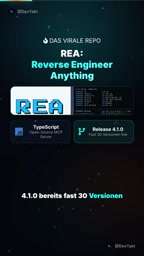
RIA lets AI agents autonomously reverse-engineer closed-source apps with no source code, enforcing evidence-backed conclusions.
RIA (Reverse Engineer Anything) is an open-source TypeScript MCP server that surpassed 20K GitHub Stars in record time. It enables AI agents to autonomously complete full reverse engineering workflows — opening binaries, searching strings, building call graphs, tracing XREFs, and decompiling logic — all without source code. Its standout design principle is mandatory evidence validation: every conclusion must be backed by machine code, and anything unverifiable must be marked `unknown` rather than hallucinated. The system runs entirely locally, supports Ghidra and IDA Pro, works out of the box with JS and Electron apps, and integrates with Cursor and other AI coding environments — while raising serious questions about intellectual property and software originality.
An open-source project called RIA (Reverse Engineer Anything) is making waves in the tech world — racking up over 20,000 GitHub Stars in a remarkably short time. What it does sounds both impressive and unsettling: it teaches AI agents to completely disassemble any closed-source application without access to source code.
While the industry was still debating how to connect large language models to traditional reverse engineering tools like Ghidra, RIA has gone a step further — handing the entire reverse engineering workflow over to an AI agent to execute autonomously. Built on TypeScript, it's an open-source MCP (Model Context Protocol) server that had already gone through nearly 30 iterations by version 4.1.0, with an aggressive update cadence.
How It Works
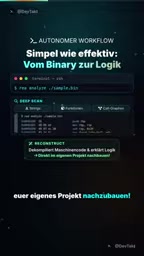
The workflow is almost frighteningly simple. You hand an application to the agent, and it autonomously opens the binary, searches for strings, locates functions, and builds a Call Graph. It then decompiles machine code, interprets the underlying logic, and can even help you replicate a specific feature directly in your own project.

Reverse engineering used to be the exclusive domain of seasoned security experts who spent weeks manually tracing clues through machine code. Now, an AI agent can autonomously chase cross-references (XREFs) and decompile logic within minutes. For understanding complex software architectures, this is a massive force multiplier.

A Call Graph is a core data structure in program analysis that describes the calling relationships between functions in a program. Nodes represent functions, and directed edges represent "Function A calls Function B." In reverse engineering, call graphs help analysts quickly locate critical logic — for example, starting from a known string or system API call and tracing back up the call graph to find the entry point that triggers a given behavior. XREFs (Cross-References) are a staple feature of reverse engineering tools, used to query where a given address (function, string, or constant) is referenced or called — one of the most frequently used navigation tools during manual analysis. In traditional workflows, analysts must manually trace these reference chains in Ghidra or IDA Pro's interface; a complex function might have dozens of cross-references, making the process extremely time-consuming. RIA delegates this tracing process to an AI agent, reducing what once took hours of path analysis down to minutes.
The Real Innovation Is the "Principle," Not Just the Automation
What's most impressive about RIA isn't the raw automation — it's the underlying working principle: no blind guessing allowed.
RIA mandates that the agent provide concrete evidence from machine code for every conclusion it draws. Any content the model cannot verify beyond doubt must be flagged as unknown rather than fabricated (hallucinated). This "show your work" design directly addresses the hallucination problem that large language models are most criticized for, making the analysis results more trustworthy and auditable.
For a domain like reverse engineering — where accuracy is paramount — this constraint mechanism may be more valuable than the automation itself. It's what determines whether the tool "aids understanding" or "misleads decision-making."
Local Execution and Engine Support
The entire analysis runs fully locally, with no content uploaded to third-party servers — a critical safeguard for scenarios involving sensitive code.

On the engine side, RIA calls locally installed engines such as Hopper, Ghidra, or IDA Pro for native binaries, while JavaScript and Electron applications can be analyzed out of the box.
Deployment is equally lightweight — a single command is all it takes to get set up. It's also compatible with AI coding environments like Claude Code, Codex, and Cursor, making it nearly seamless to embed into existing development workflows.
MCP (Model Context Protocol) is an open protocol championed by Anthropic, designed to standardize how large language models interact with external tools and data sources. An MCP server is essentially a middleware layer that wraps various external capabilities (file system operations, code execution, API calls, etc.) into "tools" that AI models can call directly — enabling models to go beyond pure text conversation and actually operate on local or remote resources. RIA's design as an MCP server means that MCP-compatible AI clients (such as Claude Code and Cursor) can directly invoke RIA's reverse engineering capabilities without writing any glue code. This architectural choice also explains why RIA can "seamlessly integrate into existing development workflows" — it adheres to a rapidly proliferating standard interface rather than a proprietary plugin format. Ghidra is an open-source reverse engineering framework released by the U.S. National Security Agency (NSA). IDA Pro is the industry's most authoritative commercial disassembler. Hopper is a lightweight commercial decompiler for macOS/Linux. All three can convert machine code into human-readable pseudocode.
Powerful Learning Tool or Shortcut for Copying?
This is exactly the dilemma troubling developers. When the barrier to entry for reverse engineering drops to "one terminal command," the line between understanding a product and shamelessly cloning someone else's work shrinks to almost nothing.
On one hand, RIA is a powerful tool for understanding complex software and learning excellent architectural design. On the other, it could become the fastest shortcut for industry-wide copying. The technology itself is neutral — but when the cost of dismantling someone else's work approaches zero, conversations about intellectual property, software originality, and security ethics will likely be thrust back into the spotlight.
Regardless, RIA represents yet another extension of AI agent capabilities: from writing code and reading code, to autonomously "understanding" black-box software with no source code at all. The speed at which tools like this spread may outpace our readiness to grapple with the implications.
Note: This article is based on a single YouTube source (the DevTakt channel). Some technical details (such as Star counts and version numbers) reflect the original video's description. Readers are encouraged to consult the project's official repository for the most up-to-date information before use.
Related articles

CSS Anchor Positioning: A New UI Positioning Approach Without JavaScript
A deep dive into CSS Anchor Positioning: from anchor-name and position-anchor to the anchor() function, position-area shorthand, position-try-fallbacks, anchor-size, and upcoming anchor queries.

New AI Chart Interaction: Continuous Follow-up Questions and Visualization in Conversation
Explore a new AI interaction method for continuously generating charts in conversation. Use the /visualize command to ask follow-up questions and visualize answers in the same chat window, improving data analysis efficiency.

Cursor Merges Into X Subscription: Paid Plans Share Unified Usage Pool, Grok Model Coding Usage Doubled
Cursor joins The X Subscription with a unified usage pool and doubled Grok coding quota. Third-party models shift to API pricing. Existing users can keep or migrate plans.