Riemann Hypothesis Showdown on the Same Day: A 12-Year, 940-Page Human Proof vs. 17.37 Million Lines of AI Code in One Day
AI produces a verifiable Riemann Hypothesis proof in one day, while a 12-year human effort is found to have gaps—the rules of mathematical proof are being rewritten.
On November 20, Anthropic mathematician Levent Alpog claimed to have found a proof of the Riemann Hypothesis together with Claude and published formalized code; the same day, Stanford urgently released Alessandro Masullo's 940-page human proof *The Music of the Primes*, 12 years in the making and emphasizing no AI use. The next day, the Lean and MathLib communities confirmed the AI code passed verification, while the human proof was found by multiple AI models within about 8 hours to have gaps, including in the Chapter 12 memory formula. Academic reactions were divided: Maynard expressed 98%–99% confidence, Shing-Tung Yau said mathematics has entered a new era, and Grandville called the document "a mess." The article argues that the day's true significance is that "passing machine verification" is becoming a new benchmark for mathematical proofs, and mathematical research may enter a norm of "first the answer, then understanding."
A Math Showdown Forced by AI
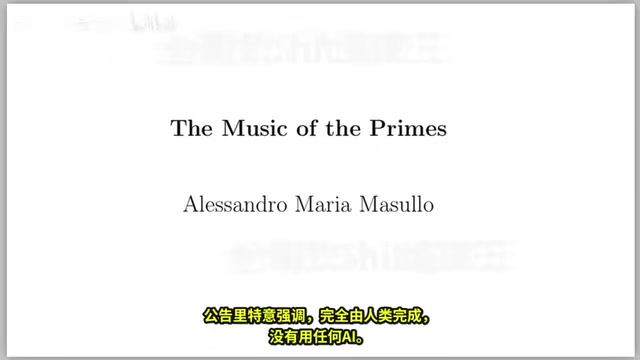
On November 20, the mathematics world experienced a day for the history books. Anthropic mathematician Levent Alpog released a mere four-page note whose first page boldly declared: "I believe Claude and I have found a proof of the Riemann Hypothesis." That same day, he published a full set of formalized code. According to a Bilibili video analysis, just hours later, Stanford urgently released another document—a 940-page paper titled The Music of the Primes. Its author, Alessandro Masullo, had devoted nearly 12 years to it, and the announcement emphasized that it was "completed entirely by humans, without any AI."
This was not a hasty draft. Originally, Masullo planned to polish it for another year before going public; the sudden appearance of the AI proof forced this human labor of love into the open ahead of schedule.
The Riemann Hypothesis is one of the most famous unsolved problems in the history of mathematics, proposed by Bernhard Riemann in 1859. Its core assertion is that all non-trivial zeros of the Riemann zeta function lie on the critical line with real part 1/2 in the complex plane. If proven, it would provide a precise characterization of the distribution of prime numbers and would implicate a large number of results in number theory. The conjecture is one of the seven "Millennium Prize Problems" of the Clay Mathematics Institute, with a one-million-dollar bounty, and has stood for over 160 years, defeating countless mathematicians. Precisely for this reason, any claim to have proven the Riemann Hypothesis triggers intense scrutiny and vigilance in the academic community—which explains why the simultaneous release of two "proofs" on the same day immediately became a focal point.
The Numbers: 12 Years vs. One Day
The juxtaposition of the two sets of numbers is visually striking. On the human side: 12 years, 940 pages, zero lines of AI code. On the AI side: one day, over 170,000 files, 17.37 million lines of Lean code. Converted to document pages, the AI output exceeds 250,000 pages.
According to cross-verification from multiple sources, this comparison has been confirmed in analyses on both Bilibili and YouTube. But the stark disparity in numbers does not directly translate into a verdict—the real watershed came the next day.

Lean is an interactive theorem prover and programming language initiated by Leonardo de Moura at Microsoft Research in 2013. Its companion mathematics library, MathLib, is maintained collaboratively by the global community, with the goal of formalizing virtually all of modern mathematics. In Lean, every piece of reasoning must be broken down into machine-checkable steps; the compiler checks the proof line by line, and any logical leap or undefined concept causes compilation to fail. Thus "passing Lean verification" means the proof has been fully confirmed at the level of formal logic, rather than judged solely by peer reading. This is precisely why the "17.37 million lines of Lean code" in this story carries weight—it represents a rigorous argumentation system that can be verified line by line by a machine.
Verification Results: AI Code Passes, Human Proof Found to Have Gaps
On November 21, the Lean and MathLib communities issued a joint statement confirming that Alpog's code had passed verification: the statement of the theorem was correct, the code compiled, the target had not been swapped, and it was not affected by kernel bugs.
The academic reaction was sharply divided. Fields Medalist Maynard said he was 98% to 99% confident; mathematician Shing-Tung Yau declared outright that "mathematics has entered a new era"; while Grandville of Montreal was more direct, calling the document Alpog published "a mess."

The situation for the 940-page human proof was more awkward. About 8 hours after its release, multiple AI models had already identified problems in it: the crucial memory formula in Chapter 12 was questioned as having gaps, and Chapter 13 had not even stated the main theorem. The author himself noted in the document that it was not yet complete.

Formal verification refers to translating a mathematical proof into a computer-checkable formal language, then using a proof assistant (such as Lean, Coq, or Isabelle) to verify step by step whether each piece of reasoning conforms to logical rules. Compared with traditional peer review, the advantage of formal verification is that it is objective, reproducible, and unaffected by reviewers' energy levels or subjective preferences, and it can eliminate hidden assumptions and issues such as "swapping the target." The cost is enormous effort: formalizing a theorem often requires several times to dozens of times more manpower than a paper proof. The "formalized mathematics" movement championed in recent years by Terence Tao and others is precisely attempting to lower this cost with the help of AI. The fact that the AI code in this story passed community verification quickly is a concentrated manifestation of this trend.
The Rules Have Changed: First the Answer, Then Understanding
The true significance of this day is not that humans lost to machines, but that the rules for evaluating mathematical proofs are being rewritten. In the past, peer review relied on the reading and judgment of human experts; today, "can it pass machine verification" is becoming a new line of judgment.
AI can produce vast amounts of formalized code in an extremely short time and subject it to automatic checking by community tools. The argumentation system that human mathematicians spent 12 years building exposed structural gaps under AI scrutiny. This does not mean human work has no value—on the contrary, it reveals the enormous potential of formal verification in mathematical research.
The tension between Maynard's 98% to 99% confidence and Grandville's "mess" assessment also shows that the academic community remains divided on the acceptance of AI-assisted proofs. But a consensus is forming: future mathematical proofs may no longer be judged by page count alone, but will use whether they pass formal verification as an important benchmark.
First the answer, then understanding—this phrase may become the norm for mathematical research in the AI era.
"First the answer, then understanding" describes a path opposite to that of traditional mathematical research. In the past, mathematicians typically built intuition and conceptual frameworks first, then gradually constructed rigorous proofs; with AI assistance, a model may first produce a formal proof that passes machine verification, and humans then work backward to interpret its reasoning and extract the new concepts and methods within. This model has sparked controversy in the mathematics community: on the one hand, it could greatly accelerate the speed at which conjectures are conquered; on the other hand, if a proof becomes so large that humans struggle to understand it, its "mathematical significance" and communicability are diminished. How to make machine-generated proofs both correct and digestible by humans is becoming a core issue in the methodology of mathematics in the AI era.
Related articles

VP ≠ VNP: A Major Breakthrough in Computational Complexity Theory
A study claiming to prove VP ≠ VNP over every field sparks heated discussion on Hacker News. This article analyzes the algebraic complexity background of VP and VNP, the proof approach, community controversy, and its potential impact on computational complexity theory.

Developer Naming Woes: The Technical Names That Drive Us Crazy
Why is technical naming so maddening? From Nginx and Vite to Qt and Sudo, a YouTube creator rants about the chaos of developer naming and pronunciation, revealing the tug-of-war between creators' intentions and community habits, and the cultural roots behind spelling traps like PyPI and GNOME.

Figma Workplace Scandal: Employee Sues CEO for Forcing Confrontation with Harasser
Figma and its CEO are sued by a current employee alleging sexual harassment and discrimination, and forcing the victim to confront her harasser. This article outlines the background, potential impact, and industry reflection.