Ring Indoor Drone Cam Hands-On: Six Years Late, Is $249 Worth It?
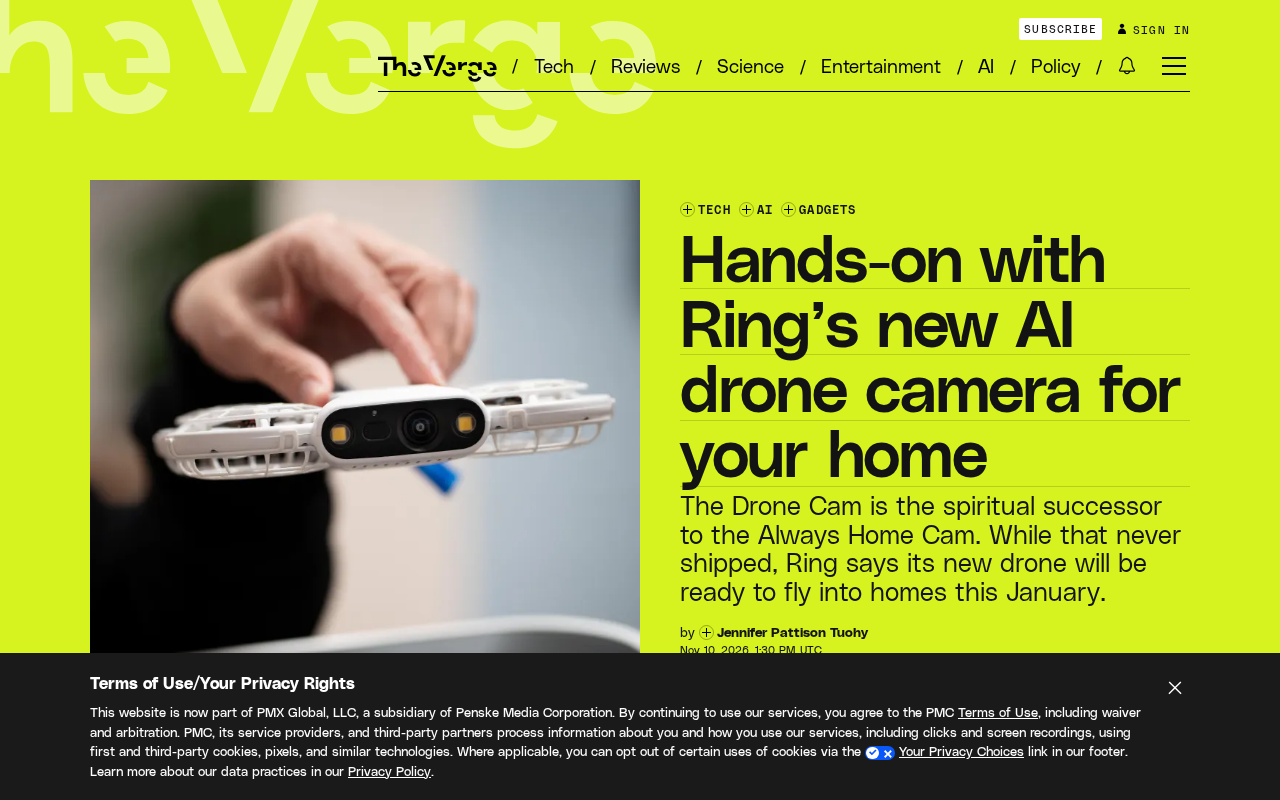
Ring's flying indoor camera, nearly six years late, is set to ship January 27, 2027, for $249.99.
Ring founder Jamie Siminoff announced at a New York event that the Ring Drone Cam, first unveiled six years ago, will ship January 27, 2027, priced at $249.99, in the mid-to-high range of Ring's lineup. Its core selling point is being an "AI drone camera": autonomous mobile patrols cover fixed-camera blind spots and use motion detection and person recognition to actively seek the best angle. The article notes that mobile recording blurs privacy boundaries more than fixed cameras, and Ring has not disclosed its local storage or privacy controls; beyond $249.99, subscriptions may be a long-term cost. Flight stability, noise control, and AI accuracy all await first hands-on reviews, and whether a six-years-late product can justify the premium remains unknown.
Ring is finally about to get that flying indoor camera into users' hands. At a New York launch event, Ring founder Jamie Siminoff announced that the Ring Drone Cam will ship on January 27, 2027, priced at $249.99. It has been nearly six years since the company first unveiled the concept.
After six years of delays, can it actually fly into the living room?
The January 27, 2027 date was given directly by Siminoff at the New York launch event. The $249.99 price sits in the mid-to-high range within Ring's existing product lineup—more expensive than a standard fixed camera, but far below a professional security system. The problem is that users have been waiting for this machine for far too long.
In the concept video six years ago, the drone camera could automatically take off at home, patrol, and follow unusual sounds. Whether the version actually shipping six years later still matches the originally promised feature list was not compared point by point at the event. Siminoff's statement was "this time it's real," but users who have been through delays will probably keep their guard up a little more.
From a product logic standpoint, Ring making a flying camera has its rationale: fixed cameras have blind spots, while an indoor drone can move along preset routes to cover different areas such as the kitchen, hallway, and kids' room. For users already deep in the Ring ecosystem, this is a missing piece of the puzzle. But a flying device entering the home also brings new problems—noise, battery life, collision risk, and how pets and children react to it.
An indoor flying camera must solve several engineering problems that are completely different from outdoor drones. First is localization: indoors there is usually no GPS signal, so the device must rely on indoor positioning solutions such as visual SLAM (simultaneous localization and mapping) or UWB to know where it is and which areas it has flown over, which directly determines whether preset patrol routes can be reproduced stably. Second is obstacle avoidance: home spaces are narrow and obstacles are random (furniture, hanging laundry, people walking around), requiring low-latency short-range sensors working with algorithms to avoid collisions. Third is the trade-off between battery life and noise—indoor models generally pursue small size and low-speed rotors, but to maintain hovering, small rotors must increase speed, and noise rises accordingly. These constraints together explain why a "flying indoor camera" often takes years to go from concept to mass production.
AI is the selling point—and an amplifier of privacy controversy
Ring positions this product as an "AI drone camera," with AI capability as the core narrative. Combined with Ring's investment in intelligent recognition in recent years, the flying camera will most likely feature motion detection, person recognition, and abnormal event push notifications. A camera that can fly means it can actively seek the best angle rather than passively waiting for events to happen within its field of view.
That is exactly where the controversy lies. For a device that can autonomously move around indoors and continuously record, its privacy boundaries are far blurrier than those of a fixed camera. Ring's cloud storage and sharing mechanisms have sparked discussion multiple times over the past few years, and the flying version will only make it harder to track "where it is now and what it has captured." The source material does not disclose specific local storage or privacy control plans; this part will need to be verified after the product officially launches.
In Ring's business model, subscription services (Ring Protect) are deeply tied to hardware: users must pay to get capabilities such as video history playback, event recording, and smart alerts. This model has special significance for a flying camera—fixed cameras trigger events locally, while a mobile device continuously generates changes in position and viewing angle, and both video data volume and event density may rise significantly, increasing the demand for higher cloud storage tiers. At the same time, regulatory requirements for such products are tightening in European and American markets; for example, face-matching features involving biometric identification require additional authorization in some jurisdictions, and indoor mobile recording may also touch local regulations on covert recording and audio capture. Therefore, in which regions and with what feature combinations the product ultimately launches often depends not only on technical maturity but also on the progress of compliance review.
What are you buying for $249?
Purely in terms of hardware, $249.99 for an indoor flying camera with AI is not an outrageous price. But Ring's business model has never been just about selling hardware; subscription services are the long-term source of revenue. A flying camera generating more video and more events will likely correspond to higher cloud storage requirements.
For ordinary households, the decision point is: does the home really have blind spots that fixed cameras cannot cover, and are they willing to accept a camera that moves around? For users with strong security needs, it offers active patrol capability; for privacy-sensitive users, it may be the last thing they should put in the bedroom.
It is worth noting that the $249.99 price point sits in a clear premium range in the home camera market. Mainstream fixed indoor cameras generally cost $30 to $80, and mid-to-high-end models with pan-tilt and AI recognition mostly cost $100 to $150. The Ring Drone Cam's pricing is closer to a mid-range security kit or a high-end smart doorbell, which means it needs to persuade users with the differentiated capability of "active patrol" rather than competing purely on image quality or price. On the other hand, a flying device is equipment with moving parts; rotors, motors, and batteries all involve wear and replacement, and long-term use costs include hardware maintenance, which is not reflected in the launch price. For users who already own a Ring doorbell or fixed camera, whether the new device can seamlessly integrate into the existing app and event system is also key to whether its value can be realized.
A product six years late—will the market still wait for it?
Over the past six years, the home camera market has become crowded, with image quality, AI recognition, and pricing of fixed products iterating rapidly. The Ring Drone Cam's differentiation lies in "it can fly," but whether this selling point can support the $249.99 premium depends on actual flight stability, noise control, and AI recognition accuracy—none of which can be fully verified at a launch event.
Siminoff says it really is shipping this time. For users who have waited six years, January 27 is a date worth marking; for those on the fence, the first batch of real hands-on reviews will be more convincing than any launch event. For a flying camera going from concept to living room, the final stretch is often the hardest.
In the consumer hardware industry, a six-year gap between concept announcement and official shipping is extremely rare. Usually, concept video to mass production takes 12 to 24 months, and anything over three years is seen as a high-risk signal, possibly due to supply chain, cost control, or core technology not reaching usable standards. Such a long cycle brings several consequences: the upgrade cycle of early followers is stretched out, competitors may have already covered the blind spots originally addressed by mobile devices with fixed multi-camera setups, and component costs and specifications have gone through several rounds of iteration over six years, so the final product may use a different hardware platform from the original concept. Therefore, the key to judging whether this product is worth waiting for is not the promises at the launch event, but the quantitative test results of the first third-party reviews on flight stability, actual battery life, and AI false-alarm rate.
One-line Summary
Ring's flying indoor camera, nearly six years behind schedule, is set to ship on January 27, 2027, priced at $249.99.
Paragraph Summary
At a New York launch event, Ring founder Jamie Siminoff announced that the Ring Drone Cam, first unveiled six years ago, will ship on January 27, 2027, priced at $249.99, in the mid-to-high range of Ring's product lineup. The product's core selling point is as an "AI drone camera": it covers blind spots of fixed cameras through autonomous mobile patrols and uses motion detection, person recognition, and other features to actively seek the best angle. The article notes that mobile recording makes privacy boundaries blurrier than with fixed cameras, and Ring has not yet disclosed its local storage and privacy control plans; beyond the $249.99 price, subscription services may constitute a long-term cost. In addition, flight stability, noise control, and AI recognition accuracy all need to be verified by the first real hands-on reviews, and whether a product six years late can justify the premium remains unknown.
Related articles

CIO SmartKobe EX05 Review: A MagSafe Power Bank with Built-in Cable and Stand
CIO SmartKobe EX05 power bank review: built-in detachable Type-C cable, folding rotating stand, Qi 2.2 magnetic 25W wireless charging with 7.5W safe mode, 10000mAh dual semi-solid-state cells, pass-through charging and three-device simultaneous power—ideal for multi-device users who hate cables.

Nobel Laureates' Daring Self-Experiments: Betting Their Bodies to Rewrite Medical History
The official Nobel Prize video chronicles five laureates' self-experiments: de Hevesy's radioactive leftovers, Forssmann's self-catheterization, Tu Youyou's first dose, and Marshall's H. pylori gamble—how betting their bodies rewrote medical history.

Anthropic CEO Rings Nasdaq Bell: Reaffirms AI Won't Be Accelerated by Commercial Pressure
Anthropic CEO Dario Amodei reaffirmed at the Nasdaq bell-ringing that regardless of commercial or political pressure, the company will hold firm to setting the pace of AI development. This article examines the background, industry pressures, and potential impact.