Ripple-65B: A US Open-Weight Dense Coding Model Takes On Terminal-Bench 2.1

Ripple-65B Preview claims US open-weight Terminal-Bench 2.1 SOTA with an Apache 2.0 dense architecture, but HN questions the evaluation transparency.
Ricursive released Ripple-65B Preview, an Apache 2.0-licensed 65B dense coding model claiming the best Terminal-Bench 2.1 score among US open-weight models. The Hacker News community raised three concerns: the SOTA scope excludes Chinese open-source models and closed-source APIs, raising comparability questions; the Preview version lacks reproducible evaluation configuration details; and the dense 65B model's inference cost is higher than MoE models of similar size, with no throughput data in the model card. The article argues that coding-assistant teams needing a commercially friendly license, terminal automation developers, and researchers wanting to reproduce the benchmark should prioritize testing; teams sensitive to inference cost or already tied to MoE models can deprioritize it. Benchmark scores should serve as a filter, not a conclusion, and must ultimately be validated on your own task set.
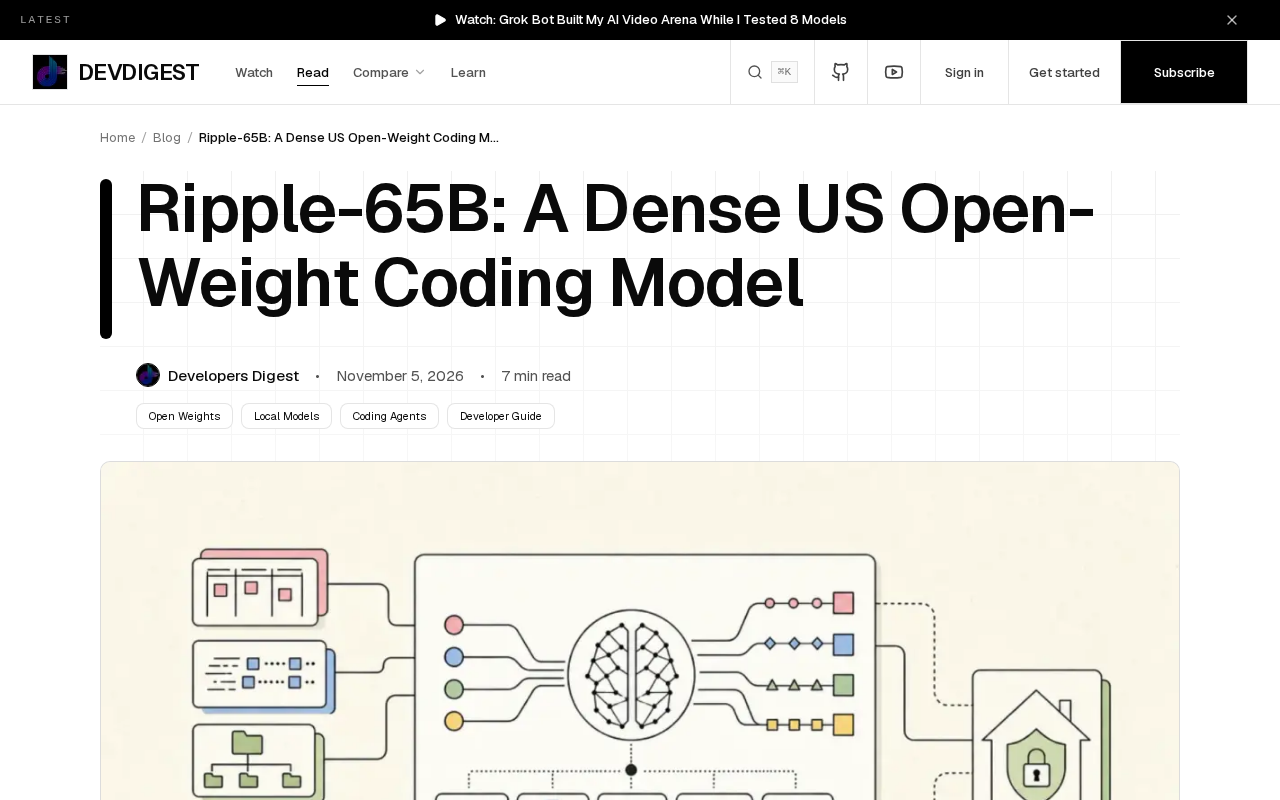
Ricursive has released Ripple-65B Preview, an Apache 2.0-licensed dense model that claims state-of-the-art (SOTA) performance on Terminal-Bench 2.1 among US open-weight models. The announcement quickly drew skepticism on Hacker News. This article breaks down what the model card actually claims, where the community pushback is focused, and which developers should consider testing it.
What Exactly Is Ripple-65B
Ripple-65B's core positioning is a "US open-weight" dense coding model. Dense means it does not use a MoE (Mixture of Experts) architecture — all parameters are activated on every inference. This contrasts with the sparse-model approach currently popular in the open-source community.
Ricursive chose the Apache 2.0 license, a clear signal of commercial friendliness: enterprises can freely use, modify, and distribute the model without worrying about license contamination. For teams that need to embed a coding model into their internal toolchain, this licensing condition reduces legal friction.
The "65B" in the model name refers to parameter scale, while "Preview" suggests this is not yet the final version. The core claim Ricursive makes in the model card is quite specific: within the scope of US open-weight models, Ripple-65B performs best on the Terminal-Bench 2.1 benchmark.
MoE (Mixture of Experts) is a sparse architecture: the model contains multiple "expert" subnetworks, and only a few of them are activated on each inference. So while the total parameter count may be large, far fewer parameters actually participate in computation, lowering inference cost. The trade-off is more complex training and deployment, plus potential expert load imbalance. In the open-source coding model space, the DeepSeekAd series and some versions of the Qwen series have adopted the MoE route. Ripple-65B goes the opposite way by choosing a dense architecture, meaning its inference behavior is more stable and predictable, but its VRAM footprint and per-inference compute are also higher.
How Far the Terminal-Bench 2.1 Result Can Be Interpreted
Terminal-Bench 2.1 is a benchmark that evaluates a model's ability to complete coding tasks in a terminal environment. It tests not single-turn code completion but multi-step command-line operations, file editing, and troubleshooting — much closer to real-world development scenarios.
Ripple-65B's claimed SOTA comes with a key qualifier: "US open-weight." This scope excludes open-source models released by Chinese teams as well as closed-source API models. In other words, this SOTA was achieved within a custom-defined arena.
The results in the model card need to be read in light of the benchmark itself. Terminal-Bench 2.1 results are influenced by prompt design, tool-call formats, retry strategies, and other factors, and the configurations used by different teams when submitting results are not necessarily identical. This is one of the starting points for the skepticism on HN.
Terminal-Bench is an agent-oriented benchmark for terminal environments. Tasks typically require the model to autonomously complete multi-step operations on the command line — for example, creating files, running scripts, debugging errors, and modifying configurations. During evaluation, the model executes commands through a tool-calling interface, and the benchmark determines success based on the final state or test cases. Scores on such benchmarks depend heavily on the agent framework: system prompts, tool descriptions, maximum step counts, and error-retry strategies can all significantly affect results. So even with the same model, results submitted by different teams can vary widely. When reading any Terminal-Bench score, you should first confirm whether the evaluation configuration is public and whether a unified agent scaffold was used.
Why Hacker News Pushed Back
The HN community's skepticism centers on several levels.
The first is benchmark comparability. Some commenters pointed out that the "US open-weight SOTA" label has fuzzy boundaries: if you're only comparing against a specific subset, the persuasiveness of SOTA is diminished. What the community wants to see is direct comparison data against more open-source models, not just a single-point result on a model card.
The second is the meaning of the Preview label. Some discussants argued that there may be a gap between the benchmark results of the Preview version and the final release, and that the model card does not sufficiently explain the evaluation configuration and reproducibility details.
The third is doubts about the practicality of a dense architecture. A 65B dense model has higher VRAM footprint and throughput cost at inference compared with MoE models of the same parameter count. Some developers wonder whether this performance advantage can offset the deployment cost in real-world coding-assistance scenarios.
These doubts do not amount to a rejection of the model itself; rather, they point to a more general issue: benchmark claims for open-source models need more transparent evaluation protocols.
Who Should Test Ripple-65B
The following types of teams are worth prioritizing for evaluating this model.
Coding-assistant teams that need a commercially friendly license. Apache 2.0 plus a dense architecture means a clear deployment path with no complex license-compliance review. If your product requires private deployment of a coding model, this is a viable option.
Developers working on terminal automation scenarios. The capabilities tested by Terminal-Bench 2.1 are highly relevant to CI/CD script generation, command-line tool orchestration, and repository-level file operations. If your workflow centers on these scenarios, Ripple-65B's benchmark performance is worth considering.
Researchers who want to verify the substance of the "US open-weight SOTA" claim. Reproducing the model card's evaluation configuration and comparing it under identical conditions against other open-source models you have on hand is the most direct way to judge whether the claim holds.
Conversely, if your scenario is mainly single-turn code completion, is sensitive to inference cost, or is already deeply tied to a particular MoE open-source model, then Ripple-65B can be given lower priority.
Apache 2.0 is a permissive open-source license that allows users to freely use, modify, and distribute software, including for commercial purposes, without requiring derivative works to adopt the same license. It includes explicit patent-grant clauses that reduce patent-litigation risk. Compared with copyleft licenses such as GPL, Apache 2.0 does not "contaminate" a company's own code, making it especially friendly for internal toolchain integration. For teams that need to embed a model into private products, Apache 2.0 means a shorter legal review path, though copyright notices and license files must still be retained.
The Trade-offs of the Dense Route
Ripple-65B's choice of a dense architecture is a noteworthy decision among today's open-source coding models. The advantage of dense models is more predictable inference behavior, no load-imbalance issues from expert routing, and relatively straightforward fine-tuning and quantization.
The cost is inference expense. A 65B dense model requires full parameter VRAM, and on the same hardware it can serve fewer concurrent requests than a sparse model with a smaller activated-parameter count. Ricursive did not provide throughput data in the model card, so testers need to evaluate this themselves.
This trade-off ultimately depends on the use case: if the quality improvement in coding tasks can cover the hardware cost, the dense route holds up; if the scenario has strict latency and concurrency requirements, a sparse model may be more suitable.
How to View This Release
Ripple-65B Preview is a release with clear claims: Apache 2.0, a dense architecture, and Terminal-Bench 2.1 SOTA within the scope of US open-weight models. Each of these three elements has real significance, but the combined claim needs more transparent evaluation data to support it.
The pushback on HN reminds us that benchmark claims for open-source models are entering a more demanding phase. The community is no longer satisfied with single-point results; it demands reproducible evaluation configurations, clear comparison scopes, and meaningful controlled experiments. For Ricursive, if the official version after the Preview can fill in these details, Ripple-65B's persuasiveness will be much stronger.
For developers, the most valuable action is not to argue about the SOTA label but to run it on your own task set. Benchmark scores are a filter, not a conclusion.
Related articles
 Tech Frontiers
Google Omni 1.2 Flash: 15-Second AI Video at Just $0.07 per Second
Google DeepMind releases Gemini Omni 1.2 Flash: 15-second video, 720p at $0.07/sec (30% cheaper), multi-turn editing without regeneration, draft upscaling to 4K.
 Tech Frontiers
No AI Ghostwriting: Writer's Quarter Reinvents Novel Writing with a Visual Workbench
The Writer's Quarter is an AI-free novel writing and planning tool that unifies character building, story planning, and manuscript writing in one visual workbench. This article analyzes its positioning, target users, and differentiated value amid the rise of AI writing tools.
 Tech Frontiers
Fleeep: A Unified Inspiration Collection Notes App for Creatives
Fleeep is a notes app for creatives that unifies screenshots, bookmarks, saved posts, and inspiration into one calm, cross-device, offline-capable space. This article analyzes its positioning, differentiation, and target users.