Ripple 65B Lands on Ollama: Million-Token Context Runs Locally with Zero Data Retention

RicursiveAI's Ripple 65B Preview lands on Ollama, focusing on local Agentic Coding and million-token context.
RicursiveAI's Ripple 65B Preview is now on Ollama, designed for Agentic Coding with up to 1M token context and local zero data retention. The article analyzes three key aspects: long-range planning and tool use for coding agents, privacy benefits for sensitive industries despite hardware hurdles, and the cost and recall trade-offs of long context. It notes that open-source competition is shifting toward distribution and deployment experience, with real value to be tested in actual workflows.
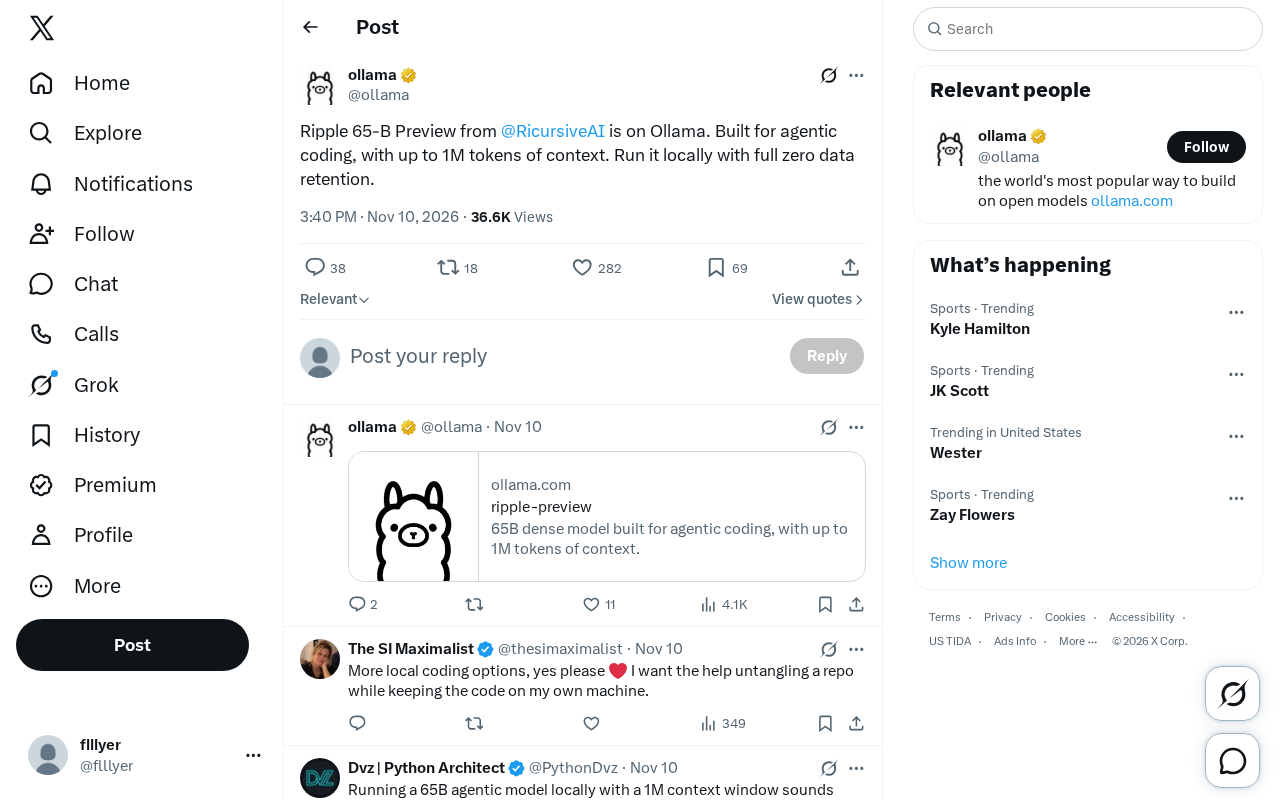
Ollama users now have a new option: RicursiveAI's Ripple 65B Preview model has officially been added to the Ollama model library. Designed specifically for Agentic Coding, this model supports a context window of up to 1 million tokens and can run locally with full zero data retention. For developers concerned with data privacy and long-context coding scenarios, this is a development worth noting.
Agentic Coding Becomes a New Anchor for Model Design
Ripple 65B Preview's positioning is very clear—Agentic Coding. This term has moved from academic papers into engineering practice over the past two years, pointing to a class of working patterns where models autonomously plan, invoke tools, and iteratively modify code. Unlike traditional code completion, Agentic Coding places higher demands on models: they need to maintain an understanding of project structure across multiple turns of interaction, remember previous decisions, and not lose sight of goals during long chains of tool calls.
Models at parameter scales like 13B and 65B have historically been limited by context length on coding tasks, making it difficult to carry information at the complete repository level. Ripple 65B Preview pushes the context ceiling to 1 million tokens, meaning the model can theoretically ingest large-scale codebases, multiple design documents, and lengthy conversation histories in one go. For coding agents that need cross-file reasoning, this is an expansion of capability boundaries.
Judging from RicursiveAI's naming and positioning, Ripple 65B Preview is clearly not a model for general chit-chat but aims at automation in developer workflows. This verticalization tendency is becoming increasingly common in recent open-source model releases; vendors no longer pursue "all-around" capabilities but instead concentrate resources on specific tasks to differentiate.
Agentic Coding differs fundamentally from traditional "code completion" in who controls the flow. Completion tools are driven step by step by humans, with the model only offering suggestions at the cursor; Agentic Coding hands a task goal to the model, which then decomposes steps itself, decides when to read files, run tests, modify code, and roll back and retry based on errors. This paradigm typically relies on several infrastructure elements: callable tool interfaces (file read/write, Shell, retrieval), context management that can carry state across multiple turns, and a self-correction loop after failures. The test for models shifts from "single-point generation quality" to "long-range consistency and instruction following," so context windows and structured output capabilities for tool calls often determine practical usability more than raw code benchmark scores.
Local Execution and Zero Data Retention: A Solution for Privacy-Sensitive Scenarios
A major feature of the Ollama platform is making local deployment simple. After pulling a model, users can run it on their own machines, with inference not passing through third-party servers. Ripple 65B Preview's listing on Ollama, combined with the "full zero data retention" statement, points to an emphasis on data sovereignty.
For enterprise development teams, code is one of the most core assets. Sending code snippets to cloud APIs always carries compliance and leakage concerns. Local execution means code never leaves the internal network and inference logs are not retained, which has practical appeal for industries sensitive to data flows such as finance, healthcare, and government/enterprise. Of course, a model at 65B parameter scale has considerable hardware requirements; ordinary consumer-grade GPUs struggle to run it smoothly, and actual deployment is more likely to occur on workstations or enterprise-grade servers.
Zero data retention has another layer of meaning: content from user-model interactions will not be used for training or analysis. Against the backdrop of increasingly strict data governance, this commitment is becoming a differentiating selling point for model distribution.
Zero data retention in the context of cloud APIs usually means the provider does not persistently store request and response content and does not use it for model training; in the context of local deployment, its meaning is more thorough—data never leaves the user's device, and whether to retain it is controlled by the user. Note that the two are not equivalent: cloud commitments rely on the provider's compliance audits and contractual constraints, while local execution turns the trust problem into a technical one. For developers, judging whether a model truly meets data sovereignty requirements also requires attention to details such as whether the inference framework writes logs by default, whether it reports telemetry data, and whether model weights require online verification after download.
Is a Million-Token Context a Capability or a Burden?
A 1-million-token context window sounds aggressive, but from an engineering perspective it needs to be viewed dialectically. Long context does not automatically equal long-context understanding. Industry research has shown that models' information recall in the middle of ultra-long inputs declines—the so-called "lost in the middle" phenomenon. Ripple 65B Preview claims to support this scale, but how it actually performs still needs to be verified by developers with real tasks.
On the other hand, the inference cost of long context grows linearly or even superlinearly. When all 1 million tokens are activated, VRAM usage and inference latency rise significantly. For local execution, this means hardware configuration and inference framework optimization become especially important. Ollama's quantized versions and memory management strategies will directly affect the user experience.
From a practical standpoint, a million-token context is better suited to "enable on demand" scenarios, such as analyzing a large repository in one pass or reviewing a long document set, rather than filling the window in every daily conversation. Developers need to weigh context length against response speed based on task type.
"Lost in the middle" refers to the phenomenon where, when processing ultra-long inputs, a model's recall accuracy for information located in the middle of the context is noticeably lower than for the beginning and end. This effect has been repeatedly observed in multiple long-context benchmarks. Its causes are related to the distribution characteristics of attention mechanisms over long sequences and the length distribution of training data. Therefore, claiming support for million-level tokens only means the model can accept such long inputs; it does not guarantee equally effective use of every segment. When evaluating long-context capabilities, the industry typically combines "needle-in-a-haystack" retrieval tests with tasks requiring cross-paragraph comprehensive reasoning—the former tests locating ability, the latter tests true understanding and integration.
Open-Source Model Competition Enters the Scenario-Specific Stage
The way Ripple 65B Preview is released—distributed through Ollama and emphasizing local execution and privacy—reflects a trend in the current open-source model ecosystem: distribution channels and deployment experience themselves become competitive advantages. As the capability gap between models narrows, whoever reaches developers faster and integrates better into existing toolchains is more likely to gain adoption.
Ollama, as one of the de facto standards for running local models, often drives a wave of trials when new models are added to its library. RicursiveAI's choice of this channel indicates that its target users are engineers already using local development tools, not callers of cloud APIs. This channel choice is itself a product positioning.
For developers, what is worth watching is not just scores on model leaderboards but stability in real Agentic Coding workflows: whether tool calls are reliable, whether consistency is maintained in long conversations, and how good error recovery is. These indicators are hard to read from release announcements and can only be tested through actual projects.
Ripple 65B Preview is still a Preview version, meaning there will be further adjustments. Developers interested in local deployment and long-context coding can pull it through Ollama to try it out, while keeping in mind hardware thresholds and the cost changes brought by long context.
Ollama is an open-source tool for running large models locally, encapsulating model download, quantized loading, and inference scheduling through a unified command line and API interface, with built-in compatibility support for multiple model formats. One of its key values is compressing the engineering barrier to "running a model" down to a single pull command, while providing a local service endpoint compatible with OpenAI-style interfaces so existing applications can switch directly. Quantization is its key means of lowering hardware thresholds—reducing VRAM usage by lowering weight precision, at the cost of possible precision loss. When model vendors choose to list on Ollama, they are effectively handing distribution, version management, and runtime optimization to the community ecosystem, thereby reaching developers already working in local toolchains faster.
One-line Summary
RicursiveAI's Ripple 65B Preview lands on Ollama, focusing on local Agentic Coding and million-token context.
Paragraph Summary
RicursiveAI's Ripple 65B Preview has been added to the Ollama model library, positioned for Agentic Coding scenarios, supporting a context window of up to 1 million tokens, and capable of running locally with zero data retention. The article analyzes the triple significance of this development: Agentic Coding requires models to have long-range planning and tool-calling capabilities, and million-token context makes repository-level code understanding possible; local deployment combined with a zero-retention commitment fits the needs of teams sensitive to code privacy in finance, healthcare, and government/enterprise, but the 65B scale still poses high hardware thresholds; long context is not free—ultra-long inputs suffer from information recall degradation and rising inference costs, so it should be enabled on demand. The article concludes that open-source model competition is shifting from单纯 score comparisons to distribution channels and deployment experience, and actual value still needs to be tested in real workflows.
Related articles

Abnormal Error Rate Spike in Claude Mythos 5.2 and Fable 5.2
Claude Mythos 5.2 and Claude Fable 5.2 show an abnormal spike in request error rates, marked as investigating on the official status page. This article covers the incident overview, practical impact on developers, and recommended responses.

ReAct Runtime Context Trimming: Why Claude Code Acts at 70%
A deep dive into ReAct runtime context trimming: why Claude Code compresses at ~70% usage, why tool calls dominate, why messages must be dropped in pairs, and why codebases don't need RAG.

AI Agent vs LLM: How Cursor and Claude Code Actually Work
An in-depth analysis of the essential difference between AI Agents and LLMs: LLMs generate code suggestions, while Agents modify files and run tests via tool calls. Using a Spring Boot bug fix as an example, it breaks down the workflows, permission control, and verification mechanisms of Cursor and Claude Code.