Rivian's Next Act: How AI Is Reshaping the Future of Mobility

TechCrunch Mobility focuses on Rivian's next act, noting AI is replacing electrification as the mobility industry's new competitive focal point.
The article interprets TechCrunch Mobility's attention to Rivian's "next act," noting this brief installment sends a clear signal: as the electrification narrative matures, AI is becoming the next competitive focal point of the mobility industry. Rivian's new phase means shifting from "building good cars" to "defining the mobility experience," with differentiation resting on software, intelligent driving, and in-vehicle AI experiences. AI's implementation in mobility spans intelligent driving perception and decision-making, natural cabin interaction, and fleet and charging network operations, while software-defined vehicles still face engineering challenges in OTA architecture, data closed loops, and compute redundancy. The article argues the industry's competitive dimension is shifting from production capacity and delivery volumes to AI-driven continuous evolution capability, and Rivian's next move has sample value.
TechCrunch Mobility recently turned its attention to Rivian's "next act," elevating AI's role in the future of mobility to an unprecedented level. Though brief, this installment sends a clear signal: as the electrification narrative matures, AI is becoming the next competitive focal point for the mobility industry.
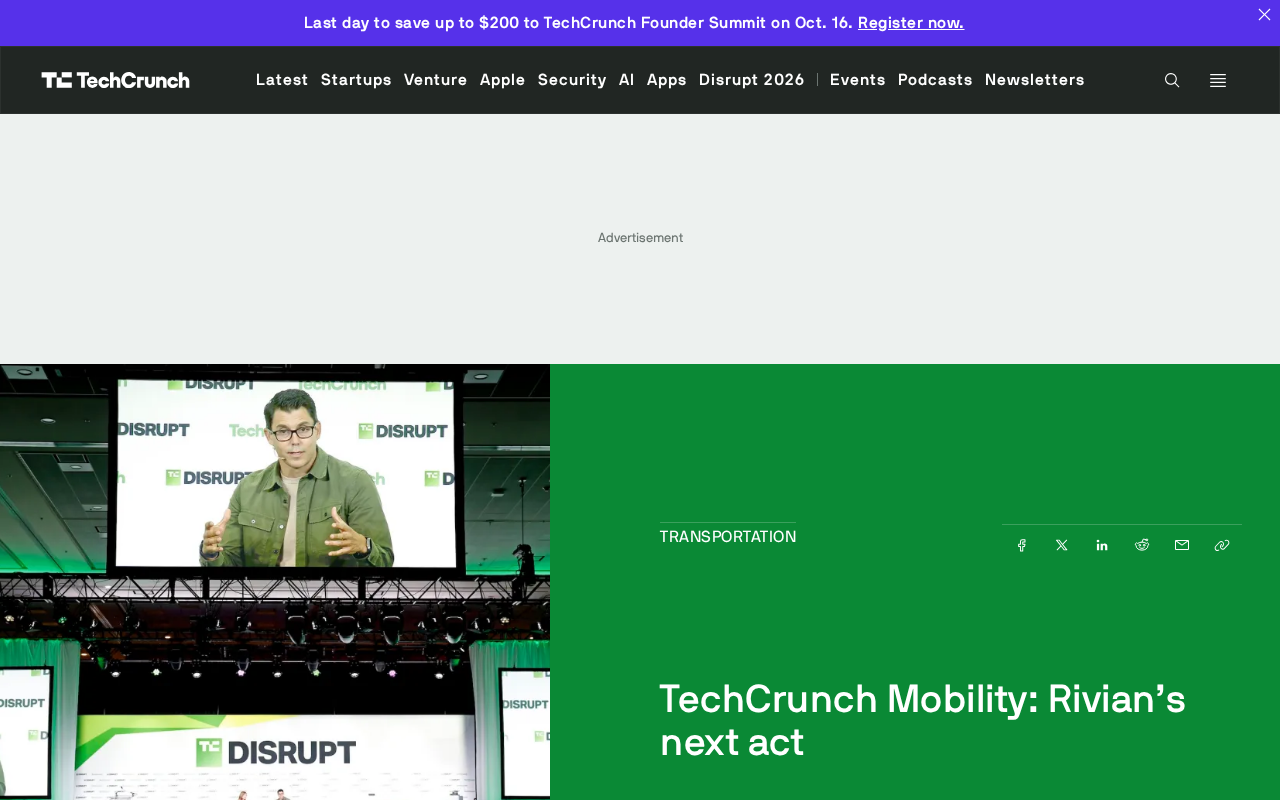
What Rivian's "Next Act" Means
Since its founding, Rivian has been regarded as one of the players with the strongest product capabilities in the electric pickup and SUV segment. TechCrunch Mobility uses "next act" to describe its new phase, hinting that the company is shifting from "building good cars" to "defining the mobility experience."
The backdrop to this shift is that electrification itself is no longer a scarce capability. As more and more manufacturers clear the threshold of electric powertrain systems, differentiation now rests on software, intelligent driving, and in-vehicle AI experiences. The question Rivian needs to answer is no longer just range and acceleration, but whether the vehicle can understand the driver and continuously evolve.
AI Is Becoming the Core of the Mobility Narrative
TechCrunch Mobility states at the outset that this column focuses not only on the future of transportation but also on the role AI plays within it—"more than ever before." The weight of this statement lies in the fact that it comes from a vertical column that has long tracked the mobility industry, not self-promotion from an AI media outlet.
From an industry logic perspective, AI's implementation in mobility manifests in at least three layers: perception and decision-making for intelligent driving, natural interaction within the cabin, and operational optimization of fleets and charging networks. For a company like Rivian that combines consumer products with commercial fleet business, none of these three lines is optional.
The Real Challenges of Software-Defined Vehicles
"Software-defined vehicles" have been discussed for many years, but few manufacturers truly push AI capabilities to users' vehicles on an ongoing basis. Behind this lies the comprehensive engineering challenge of OTA architecture, data closed loops, and compute redundancy. Whether Rivian's next act can stand firm depends largely on whether it can turn AI capabilities into an iterable product rhythm rather than a concept demo at a launch event.
OTA (Over-the-Air) architecture refers to the ability to push software updates to vehicles via wireless networks, covering remote upgrades from cabin entertainment to powertrain control and intelligent driving algorithms. It is an engineering challenge because the vehicle's electrical and electronic architecture must support zone management and secure rollback, and update packages must pass functional safety and cybersecurity validation to avoid failures in critical systems such as braking and steering during upgrades.
Data closed loop refers to the cycle in which vehicles collect real-world scenario data during driving, transmit it back to the cloud for model training, and then push the improved models back to the vehicle via OTA. Its difficulties lie in the bandwidth cost of data transmission, privacy compliance, and the efficiency of filtering high-value long-tail scenarios from massive amounts of data.
Compute redundancy refers to reserving compute power and sensor interfaces in the vehicle that exceed current software requirements, so that future software upgrades can support higher-level functions. Insufficient redundancy means the vehicle cannot carry new models two or three years after delivery, directly affecting the product's sustainable evolution capability.
Perception and decision-making for intelligent driving typically refers to vehicles building an environment model through sensor fusion of cameras, millimeter-wave radar, LiDAR, and other sensors, then completing object detection, trajectory prediction, and driving decisions through algorithms. The introduction of end-to-end large models in recent years has moved perception and planning from modular pipelines to unified networks, but it also brings new challenges in interpretability and safety validation.
Natural interaction within the cabin refers to in-cabin assistants based on voice, vision, and multimodal large models that can understand continuous dialogue, context, and user preferences, and connect with vehicle control functions. What distinguishes it from traditional voice commands is its proactivity and personalization.
Operational optimization of fleets and charging networks refers to using AI for charging pile scheduling, energy consumption forecasting, vehicle maintenance alerts, and route planning, which directly affects the unit operating cost of commercial fleets. For companies operating both consumer products and fleet businesses, these three lines together form the implementation matrix of AI capabilities.
The Competitive Dimension of the Mobility Industry Is Shifting
If Rivian is placed back in the context of the entire mobility industry, it becomes clear that the competitive focus is shifting. In recent years, capital and markets have focused on production ramp-up and delivery volumes; the next questions will lean more toward: who can make vehicles continuously better during use, and who can use AI to reduce operating costs.
This puts new players and traditional automakers on the same starting line. Traditional manufacturers have advantages in scale and supply chains, while new players have software architecture and organizational agility, and the introduction of AI capabilities will redistribute the weight of these two sets of advantages. Rivian's "next act" is, in a sense, a microcosm of the entire industry's transformation.
Several Signals Worth Watching
The information in this TechCrunch Mobility installment is limited, but several signals worth continuing to track can be distilled:
- Mobility media's focus is shifting from "electrification" to "AI-ification," which is often a leading indicator of industry inflection points;
- Rivian is discussed within the framework of a "next act," indicating that the outside world expects it to offer answers beyond electrification;
- AI's role in mobility is defined as infrastructure-level rather than an add-on feature.
For those following intelligent mobility, what to watch next is not the spec sheet of a particular model, but whether manufacturers can truly embed AI into product iteration and operating systems. Rivian's next move will be a valuable reference sample.
One-line Summary
TechCrunch Mobility focuses on Rivian's next act, noting that AI is replacing electrification as the new competitive focal point of the mobility industry.
Paragraph Summary
The article interprets TechCrunch Mobility's attention to Rivian's "next act," noting that this brief installment sends a clear signal: as the electrification narrative matures, AI is becoming the next competitive focal point of the mobility industry. Rivian's new phase means shifting from "building good cars" to "defining the mobility experience," with differentiation resting on software, intelligent driving, and in-vehicle AI experiences. AI's implementation in mobility manifests across three layers: perception and decision-making for intelligent driving, natural cabin interaction, and fleet and charging network operations, while software-defined vehicles still face engineering challenges in OTA architecture, data closed loops, and compute redundancy. The article argues that the industry's competitive dimension is shifting from production capacity and delivery volumes to AI-driven continuous evolution capability, and Rivian's next move has sample value.
Related articles

5 Practical Ways Real Estate Agents Can Use AI to Boost Efficiency (2026 Edition)
How can real estate agents use AI to boost efficiency? Based on a YouTube walkthrough, this breaks down five methods — ChatGPT for listing descriptions, Canva for marketing materials, forms for open house leads, Zapier for automated follow-up, and seller meeting prep — and flags risk boundaries like fair housing laws, photo authenticity, and price verification.

Grok Bot vs ChatGPT Agent: Which AI Agent Is More Powerful?
How does Grok Bot differ from ChatGPT Agent? This comparison examines how they work: Grok Bot has a cloud computer and runs persistently inside tools to execute multi-step tasks automatically; ChatGPT Agent operates web pages in a browser and is more mature at general tasks. Includes selection advice.

Walmart Agent Gateway: AI Shops for You Automatically—Why Is Amazon Going the Opposite Way?
Walmart's Agent Gateway lets ChatGPT, Gemini and other AI assistants access its product catalog to search, compare and add to cart, with spending limits and per-purchase approval. Amazon blocks external AI agents—two retail giants, opposite paths. Currently US-only, India may follow.