Rivian's Spinoff Also: To Reinvent the Wheel, First Ship the Product
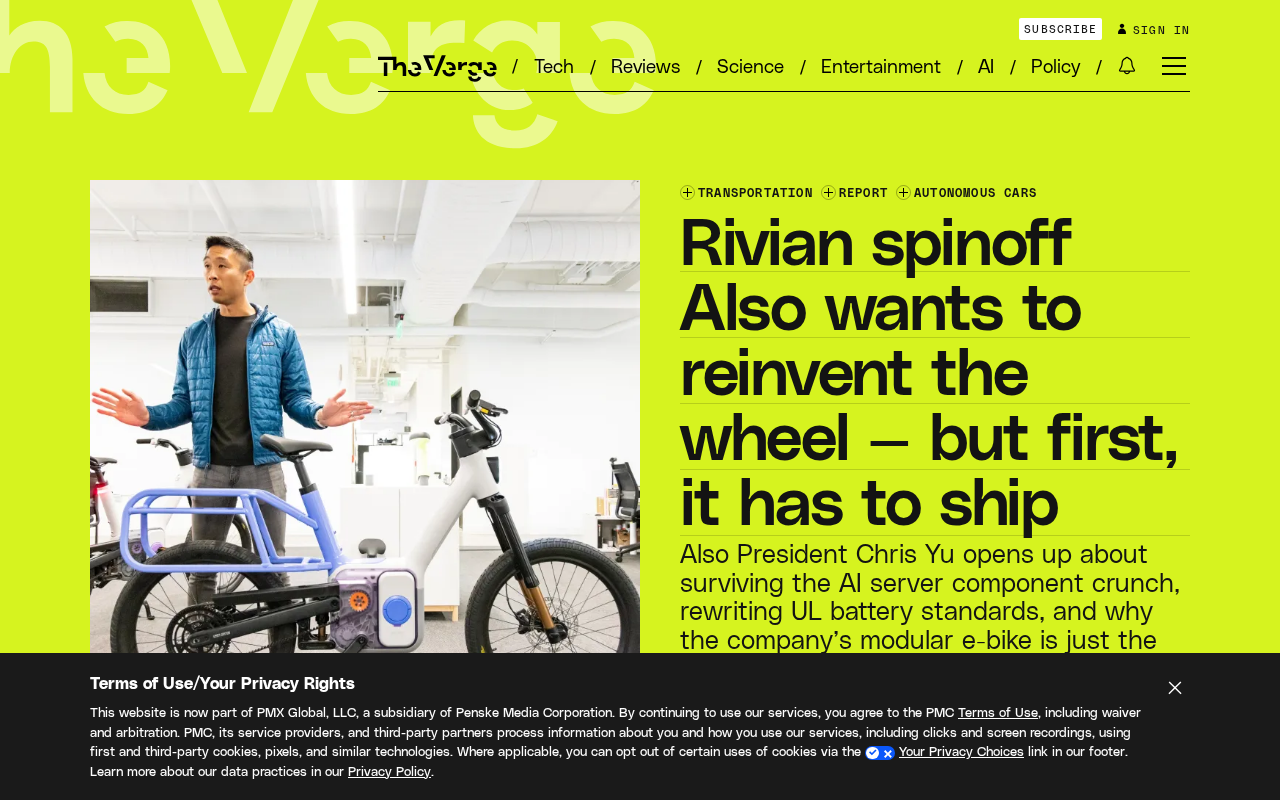
Rivian's spinoff micromobility company Also, led by former Specialized CTO, has a grand vision but prioritizes shipping first.
Also is an independent micromobility startup spun off from Rivian, run by Stanford aeronautics PhD and former Specialized CTO Chris Yu, with Rivian serving only as one investor providing funding and resources while the Also team makes day-to-day decisions autonomously. This spin-off model lets Also experiment with a lighter organizational form but prevents it from directly leveraging Rivian's large-scale manufacturing system. Chris Yu's combined aeronautics and bicycle industry background gives Also the engineering conditions to redesign micromobility products from the ground up, hence its "reinvent the wheel" slogan. However, the article stresses that Also's most urgent task is completing product delivery and mass production, requiring it to overcome typical hardware startup hurdles like supply chain management, quality control, and regulatory certification. With the shared scooter boom fading and the market focusing more on durability and genuine value, Also must also find a differentiated positioning and prove its vision is not empty talk through its products.
When Rivian quietly spun off its micromobility brand Also, many observers wondered whether the luxury EV maker was spreading itself too thin. But Chris Yu, the man at the helm of Also, insists that's not the case. The Stanford aeronautics PhD and former Specialized CTO is running this startup as an independent company, with Rivian serving as just one of its investors.
Spinning Off from Rivian: Independent Operations and Rivian's Role
Also is not a division of Rivian but an independently operated startup. Chris Yu emphasizes that this independence allows Also to explore the micromobility space with greater flexibility, free from the constraints of traditional automotive manufacturing thinking. Rivian, as an investor, provides funding and resource support, but day-to-day decisions and product direction are made autonomously by the Also team.
This spin-off model is not uncommon in the tech hardware space: large companies divest non-core businesses, letting startup teams experiment in a more lightweight way. For Rivian, Also is a tentacle reaching into urban micromobility; for Yu, it's an opportunity to redefine personal transportation.
In tech hardware, large companies typically spin off sub-brands for two reasons: first, to separate non-core or high-risk businesses from the parent company's financial statements and decision-making processes, allowing them to operate with independent financing and valuation; second, to attract entrepreneurial talent that would be hard to retain within a mature corporate system by offering equity incentives. After the spin-off, the parent company often retains a minority stake or board seat, participating as a strategic investor rather than a controlling shareholder. This structure has precedents in the EV and mobility industry—Ford, for example, has spun off or independently operated some of its mobility services to test new markets with a lighter organizational form. For Also, independent operation means it can adopt supply chains, pricing strategies, and iteration cadences different from Rivian's, but it also means it cannot directly leverage Rivian's mass-production system and must build or outsource manufacturing capabilities.
Who Is Chris Yu: From Aeronautics PhD to Bicycle Industry CTO
Chris Yu's résumé is notably interdisciplinary. He earned a PhD in aeronautics from Stanford University and later served as CTO of Specialized—a globally renowned bicycle brand. His aeronautics background gives him a deep understanding of aerodynamics, structural design, and lightweight materials, while his bicycle industry experience familiarizes him with the user needs and manufacturing supply chains of two-wheeled transportation.
This hybrid background is exactly what Also needs: micromobility products require both automotive-grade engineering rigor and bicycle-grade cost control and user experience. Yu's leadership style is also engineering-driven; he has said in interviews that Also's goal is to "reinvent the wheel" rather than simply making incremental improvements to existing products.
Aeronautics is the engineering discipline that studies the motion of aircraft in the atmosphere, with core training in aerodynamics, structural mechanics, aircraft design and control, lightweight materials, and systems integration. This background has direct transferable value in micromobility products: electric scooters and e-bikes at low speeds also face trade-offs among wind resistance, center of gravity distribution, structural rigidity, and weight, and the "system-level weight reduction" and "simulation-driven design" methodologies emphasized in aerospace engineering can significantly shorten the cycle from concept to manufacturable product. Specialized is a global high-end bicycle and cycling equipment brand known for carbon fiber frames, suspension systems, and ergonomic design; its CTO position requires managing engineering teams, supply chains, and product certification simultaneously. The crossover from aviation to bicycles is essentially a transition from a "high-reliability, low-volume" engineering culture to a "high cost-performance, large-scale manufacturing" engineering culture—precisely the capability combination hardware startups need most when moving from prototype to mass production.
What "Reinventing the Wheel" Means
"Reinventing the wheel" is a bold slogan. In micromobility, it means Also may not follow existing electric scooter or e-bike architectures but instead rethink vehicle design, powertrains, and user experience from the ground up.
Given Yu's aeronautics background, Also's products may differ from conventional approaches in aerodynamic efficiency, material selection, and structural integration. At the same time, as a startup, Also must confront the practical challenges of mass production, cost control, and channel development. No matter how loud the slogan, ultimately the product must speak for itself.
"Reinventing the wheel" in English usually carries a negative connotation, meaning to duplicate an existing solution; but in a product context, it is repurposed as a manifesto emphasizing not incremental improvement but a re-examination of underlying architecture. For micromobility products, this could mean redesigning how hub motors integrate with wheelsets, sharing structure between battery packs and frames, rethinking brake and suspension layouts, or even reconsidering whether the basic "two wheels plus deck" form factor is optimal. Historically, similar approaches appeared in products like Segway, Boosted Boards, and VanMoof—each reconstructed traditional architecture along some dimension but also commonly encountered challenges in production ramp-up, after-sales repair, and cost control. Therefore, the engineering premise for "reinventing the wheel" is that the team possesses both underlying design capability and the supply chain capability to translate design into manufacturable products; otherwise, innovation easily stalls at the prototype stage.
The Top Priority: Ship
Despite the grand vision, Also's most pressing task right now is to "ship." The original headline makes this priority clear: first, build the product and sell it. For hardware startups, the transition from prototype to mass production is the stage most prone to failure—supply chain management, quality control, and regulatory certification are all unavoidable hurdles.
Also's independence is a double-edged sword here: on one hand, it doesn't have to wait for Rivian's decision-making processes and can iterate quickly; on the other hand, it lacks Rivian's large-scale manufacturing experience and supplier network. Yu needs to prove that Also can not only design good products but also mass-produce and deliver them reliably.
Hardware startups typically must cross multiple "valleys of death" from prototype to mass production: the design validation (DV) phase requires confirming product reliability under real-world conditions; the production validation (PV) phase requires verifying production line yield and consistency; then come regulatory certification (such as speed limits for e-bikes, battery safety, and electromagnetic compatibility standards), supplier lock-in, and channel distribution. Delays at any stage can tighten cash flow. The typical risk for independent spin-offs at this stage is the lack of the parent company's scale purchasing power and mature quality management system, often requiring contract manufacturers (OEM/ODM) for initial production runs—which in turn brings new issues around intellectual property protection and quality control consistency. Therefore, "shipping" means not just building the product but establishing a repeatable, scalable manufacturing and after-sales system.
Opportunities and Challenges in the Micromobility Market
The micromobility market has experienced rapid expansion and a rational correction in recent years. After the shared scooter boom faded, the market has become more focused on product durability, safety, and genuine user value. For Also to enter this market, it needs to find a differentiated positioning—whether targeting high-end individual users, commercial fleets, or both.
Rivian's brand endorsement can help Also gain attention and trust, but ultimately consumers are paying for the product itself. In the fiercely competitive micromobility track, Also needs to deliver a compelling product as soon as possible to prove that "reinventing the wheel" is not an empty slogan.
Summary
Also's story is a classic hardware startup narrative: a star team, a grand vision, independent operations, and most critically—shipping pressure. Chris Yu's interdisciplinary background and Rivian's resource support are Also's advantages, but whether it can establish a foothold in the micromobility market depends on whether it can deliver products that withstand market scrutiny on time. First ship, then talk about reinventing.
One-line Summary
Rivian's spinoff micromobility company Also, led by former Specialized CTO, has a grand vision but prioritizes shipping first.
Paragraph Summary
Also is an independent micromobility startup spun off from Rivian, run by Stanford aeronautics PhD and former Specialized CTO Chris Yu. Rivian serves only as one investor providing funding and resources, while day-to-day decisions are made autonomously by the Also team. This spin-off model allows Also to experiment with a lighter organizational form but also prevents it from directly leveraging Rivian's large-scale manufacturing system. Chris Yu's combined background in aeronautics and the bicycle industry gives Also the engineering conditions to redesign micromobility products from the ground up, hence the company's "reinvent the wheel" slogan. However, the article emphasizes that Also's most pressing task is completing product delivery and mass production, requiring it to overcome typical hardware startup hurdles such as supply chain management, quality control, and regulatory certification. With the shared scooter boom fading and the market focusing more on durability and genuine value, Also also needs to find a differentiated positioning and use its products to prove its vision is not empty talk.
Related articles
 Tech Frontiers
Stylome Bot Slammed as Useless Junk: Why Do AI Detection Tools Keep Failing?
Reddit users test the Stylome AI detection bot: Gemini-rewritten text judged human-written, consistently low confidence. An analysis of AI text detection's technical dilemmas, privacy concerns, and credibility crisis in community governance.
 Tech Frontiers
When AI Becomes a Productivity Divide: Clarity or "AI Psychosis"?
A civil engineer's deep use of agentic AI boosted efficiency but bred contempt for peers who refuse to learn. Is this clarity or AI psychosis? An analysis of the cognitive and psychological challenges behind the AI productivity divide.
 Tech Frontiers
Opus 5.5 Benchmark Scores Climb, Community Says Its "Weights Are Blessed"
Reddit community discusses Opus 5.5's rising scores on the Benchmaxxing Bench, with users describing its performance as "weights are blessed." This article interprets the community reaction and cautions against conflating benchmark scores with real capability.