RL Only Changes 1-3% of Tokens — What Does Single-Problem Test-Time Training Change?

Single-problem test-time training approaches certified target scores with tiny updates, but a token-level gap remains between parameter changes and RL's 1-3% token changes.
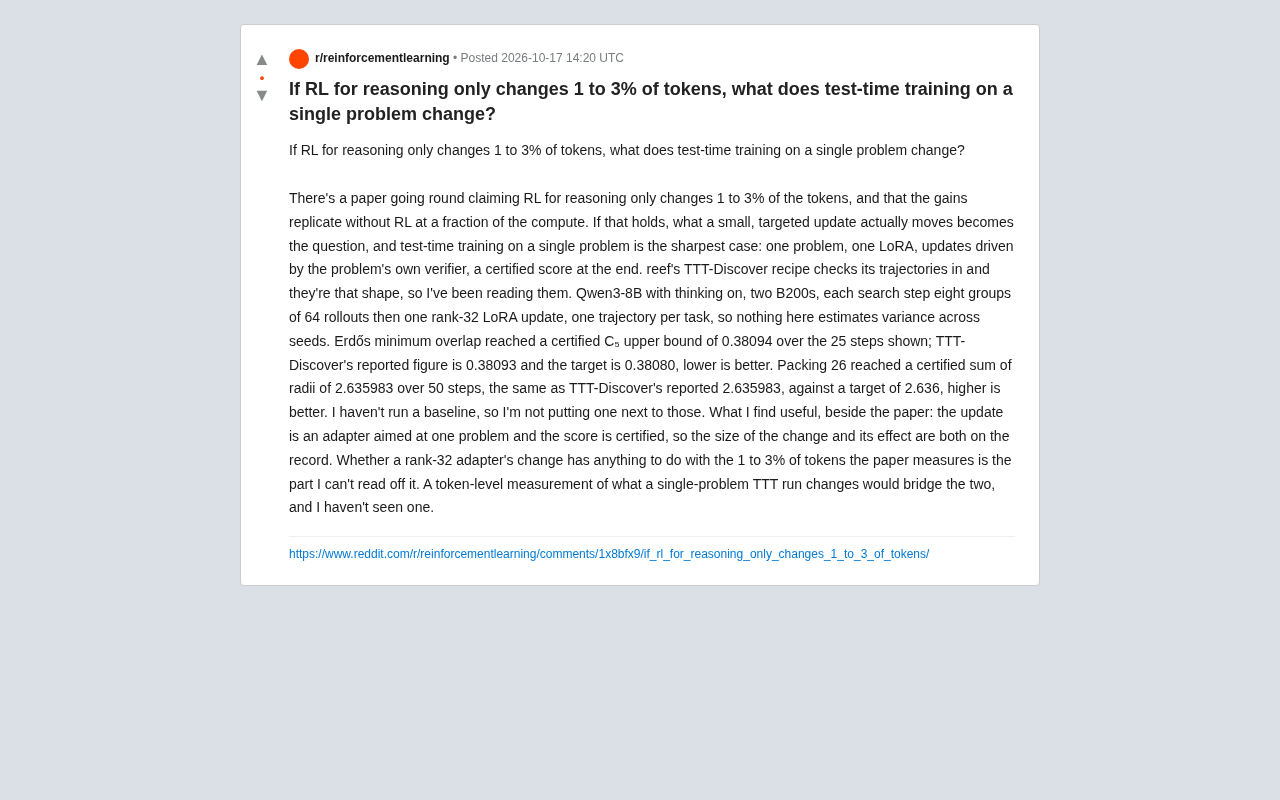
The article centers on a paper claiming reasoning RL changes only 1-3% of tokens, using a Reddit-discussed single-problem TTT experiment to examine "why small updates work." The experiment uses Qwen3-8B on two B200s, doing eight groups of 64 rollouts per step followed by one rank-32 LoRA update, keeping only one trajectory per task. It reaches a certified upper bound of 0.38094 on the Erdős minimum overlap problem (target 0.38080) and a certified radius sum of 2.635983 on Packing 26 (target 2.636), nearly matching TTT-Discover's reported values. No baselines were run, so certified scores show achieved values, not relative gains. The core gap: no token-level measurement yet links the rank-32 adapter's parameter changes to the paper's 1-3% token changes, so shared mechanism cannot be inferred.
A Provocative Finding: RL Only Moves 1-3% of Tokens
A recently circulating paper makes a striking claim: reinforcement learning (RL) for reasoning tasks changes only 1% to 3% of tokens, and most of the gains can be reproduced with far less compute without RL. If true, this pushes a sharper question to the forefront: what exactly does a small, targeted update change in a model?
Reddit discussants turned their attention to how test-time training (TTT) performs on a single problem, viewing it as the sharpest lens for examining this question — one problem, one LoRA, updates driven by the problem's own verifier, ending with a certified score. This setup puts "how much changed" and "what effect it produced" on the table at the same time.
Reinforcement learning (RL) for reasoning tasks refers to fine-tuning a language model using verifiable final answers (such as the numerical result of a math problem) as reward signals, via policy-gradient-style algorithms (e.g., GRPO, PPO), so that it generates longer chains of thought and improves accuracy. Such training typically requires only a few epochs and a small learning rate, so the magnitude of parameter updates is limited. Tokens are the basic units the model processes text in; one token roughly corresponds to a word or subword fragment. Saying "RL only changes 1-3% of tokens" means that when comparing the model's output distribution before and after RL on the same batch of inputs, only a very small number of positions show a significant shift in prediction. This metric maps parameter-space updates into output space, but details like the threshold for judging "change" and the sampling temperature greatly affect the percentage value, so the conclusion itself must be understood in light of the specific measurement protocol.
What the Single-Problem TTT Experiment Looks Like
The discussant cited reef's TTT-Discover recipe and carefully read its public run trajectory. The experimental configuration is quite specific: Qwen3-8B with thinking mode enabled, running on two B200s. Each search step first does eight groups of 64 rollouts each, then performs one rank-32 LoRA update. Only one trajectory is kept per task, so there is no variance estimate across random seeds.
This design means we are looking at a deterministic search process on a single problem, not a statistically averaged performance. This is precisely its value as a "single-point observation": small update magnitude, single objective, verifiable score.
Test-time training (TTT) differs from conventional training in when the update happens: the model temporarily adjusts its parameters for the current input (or current problem) during inference, rather than pre-training on a fixed dataset. LoRA (low-rank adaptation) is a parameter-efficient fine-tuning method that freezes the original model weights and trains only two low-rank matrices (of rank r), expressing the update as a low-rank decomposition and thereby reducing the number of trainable parameters by orders of magnitude. rank-32 means each adapter matrix has rank 32; for an 8-billion-parameter model, the trainable parameter share is typically under 1%. Rollout refers to the model sampling multiple complete reasoning trajectories for the same problem; each trajectory is scored independently, and these scores are used to estimate the policy gradient and update the LoRA. Thus "eight groups × 64 rollouts plus one LoRA update" constitutes a complete search-learn loop, whose computational cost comes mainly from sampling rather than parameter updates.
Two Verifiable Score Results
The first task is the Erdős minimum overlap problem. Within the 25 steps shown, the method reached a certified C₅ upper bound of 0.38094. TTT-Discover reported 0.38093, while the target is 0.38080, with lower being better. In other words, this run's result is almost identical to the reported result, but still a tiny gap from the target.
The second task is Packing 26, which within 50 steps reached a certified radius sum of 2.635983, exactly matching the 2.635983 reported by TTT-Discover, with the target being 2.636, higher being better.
The discussant explicitly states they did not run baselines, so baseline numbers are not shown side by side. This restraint is notable: without a control, these certified scores indicate "what was achieved," not "how much relative improvement."
Certified score in this context means the result has been confirmed by an independent verifier or formal check, not merely self-reported by the model. For the Erdős minimum overlap problem, the goal is to find the minimum overlap area upper bound for a set of points inside the unit square; 0.38080 is the target value corresponding to the known optimal construction, with lower being better. Reaching 0.38094 means a gap of about 0.00014 from the target. Packing 26 is the problem of placing 26 non-overlapping circles inside the unit square to maximize the sum of radii; 2.636 is the theoretical or known optimal target, with higher being better. Reaching 2.635983 means it is very close to the target. Note that such certification only guarantees "the construction satisfies the constraints and the score is computed correctly"; it does not guarantee global optimality, nor does it provide information about relative merit versus other methods — precisely why the discussant declined to show baseline numbers side by side.
The Core Question: Can Adapter Changes Be Mapped to Token Changes?
The discussant considers the most valuable point — aside from the paper itself — to be that this setup leaves a record of both the magnitude and the effect of the update: the update is an adapter targeting a single problem, and the score is certified. But the real sticking point is: is there any relationship between the change brought by a rank-32 adapter and the 1% to 3% of tokens the paper measured?
The answer cannot be read from the existing trajectory. Bridging the two requires token-level measurement of the single-problem TTT run, to see exactly which tokens it changed and by how much. The discussant says they have not yet seen such a measurement. This is a concrete and actionable research gap: mapping small updates in parameter space back to the distribution of changes in token space.
What This Means for Understanding RL Reasoning Gains
If RL's gains really come from changes to only a very small number of tokens, then the single-problem TTT experiment offers a complementary perspective: it approaches the same target scores with a far finer update granularity (one LoRA, one problem), and the process is certifiable. If the two could be connected through token-level measurement, it might explain why small updates can still yield substantial reasoning improvements — perhaps what matters is not how much changed, but where it changed.
In the absence of such measurement, the reasonable stance is: the certified scores demonstrate the effectiveness of single-problem TTT, but one cannot directly infer that its mechanism is the same as RL's 1-3% token phenomenon. This is precisely where the discussion is most valuable — it does not give a conclusion, but precisely points out a gap that has yet to be filled.
Related articles

Amphibious Transforming Drone: Beyond 100x Power Savings, What Are the Real Needs?
Is the amphibious transforming drone just a gimmick? Starting from the 100x power difference of the M4 Morphobot, explore real application scenarios and thesis topic ideas, analyzing boundary conditions where pure drones and pure ground robots both fail.

Warhound Raises $200 Million: Genetically Engineered "War Dogs" Paired with Anduril Gear
Warhound raises $200M, backed by Ben Lamm and Palmer Luckey, to genetically engineer dogs for military and law enforcement use and equip them with Anduril gear. This article analyzes its technology direction, funding logic, and ethical controversy.

Claude API Comes to Google Cloud: IAM Integration and SDK Access Guide
Anthropic hosts the full Claude API on Google Cloud with IAM-controlled permissions and unified billing. This guide covers the Vertex AI and Anthropic-hosted entry points, IAM role configuration, and SDK access.