roastme.gg: How a Counterintuitive Product That Charges Users to Get Publicly Roasted by AI Engineered Viral Spread
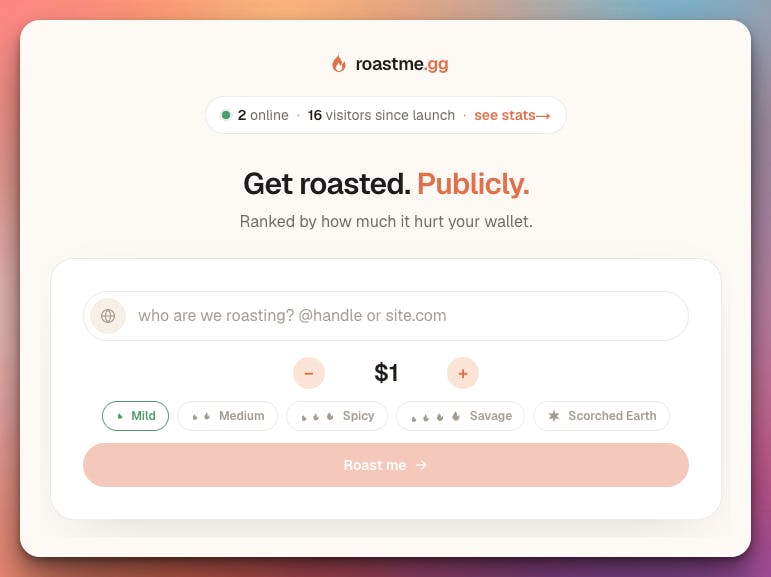
roastme.gg charges users $1-$1000 to get publicly roasted by AI, turning self-deprecation into viral social currency.
roastme.gg is a counterintuitive AI product where users pay to be publicly roasted by Claude, with pricing from $1 to $1,000+. It generates roasts based solely on usernames—no data scraping—while using public leaderboards ranked by payment amount and shareable social cards to drive viral spread. The product exemplifies how generative AI is expanding from productivity tools into entertainment and emotional value, leveraging micropayments and social currency mechanics.
A Counterintuitive AI Entertainment Product
In an era where AI applications overwhelmingly emphasize "boosting productivity" and "solving pain points," a product called roastme.gg has chosen the exact opposite path—its selling point is paying to be publicly humiliated. This product, which launched on Product Hunt, sums itself up with a blunt tagline: "Get roasted. Publicly."
Product Hunt is the world's most well-known platform for discovering new products, founded in 2013 and currently owned by the venture capital firm a16z. Dozens of products launch there daily, gaining exposure through community upvotes. While vote counts don't directly equate to commercial success, it serves as an important window for the tech community to observe early-stage product creativity—many future unicorns (such as Notion and Loom) completed their cold starts here.
The mechanics are dead simple: users submit their X (formerly Twitter) handle or personal website, select a "pain level," and then Claude generates a targeted roast. Interestingly, pricing ranges from $1 all the way up to $1,000+ for the "scorched-earth tier"—the more you pay, the harsher the roast.
This is a textbook "emotional value" product. It combines the long-standing internet tradition of "roasting" with generative AI and micropayment mechanics.
The Internet Roots of Roast Culture
Roast culture traces back to American comedy traditions—as early as the 1940s, New York's Friars Club regularly hosted celebrity "roast" events where comedians performed exaggerated satirical takedowns of honored guests. This tradition later went mainstream through Comedy Central's Roast specials. In the internet era, Reddit's r/RoastMe subreddit (created in 2015) democratized the culture: users voluntarily upload photos and invite strangers to creatively roast them, boasting over 3 million subscribers to this day. roastme.gg is essentially an AI-automated version of this cultural tradition—it replaces human "roasters" with machines and substitutes community-driven spontaneous creation with a paid mechanism.
Core Mechanism: Generating Roasts Based on Nothing But "Name and Vibe"
The most intriguing design choice in roastme.gg is its extreme restraint regarding AI input. The product explicitly states: no bio, no posts, no scraping.
Claude generates roasts based solely on your account name and the "vibe" that name gives off.
This design has several layers of consideration:
Clever Privacy Compliance Avoidance
By not scraping user data, the product sidesteps compliance risks related to social platform data collection and reduces privacy controversies. In the current environment—with EU GDPR, various US state data privacy laws, and X's own tightening API policies—any application involving social media data scraping faces legal risk. roastme.gg's "don't touch the data" design completely extracts itself from these complex compliance obligations. It doesn't need to access users' actual content to deliver a "personalized" experience—though this personalization is really just creative extrapolation from minimal information.
It Actually Demands More LLM Creativity
Writing a roast that makes someone chuckle based solely on a name actually places higher demands on a large language model's associative abilities and sense of humor. This also indirectly serves as a public showcase of Claude's capabilities in "creative generation" and "tone control."
Claude is the large language model developed by Anthropic, known in the industry for its safety and creative writing capabilities. Compared to OpenAI's GPT series, Claude excels in long-text comprehension, tone control, and role-playing tasks. roastme.gg's choice of Claude over GPT-4 or other models is likely related to Claude's advantage in "constrained creative output"—it can generate sharply humorous content while staying relatively controllable and avoiding genuinely offensive territory. This balance between "funny" and "safe" is precisely one of the key competitive differentiators among major models today.
The less information available, the more the output depends on the model's understanding of language, cultural references, and comedic timing. From a technical perspective, this type of task tests a model's "zero-shot creativity"—generating high-quality content with almost no contextual information, relying purely on cultural knowledge and language patterns absorbed from training data.
Product Loop Design for Viral Spread
roastme.gg's design for propagation mechanics is remarkably sophisticated—nearly every element serves social virality.
A Public Leaderboard Ranked by Price
Every roast appears on a public leaderboard, sorted by payment amount. This design is exquisitely clever—it transforms the potentially embarrassing act of "being roasted" into a status symbol of sorts. Users who can afford the $1,000 "scorched-earth tier" actually gain attention by topping the leaderboard.
This is essentially "performative consumption": spending money not to receive a service, but to publicly demonstrate that you can "play the game." In behavioral economics, this mechanism is known as the "Veblen Effect"—the higher the price of a good, the stronger the consumer's desire to purchase it, because the high price itself functions as a status signal.
Shareable Social Cards Drive Secondary Spread
The product generates a shareable card for each roast that can be posted to X. This means the most natural behavior after being roasted is to screenshot, repost, and @ friends—creating a propagation loop of "get roasted → share → attract more participants." Users themselves become the product's distribution nodes.
From a communications theory perspective, this leverages the "Social Currency" mechanism—one of the six key drivers of sharing identified by marketing scholar Jonah Berger in his book Contagious. People share certain content because the act of sharing itself makes them appear more interesting, tasteful, or high-status. When users share their AI-generated roast, they're ostensibly self-deprecating, but actually showcasing a persona of someone who "can take a joke" and "has a sense of humor" to their social network, thereby gaining social validation.
Business Model and Pricing Strategy Analysis
From a business perspective, roastme.gg's payment logic upends conventional SaaS "value-based pricing." It sells not functionality, but entertainment, social currency, and emotional release.
The wide pricing range from $1 to $1,000 effectively functions as a self-selection mechanism: lower tiers attract curious casual users, while higher tiers target KOLs, founders, or influencers willing to pay for edginess and buzz. Higher payments mean harsher roasts and higher rankings—this design linking "pain to status" transforms a one-time purchase into a social game with competitive dynamics.
Mature Micropayment Infrastructure Makes This Possible
Notably, the viability of products like this largely benefits from advances in payment infrastructure. Micropayments—online transactions with very small individual amounts—failed to gain traction in traditional internet commerce due to excessive payment friction. But with the maturation of one-click payment tools like Stripe and Apple Pay, combined with growing user acceptance of "pay-per-use" mental models, micropayments are experiencing explosive growth in AI applications. Compared to subscription models (monthly/annual fees), micropayments lower the decision threshold for users, making them particularly suitable for entertainment and one-time experience products. roastme.gg's $1 starting price capitalizes on exactly this trend—users don't need to commit to any long-term relationship; they can get instant gratification for less than the cost of a cup of coffee.
However, the challenges for products like this are also apparent: novelty is both its greatest asset and its greatest vulnerability. Roast-style content is prone to fatigue, and users' willingness to pay repeatedly is questionable. Whether the product can sustain itself likely depends on its ability to continuously refresh its mechanics or develop richer community interactions.
Trend Signals in the AI Entertainment Space
Although roastme.gg currently has only about 4 votes on Product Hunt and ranks 20th—still quite small in scale—it represents a noteworthy trend:
Generative AI is expanding from "productivity tools" into "emotional and entertainment products." When large models have sufficiently strong creative writing capabilities, combined with micropayments and social propagation mechanics, even a seemingly absurd idea can quickly become an operational product.
This trend is not isolated. Over the past year, Character.AI attracted millions of daily active users with AI character chat, AI-generated "year in review" and "personality test" viral products repeatedly swept social media, and even AI-generated music and short videos are rapidly being commercialized. All of these point in the same direction: when technological capabilities overflow enough to support rich creative expression, entertainment and emotional value are often the application scenarios first embraced by the masses.
It also reminds entrepreneurs: AI products don't necessarily need to solve "serious problems." Sometimes, a sufficiently entertaining idea with inherent viral DNA, paired with the right business model design, can carve out space in the crowded AI application market.
For ordinary users, this might just be a dollar's worth of fun; but for those observing the AI application ecosystem, roastme.gg is a vivid case study of how "AI + entertainment + social currency" can be combined.
Key Takeaways
Related articles

"Black October": Did AI Uncover 3% of All Critical Vulnerabilities Ever?
A Reddit post claims 3% of all critical software vulnerabilities ever were found in the past month, dubbed 'Black October.' We break down the statistical issues, how AI-assisted code auditing accelerates discovery, and how developers should respond.

Microsoft Project Gecko: Using AI to Bridge Language Gaps for African Farmers
Microsoft's Project Gecko launches PharmaChat, letting African farmers ask questions in their native language and get precise video clips and farming book chapters via AI. The project also releases three interactive manuals to advance inclusive AI.

Musk's Space Dominance: How Starlink Throttling Undermines Ukraine's Defense
SpaceX's Starshield throttling disabled Ukraine's high-speed interceptor drones, exposing how Musk's private control over low Earth orbit communications affects battlefield dynamics and national security, and highlighting the risks of commercial space militarization and space governance dilemmas.