Robinhood's Hybrid AI Reviewer: 60% of Data PRs Auto-Merge
Robinhood uses a three-layer review of scripts, Agents, and humans to auto-merge 60% of data pipeline PRs.
The article describes the three-layer hybrid review architecture designed by Robinhood's data platform team to handle the flood of AI-generated PRs: deterministic scripts verify facts against authoritative sources like the schema registry and data catalog, AI Agents focus on contextual risks scripts can't capture, and humans retain key decisions like sensitive authorization and migration intent. In a typical case, a type-widening PR that was all green in CI and passed all registered consumer checks was found by the Agent to have an unrecorded downstream job in lineage that would crash due to a type mismatch, so it escalated to a human and was fixed in the correct order. As of August 31, 2026, about 60% of data pipeline PRs can merge without human review, human review workload is down about 75%, saving about 132 engineering hours monthly, related incidents are down about 30%, and the miss rate is about 2%. The team emphasizes the goal is to reduce review work, not remove accountability, and notes that the current two layers running independently in parallel and invisible to each other is the main architectural flaw.
When PRs Arrive at Machine Speed, but Human Review Is Still Stuck at Human Speed
Chetas, an engineer on Robinhood's data platform team, shared a real-world dilemma at AI Engineer: AI coding assistants have made submitting PRs incredibly cheap—a query, a schema change, an authorization request can be generated in minutes. But reviewing these PRs still depends on the few people who hold the context—who reads this table? How big is the table? How sensitive is the data?
CI passing does not mean it's safe. A schema change that's all green in CI can still break downstream SLAs, affect consumers three teams away, or expose data that should never have been accessed. PRs arrive at machine speed, but the number of people who can judge "whether it's safe to merge into the production data pipeline" hasn't grown. That's the gap.
Schema registry is an authoritative service that centrally manages data table structure definitions and their version evolution. Producers and consumers both query it for the current schema before reading or writing data, so incompatible changes can be caught at compile time or during CI. Common compatibility strategies include backward compatibility (new consumers can read old data), forward compatibility (old consumers can read new data), and full compatibility. The "type widening" (integer→bigint) in the article is a backward-compatible change in most registries, so it passes the first-layer check; but the registry only records the table structure itself, not who consumes these columns and where—which is exactly the fundamental reason a second-layer Agent is needed to fill the gap.
Data lineage describes the dependency graph of data flowing from source tables through various processing jobs to target tables, typically reported automatically by query engines, ETL schedulers, or dedicated collectors. The value of lineage lies in impact analysis: before changing a column, you can list all downstream consumers based on it. But its completeness depends on whether every execution engine actively publishes lineage events—if an engine isn't connected to collection, the jobs on it become "dark nodes" in the graph. The downstream crash described in the article happened precisely because the engine hosting that job didn't report lineage, so the lineage graph was completely blind to it.
Three-Layer Hybrid Architecture: Scripts Handle Facts, Agents Handle Judgment, Humans Handle Key Decisions
Robinhood's solution isn't to have AI review everything, but to layer by responsibility:
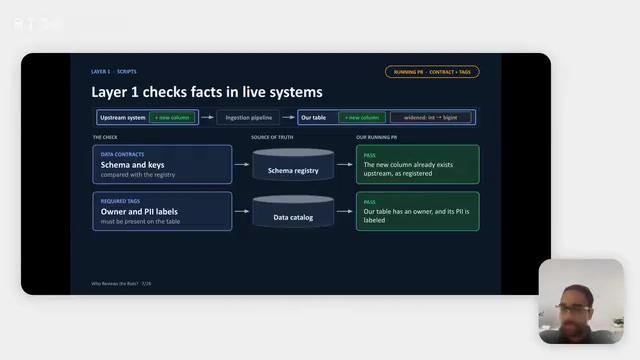
- Layer 1: Deterministic scripts. Check facts against authoritative sources like the schema registry and data catalog. Data contracts, tag compliance, lineage impact scope, performance tests—if any one fails, CI turns red and blocks the merge.
- Layer 2: AI Agent. The rules explicitly tell the Agent what Layer 1 already covers, so the Agent focuses on risks scripts can't capture—query anti-patterns, sensitive data requests, unregistered downstream consumers. The Agent reads the diff, PR description, and commit messages, and uses file tools to search the entire repository.
- Layer 3: Humans. When sensitive data authorization, migration intent changes, or the Agent's own confidence is insufficient are involved, the Agent can never approve—it can only escalate to a human.
Both layers review the same PR, and merging requires checks to pass plus approval. This design also controls AI cost—using AI for judgment, not for re-discovering facts that scripts can check.
The Complete Journey of a PR: Scripts Say Safe, Agent Finds the Blind Spot
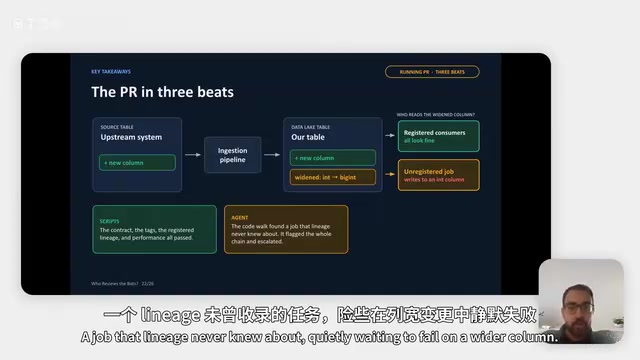
The talk tracked a typical PR: adding a column to a source table while widening an existing column from integer to big integer. Widening a type sounds like the safest possible schema change, but the real question is: who reads it downstream?
Layer 1 all passed: the new column does exist in the upstream schema registry; the table has an owner and PII is tagged; all registered consumers recorded by the lineage tool won't break after the type widening; the performance test with the same data volume in staging passed.
But after walking through the code, the Agent found a job that lineage had never recorded—it was right there in the repository, reading the widened column of this table and writing to another table, where the corresponding column was still integer. When the first value exceeding the integer range arrived, the write would fail. A legitimate change that's all green in CI and passes all registered checks would still crash a downstream job.
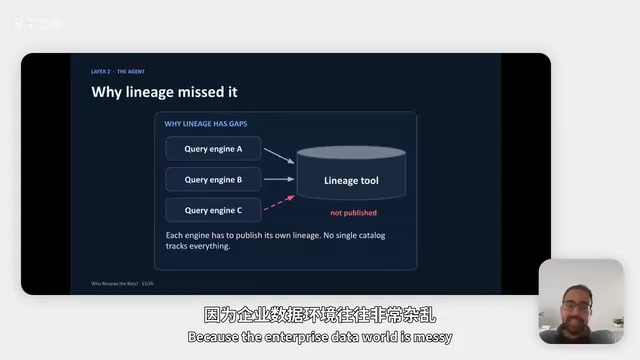
Why did lineage miss it? Because enterprise data environments are messy: workloads run across different query engines, and each engine has to publish its own lineage. If an engine doesn't publish, that relationship disappears from the graph. As the screenshot shows, no single catalog automatically sees everything.
The Agent annotated the entire chain in a review comment and provided its reasoning, gave it a high risk score, and escalated to a human. The human confirmed the job was indeed actively running in production, then fixed it in the correct order: first update the downstream table so it can hold the wider type, then merge the PR. No incident occurred.
The Agent's honest boundaries matter just as much: it can only search pipeline code and access grants in the repository, and cannot see hand-written ad-hoc queries and dashboards. So when it can't find downstream consumers, it can't say "no downstream consumers exist"—only "I didn't find any in the places I searched." And the Agent can never claim "everything is safe."
CI (continuous integration) and PR gates typically take the form of: every commit triggers a pipeline that runs schema validation, unit tests, static checks, and integration tests, and merging is only allowed if all pass. The gate only answers "does it pass in a controlled test environment," not "is it safe on production data." The gap between the two comes from test data scale, downstream consumer coverage, and runtime configuration—CI usually only runs in staging with sampled data and cannot exhaustively cover all registered and even unregistered consumers. When the article emphasizes "CI passing does not mean it's safe," it's precisely referring to the gate's proof boundary: it proves that known checks pass, not that unknown risks don't exist.
Tool calling in agentic review means the Agent doesn't rely solely on the model's internal knowledge, but actively obtains facts within the repository through file search, code retrieval, catalog queries, and other tools, then reasons based on those facts. This enables the Agent to discover patterns not covered by static rules, such as anti-pattern queries and cross-table type mismatches. But it also brings capability boundaries: the reach of the tools is the reach of the Agent's cognition—ad-hoc queries outside the repository, BI dashboards, and manual scripts are invisible to it. Therefore, a responsible Agent can only state "not found within the searched scope" and cannot assert "does not exist"—this wording constraint is part of the system design.
Feedback Loop: How Human Corrections Become New Rules
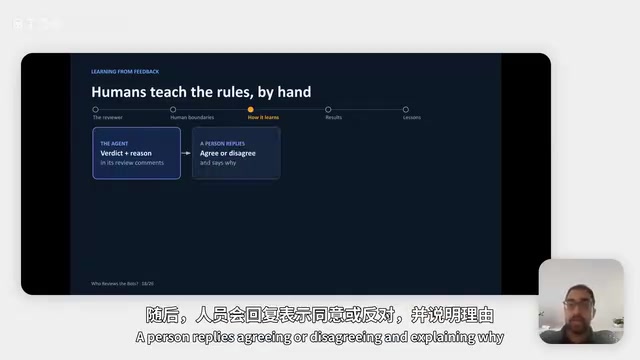
The Agent produces review conclusions and reasoning every day, and humans reply with agreement or disagreement and explain why. Each week, on-call staff read the feedback and update review rules. There's no automatic retraining currently, but the team has an idea to have an incident-investigation Agent assist with weekly updates—not yet built.
A real correction case: a column was tagged as PII in the source database, but the ingestion pipeline encrypted it before writing to the data lake, so a PR proposed marking it as non-sensitive in the data lake. The Agent objected based on the upstream tag, the author pushed back and asked to reference how similar columns on other tables had been classified, and the human agreed with the author. This kind of correction is exactly the signal that makes rules smarter—but the team also cautions that it relies on that specific pipeline encrypting before writing, and is not a general rule that "encrypted means non-sensitive."
The evaluation system tracks two types of errors: bad PRs being approved (misses, dangerous) and good PRs being unnecessarily escalated (false positives, consuming manpower). As of August 31, 2026, the miss rate is about 2%, mainly from rule gaps rather than judgment failures. There's no single clean number for the false-positive rate, but the main cause is missing context, such as the encrypted column example.
A miss led to a new rule: a column in an open-data copy was re-tagged as PII, the tagging PR looked fine and was merged, but no one checked whether any downstream was still reading those columns from the old copy. As a result, the reader crashed after the column disappeared. This became a new rule: when a column is re-tagged as sensitive, search the codebase for consumers still reading it from the copy that's about to lose that column.
The trade-off between false positives and false negatives is the core metric of any review gate. A miss means a problematic PR is let through, at the cost of production incidents; a false positive means a harmless PR is blocked or escalated, at the cost of manpower and developer experience. The two usually trade off against each other: tightening thresholds raises false positives, loosening them raises misses. The article specifically notes that "a gate that escalates everything doesn't reduce anyone's workload," because a system that always escalates is equivalent to no automation—it only adds process steps. A reasonable approach is to measure the two error rates separately and have rule updates target specific causes: misses mostly come from rule gaps, false positives mostly from missing context (such as domain knowledge like "the pipeline already encrypts before writing" not being known to the Agent).
The difference between rule evolution and automatic retraining is worth clarifying. The current team follows a manual rule-iteration path: each week, on-call staff read Agent conclusions and human agree/disagree records, and abstract recurring corrections into new rules or new prompts. This is different from automatically fine-tuning the model with feedback data—the advantage is that every rule is auditable, explainable, and rollbackable; the disadvantage is that it relies on manual effort and updates lag. The team's envisioned "incident-investigation Agent assisting weekly updates" is still a proposal, not yet built.
Results and Unsolved Problems
As of August 31, 2026: about 60% of data pipeline PRs can merge without human review, human review workload is reduced by about 75%, saving about 132 engineering hours per month, and incidents related to these PRs are down about 30%. But this isn't review-free—protected decisions still reach humans by design. The goal is to reduce review work, not remove accountability.
There are clear architectural mistakes: Layer 1 and Layer 2 are currently independently triggered systems running in parallel, unable to see each other's pass, fail, or outage status. The Agent's tools can only read repository files and cannot call live production facts; when one side can't complete, the only option is to wait for a human, with no automatic fallback. The team is exploring a unified-entry proposal—a classifier looks at the whole PR to decide which changes to review separately and which together, and the Agent treats Layer 1 checks as callable tools—but it hasn't been built yet.
Three transferable lessons: let scripts prove what can be proven by authoritative sources—it's not only cleaner but cheaper; for changes that genuinely scare you (sensitive authorization, migration intent, low-confidence conclusions), always flag but never clear, keeping decision authority in human hands; and measure the cost of false positives as seriously as the cost of misses—a gate that escalates everything hasn't reduced anyone's workload.
The state isolation problem in layered review refers to the coordination loss caused when review layers are independently triggered and invisible to each other. Ideally, Layer 2 should know whether Layer 1 passed, whether it's down, and what it checked, so it can avoid duplicate validation and correctly decide whether to escalate. Currently the two run in parallel, and the Agent can see neither the scripts' conclusions nor use script checks as tool calls, so any failure in either link can only degrade to waiting for a human. The unified-entry proposal is essentially introducing an orchestration layer: first a classifier judges the change type and risk surface of the PR, then decides whether each layer intervenes serially or in parallel, and wraps deterministic checks as tools the Agent can call. This kind of orchestration design is a key step for Agent systems moving from "parallel stacking" to "collaborative decision-making," but it adds latency and implementation complexity, requiring a trade-off between throughput and correctness.
Related articles
Unlock All Claude Models for Free? Developer Mode + Gateway Configuration Tutorial
A YouTube tutorial claims that enabling Claude desktop developer mode and configuring a third-party gateway allows free use of all models, including Opus 5.5. This article breaks down the steps, analyzes the gateway technical principles, and reveals the triple risks of account bans, data privacy, and service stability, as well as the authenticity of model names.

Making Marketing Videos with Claude Code Is More Efficient Than AI Video Generation
Generate marketing videos programmatically with Claude Code—more flexible and cheaper than AI video generators. Reference a style, generate a storyboard, output content as code, and make edits instantly.
Open-Weight Models Are Falling Behind: Three Structural Reasons
A veteran developer uses his platform's usage data and public benchmark experiments to argue why open-weight models are falling behind closed-source frontier models.