RoboArchitect: Automatically Designing Robotic Agents, Boosting Success Rate by 4.5x
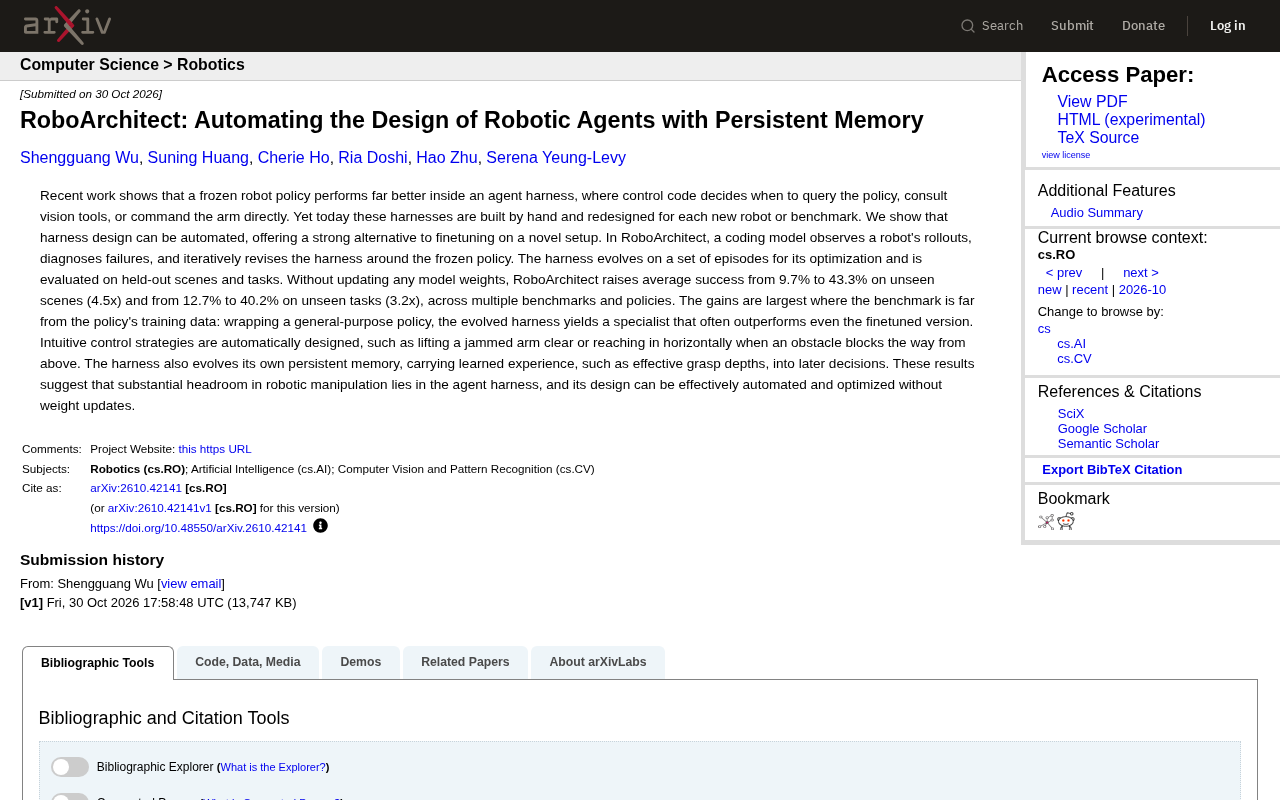
RoboArchitect uses a coding model to auto-evolve agent harnesses around frozen policies with persistent memory, greatly boosting success on unseen scenarios.
RoboArchitect introduces a weight-free robot adaptation path: a coding model observes rollouts, diagnoses failures, and iteratively generates an agent harness around a frozen policy, evolved over episodes and evaluated on held-out scenarios to avoid overfitting. It also evolves persistent memory, carrying lessons like effective grasp depth into later decisions. Experiments show success rates rise from 9.7% to 43.3% on unseen scenarios and from 12.7% to 40.2% on unseen tasks, with the largest gains far from the training distribution—often surpassing fine-tuned versions. The work turns harness design into an automated search problem, changing adaptation costs.
Title
RoboArchitect: Automatically Designing Robotic Agents, Boosting Success Rate by 4.5x
Meta Description
RoboArchitect introduces a new approach to automatically designing robotic agent harnesses: without updating model weights, a coding model observes rollouts, diagnoses failures, and iteratively revises the harness, raising success rates from 9.7% to 43.3% on unseen scenarios. The harness also evolves persistent memory, carrying lessons such as grasp depth into subsequent decisions.
Article Content
The field of robotic manipulation has long been dominated by the "fine-tune the model" mindset, but a new study proposes a completely different path: without updating any model weights, let a coding model automatically design the agent harness wrapped around a frozen policy, and inject persistent memory into it. This is RoboArchitect, which turns agent engineering from manual labor into an automated search problem.
Why "Harness" Deserves More Attention Than Fine-Tuning
Recent research has shown that a frozen robot policy performs far better when run inside an agent harness than when used alone—the control code decides when to query the policy, when to call vision tools, and when to command the robotic arm directly. But the problem is that these harnesses are currently hand-built, and must be redesigned for every new robot or benchmark.
The core insight of RoboArchitect is that harness design itself can be automated. Compared with fine-tuning model weights in new scenarios, an automatically evolved harness offers a powerful alternative. This implies that the adaptability of robotic systems may depend more on the "peripheral scheduling logic" than on "the model parameters themselves."
Robot policy typically refers to a mapping function from observations (such as camera images and joint angles) to actions (such as end-effector pose and gripper open/close), often implemented as a neural network and trained on large amounts of data via imitation learning or reinforcement learning. Fine-tuning means continuing to update the network's weights on data from a new task or scenario so that it adapts to distribution shifts. Although effective, fine-tuning requires collecting demonstration data for the target scenario, consumes compute, and may damage the original policy's generalization ability. In contrast, a frozen policy means keeping the network parameters unchanged and only scheduling the policy's inputs and outputs, calling tools, or switching skills through peripheral code (i.e., the "harness"). This approach shifts the cost of adaptation from "retraining the model" to "designing the scheduling logic," and the scheduling logic itself can be automatically generated via search or evolution methods, thereby avoiding the repetitive labor of manually designing harnesses.
How the Coding Model Evolves Control Strategies
RoboArchitect's workflow is a closed loop: the coding model observes the robot's rollouts (execution trajectories), diagnoses the causes of failure, and then iteratively revises the harness wrapped around the frozen policy. The harness is evolved and optimized over a set of episodes and evaluated on held-out scenarios and tasks to avoid overfitting.
No model weights are updated throughout the process. The evolved control strategies often have intuitive physical meanings, such as lifting a stuck robotic arm to free it from an obstacle, or approaching horizontally when the top is blocked. These strategies are not human-written rules but behavior patterns discovered through automated search.
Coding model refers to a large language model with code generation and understanding capabilities, such as code-fine-tuned GPT series or open-source code models. In RoboArchitect, the coding model does not directly output robot actions; instead, it outputs executable Python control code—that is, the harness wrapped around the frozen policy. Rollout refers to the trajectory data generated by running a complete task sequence in simulation or a real environment, including observations, actions, rewards, and success/failure signals. The coding model diagnoses problems by reading rollout logs (such as the end-effector position at failure or collision information) and modifies the harness code, forming a "generate—execute—observe—modify" loop. Evolutionary optimization here means maintaining a pool of harness candidates, eliminating poor harnesses and mutating good ones based on metrics such as task success rate, and retaining individuals that perform stably on held-out scenarios, thereby avoiding overfitting to the training episodes.
Persistent Memory: Carrying Experience Into Subsequent Decisions
Another key design of RoboArchitect is that the harness evolves its own persistent memory. Learned lessons—such as effective grasp depth—are carried into subsequent decisions. This allows the system to accumulate "feel" across multiple tasks rather than starting from scratch each time.
The memory mechanism co-evolves with the harness structure, meaning the system is not only optimizing the current action sequence but also optimizing "what to remember and how." For robotic applications that require long-term operational consistency, this may be more valuable than single-run success rate.
Persistent memory in agent systems typically refers to structured information storage retained across episodes or tasks, as distinct from the context window used only within a single inference. In RoboArchitect, memory is not simply conversation history but an experience library that the harness code can read and write, such as "a gripper depth of 2 cm at a certain grasp pose yields a higher success rate" or "when top collision detection triggers, first retreat horizontally and then lift." These lessons are persisted in forms such as key-value pairs, rules, or code comments, and are queried by the harness logic in subsequent decisions. Memory co-evolves with the harness structure, meaning the system simultaneously optimizes "what to remember" and "how to use memory to guide actions." This mechanism resembles procedural memory, enabling the robot to accumulate operational feel across multiple tasks and reduce repeated trial and error, which is especially important for industrial or household scenarios that require long-term consistency.
Data Performance: Largest Gains When Far From the Training Distribution
Evaluations across multiple benchmarks and policies show that RoboArchitect raises the average success rate from 9.7% to 43.3% (4.5x) on unseen scenarios, and from 12.7% to 40.2% (3.2x) on unseen tasks.
The largest gains occur precisely when the benchmark is far from the policy's training data. Using a general-purpose policy as the wrapper, the evolved harness can produce an "expert" that often even surpasses the fine-tuned version. This suggests that there is considerable room for improvement in robotic manipulation, and that this room lies at the agent harness layer, whose design can be effectively automated and optimized without weight updates.
Implications for Robotic Engineering Practice
The practical significance of this research lies in changing the cost structure of adapting to a new robot or task. Fine-tuning requires data, compute, and time, whereas harness evolution only requires rollout feedback and the coding model's iterative capability. For rapid deployment scenarios, this may be a lighter-weight path.
Of course, harness evolution still relies on enough episodes for optimization, and evaluation must strictly isolate scenarios and tasks. But the direction is clear: the agent harness is not an accessory but a key lever for robotic system performance.
One-line Summary
RoboArchitect uses a coding model to automatically evolve an agent harness wrapped around a frozen policy and injects persistent memory, greatly improving success rates on unseen scenarios.
Paragraph Summary
RoboArchitect proposes a robot adaptation path that does not update model weights: let a coding model observe rollouts, diagnose failures, and iteratively generate an agent harness wrapped around a frozen policy. The harness is evolved and optimized over a set of episodes and evaluated on held-out scenarios and tasks to avoid overfitting. The system also evolves persistent memory, carrying lessons such as effective grasp depth into subsequent decisions. Experiments show that the average success rate rises from 9.7% to 43.3% on unseen scenarios and from 12.7% to 40.2% on unseen tasks, with the largest gains when the benchmark is far from the training distribution; the evolved harness often even surpasses the fine-tuned version. This research turns harness design from manual labor into an automated search problem, changing the cost structure of adapting to a new robot or task.
Related articles

AI Can Read Neural Network Weights Directly: Do Models Already Exceed Expectations?
A Reddit developer experiment shows language models can directly read neural network weights and infer their function. Astra, Opus 5.5, and Muse Spark 1.3 all passed the test, sparking discussion on model generalization and training sources.

India's Microdrama Market Explodes: EloElo Secures $80M Investment from NBCUniversal
EloElo secures $80M from NBCUniversal to boost StoryTV, its microdrama platform with over 33M monthly active users, as India's microdrama market draws global capital.

Acoustic Detection of Multi-Rotor UAVs: Fusing Handcrafted Features with Pre-Trained Embeddings
Study reveals data leakage from random splits in UAV acoustic detection, proposes source-disjoint protocol with stacked ensemble of handcrafted features and YAMNet embeddings, achieving 95.29% accuracy for low-cost drone detection.