RoboBuilder: How AI Agents Bridge the Sim-to-Real Gap in Robot Design
RoboBuilder reveals the systematic sim-to-real gap when AI agents design real robots.
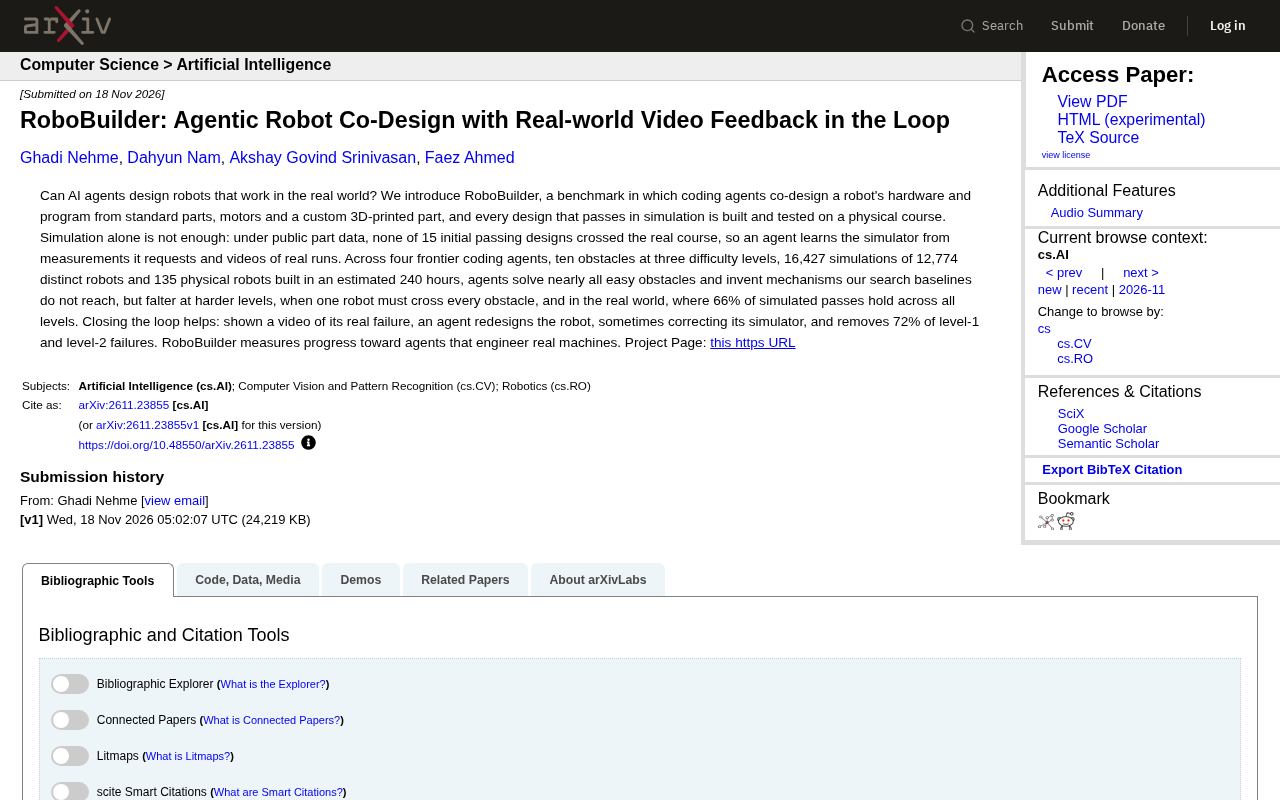
RoboBuilder is a benchmark where AI coding agents co-design robot hardware and control programs, requiring every simulation-passing design to be manufactured and validated on a physical track. Using only public part data, none of 15 sim-passing designs completed the real track, exposing systematic sim-to-real discrepancies. Agents actively learn the simulator, and real operation videos serve as a feedback loop. Across four frontier coding agents, ten obstacles, and three difficulty levels, only 66% of sim-passing designs held up in reality, while video feedback eliminated 72% of failures at levels 1 and 2.
When AI Agents Start Designing Robots: A Showdown Between Simulation and Reality
Can AI agents design robots that work in the real world? It sounds like science fiction, but the RoboBuilder project from academia is turning this into a measurable engineering challenge. Researchers built a benchmark that tasks coding agents with co-designing a robot's hardware and programs, starting from standard parts, motors, and custom 3D-printed components—and every design that passes in simulation must be manufactured and tested on a physical track. This isn't just another algorithm competition in a simulated environment—it directly exposes the often-overlooked gap between simulation and reality.
Passing in Simulation Doesn't Mean It Works in Reality: A Sobering Finding
The core insight of RoboBuilder comes from a simple but powerful experimental design: using only publicly available part data, none of the 15 designs that initially passed in simulation could complete the real track. This result directly points to a systematic discrepancy between simulators built on standard parameters and the physical world. For AI research accustomed to climbing leaderboards in simulation, this is a wake-up call—an agent's strong performance in a virtual environment doesn't mean it has grasped the physical intuition needed to make a machine work in reality.
Faced with this challenge, RoboBuilder's solution is to have agents actively learn the simulator. Instead of passively accepting preset simulation parameters, agents actively request data and revise their understanding of the simulator based on measurements and real-world operation videos. This closed loop of "learning the simulator from measurements" is the key mechanism that enables AI agents to bridge the sim-to-real gap.
Sim-to-Real Gap is a core challenge in robot learning, referring to the phenomenon where policies that perform well in simulation fail on real hardware. Its root cause is that simulators cannot precisely model real-world physical details: motor response delays, gear backlash, nonlinear friction, sensor noise, material deformation, and manufacturing tolerances. These small errors get amplified in closed-loop control, causing behavior to deviate from expectations. Common mitigation approaches include domain randomization (randomly perturbing physical parameters in simulation to strengthen policy robustness) and system identification (calibrating simulation parameters with real measurement data). RoboBuilder's finding is a textbook example of this gap: a simulator built solely from vendor-provided standard part parameters has systematic discrepancies with robot behavior on a real track, causing nearly all designs that pass in simulation to fail in reality.
Large-Scale Experiments Reveal the Boundaries of Capability
Researchers mobilized four frontier coding agents and ran large-scale tests across ten obstacles and three difficulty levels. The scale was considerable: 16,427 simulations of 12,774 different robots, plus 135 physical robots estimated to take 240 hours to build. Behind these numbers is a systematic stress test of agents' design capabilities.
The results show a clear capability stratification. Agents solved almost all simple obstacles and even invented mechanisms that search baseline methods couldn't reach—demonstrating that agents have some creativity in open-ended exploration. But when tasks got harder, when a single robot had to overcome all obstacles, and when the battlefield shifted from simulation to reality, agents began to struggle. Across all difficulty levels, only 66% of designs that passed in simulation still held up in reality. This retention rate reveals clear shortcomings in current agents' robustness and generalization abilities.
Coding Agent refers to an AI system capable of autonomously writing, modifying, and debugging code, typically built on large language models with tool-calling, file manipulation, and iterative execution capabilities. Unlike traditional code completion tools, coding agents can receive high-level task goals, autonomously plan implementation steps, run code in an environment, and adjust strategies based on feedback. In RoboBuilder, coding agents must complete two coupled tasks: designing the robot's hardware structure (selecting parts, assembling 3D-printed components) and writing control programs (driving motors to complete track tasks). This hardware-software co-design places higher demands on agents—they must not only write working code but also understand the geometric and dynamic constraints of the physical system that the code controls. The performance differences among the four frontier coding agents used in the experiments reveal the current capability stratification of models in open-ended engineering exploration.
Video Feedback Loop: Turning Failure into Fuel for Design Iteration
RoboBuilder's most inspiring design is incorporating real-world video feedback into the agent's learning loop. When agents see videos of their own robot designs failing in reality, they can redesign the robot—and sometimes even proactively correct their understanding of the simulator. This "watch failure—redesign" loop delivers quantifiable gains: it eliminated 72% of failure cases at difficulty levels 1 and 2.
The significance of this mechanism extends beyond robot design itself. It demonstrates a general paradigm for improving AI agents: letting agents directly observe feedback from the physical world rather than relying on hand-coded reward signals or simulation metrics. Video, as a rich and intuitive feedback modality, provides agents with clues to understand "why it failed," triggering more targeted redesigns.
The role of visual feedback in agent learning deserves further elaboration. Traditional reinforcement learning relies on scalar reward signals—agents can only know "how well they did," but struggle to understand "why it went wrong." Video provides high-dimensional, spatiotemporally continuous observations that enable agents to pinpoint the specific failure point—whether a joint got stuck, a part broke, or the control timing was wrong. With the support of multimodal large models, agents can parse visual information from video frames and map it to their own design parameters and control code, forming causal inferences. This capability makes "redesigning after watching failure videos" possible and makes video a scalable feedback modality that requires no manual annotation. RoboBuilder's elimination of 72% of failure cases at difficulty levels 1 and 2 is direct evidence of the effectiveness of the visual feedback loop.
A Signpost Toward Engineering-Grade Agents
RoboBuilder's value lies not just in showing what agents can do, but in providing a yardstick to measure progress. The project explicitly positions itself as "measuring progress toward agents that design real machines." This benchmark integrates hardware design, program writing, simulation learning, and physical validation into a single closed loop, forcing agents to confront the complexity of real engineering—part tolerances, assembly errors, material properties—factors often ignored in pure simulation that must be overcome here.
From a broader perspective, this research points to a noteworthy trend: AI agent evaluation is shifting from purely digital tasks to embodied tasks in the physical world. Only when agents are accountable for their designs in reality can researchers and engineers accurately assess how far they are from true engineering capability. RoboBuilder's preliminary answers are both encouraging—agents can invent new mechanisms and learn from video—and sobering—on difficult tasks and in the real world, they still need human guidance and more powerful learning mechanisms.
One-line Summary
RoboBuilder benchmark reveals the systematic sim-to-real gap when AI agents design real robots.
Paragraph Summary
RoboBuilder is a benchmark where AI coding agents co-design robot hardware and control programs, requiring every simulation-passing design to be manufactured and validated on a physical track. The key finding: using only public part data, none of 15 simulation-passing designs could complete the real track, exposing systematic sim-to-real discrepancies. Researchers had agents actively measure and learn the simulator, and introduced real operation videos as a feedback loop. In large-scale experiments with four frontier coding agents, ten obstacles, and three difficulty levels, agents excelled on simple tasks and even invented new mechanisms, but struggled on difficult tasks and real-world transfer—across all difficulty levels, only 66% of simulation-passing designs held up in reality. The video feedback loop eliminated 72% of failure cases at difficulty levels 1 and 2, demonstrating an improvement paradigm where agents directly observe physical feedback.
Related articles

Zero-Code Replication of a $10,000 3D Website with Claude Code: A Six-Tool Breakdown
Bilibili creator Yomi used Claude Code plus five free tools to build a 3D product landing page quoted at $10,000 overseas—zero code. Breakdown of the six-tool division of labor, image-to-3D workflow, and the core collaboration method: "give AI a reference, not 'make it look better.'"

Claude Code in Practice: Install, Connect Models, Calculate Tokens, and Ship a Full-Stack Project with a Single Document
Based on a Bilibili public course demo, this covers Claude Code installation, model connection, token cost calculation, and the practical path of shipping a full-stack project with a single document, plus comparisons with Copilot, Cursor, Trae, and other coding assistants.
Who Accepts AI-Written Code? A 25-Minute Deep Dive into Verification Loops and the New Code Review Paradigm
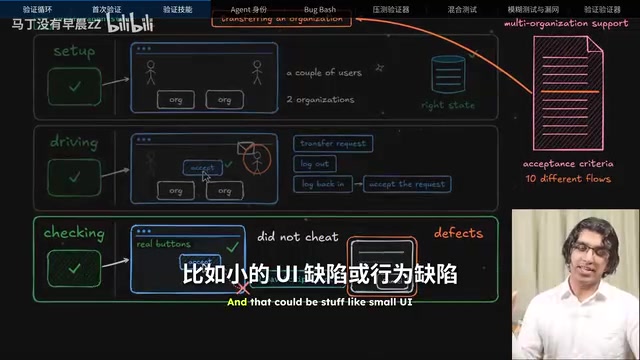
After AI writes lots of code, how should Code Review verify it? This article breaks down the Claude Code team's verification loop framework: surface-level end-to-end verification, setup/drive/check three-stage skills, hybrid end-to-end testing and reliability checklists, and how to tighten the loop when issues slip through.