ROCmFix and InferBench: Running Local LLMs on AMD GPUs — A Practical Look
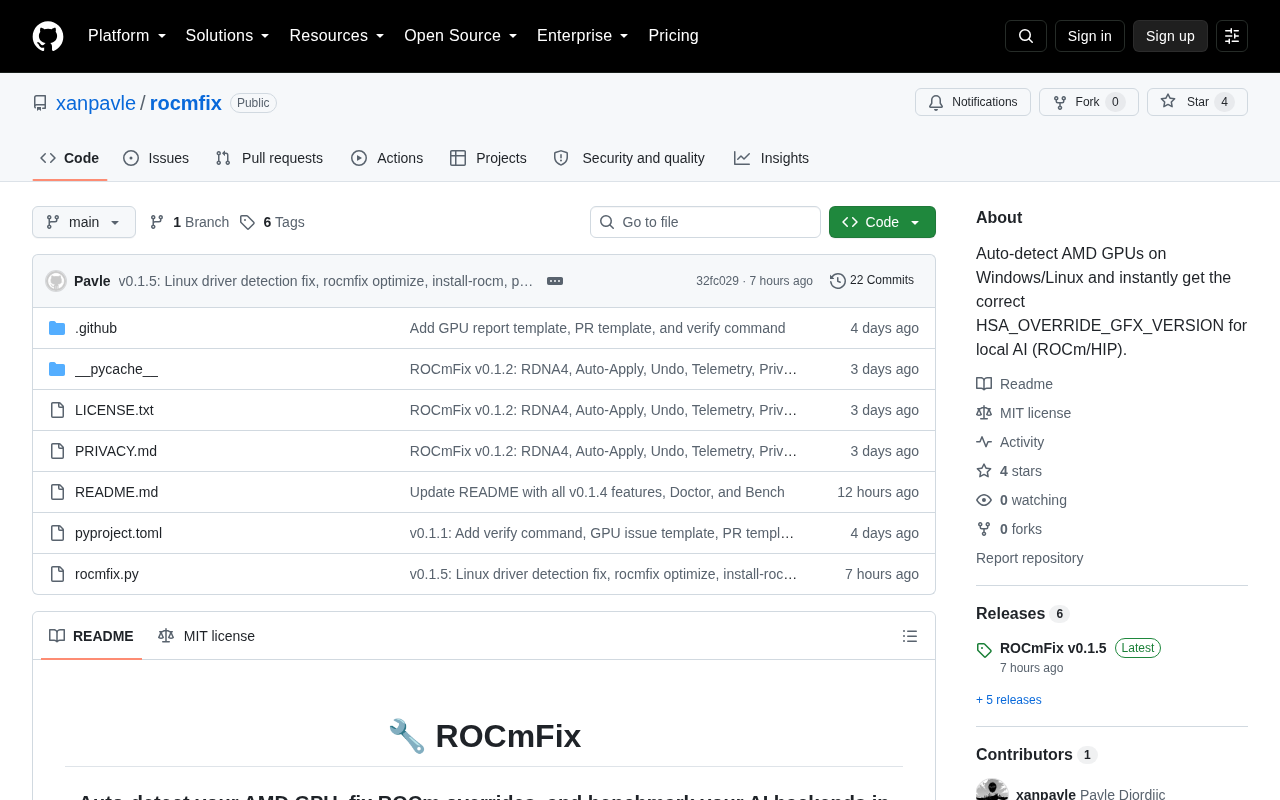
ROCmFix and InferBench tackle AMD GPU local LLM deployment friction and the Vulkan vs. HIP performance debate.
This article introduces two community tools for AMD GPU users that surfaced on Hacker News: ROCmFix and InferBench. ROCmFix aims to simplify ROCm environment setup, helping users more smoothly deploy local LLMs like Llama and Mistral on AMD hardware. InferBench addresses a long-standing gap in systematic benchmarking: on the same AMD GPU, which backend is faster — the broadly compatible Vulkan or the higher-potential native HIP (ROCm) path? Together, they reflect community developers actively filling tooling and benchmark gaps in the AMD local LLM ecosystem.
Background: The Pain of Running Local LLMs on AMD GPUs
In the local large language model (LLM) space, NVIDIA has long dominated thanks to its mature CUDA ecosystem. AMD GPU users who want to run local inference typically have to wrestle with the ROCm (Radeon Open Compute) driver stack for hours — dealing with complex environment setup, dependency version conflicts, and the challenge of choosing the right backend.
Two projects recently shared on Hacker News — ROCmFix and InferBench — take direct aim at these pain points. The former tries to simplify the local LLM deployment process on AMD platforms, while the latter focuses on a long-debated question: on AMD hardware, is the Vulkan backend faster, or is HIP (ROCm's programming interface) the better choice?
ROCmFix: Lowering the Barrier to AMD Local Deployment
ROCmFix is positioned as a helper tool designed to reduce the friction AMD GPU users face when setting up a local LLM inference environment. While ROCm — AMD's open-source compute platform and CUDA counterpart — has made notable strides in deep learning framework support in recent years, correctly installing drivers, matching ROCm versions, and compiling inference engines remains a significant hurdle for everyday users.
The value of tools like this lies in codifying scattered configuration knowledge, reducing the trial-and-error cost of version compatibility and environment setup. For developers and enthusiasts who want to run models like Llama and Mistral locally on their AMD GPUs rather than relying on the cloud, an "out-of-the-box" experience is a genuine necessity.
ROCm (Radeon Open Compute) is AMD's open-source GPU compute platform, analogous to NVIDIA's CUDA, providing a complete software stack including drivers, runtime, compilers, and math libraries for general-purpose GPU computing. A core challenge with ROCm is its relatively limited range of supported GPU models — primarily covering Radeon RX 6000/7000 series and Instinct data center cards, with some consumer GPUs (like the RX 5000 series) sitting on the edge of or entirely outside official support. On top of that, ROCm iterates quickly, making version alignment with upstream frameworks like PyTorch and llama.cpp complex — a mismatch can lead to compilation failures or runtime crashes. This is exactly why "fix scripts" and configuration tools like ROCmFix have found a community audience: they essentially package community-accumulated version compatibility patches, letting ordinary users skip the tedious manual troubleshooting process.
InferBench: The Vulkan vs. HIP Performance Showdown
InferBench addresses a very specific question: given the same AMD GPU running the same model with different inference backends, how large is the performance gap?
The Technical Differences Between the Two Backends
HIP is ROCm's native programming interface. In theory, it sits closer to the hardware and delivers higher computational efficiency — but at the cost of stricter driver and environment requirements and more frequent compatibility issues.
Vulkan, as a cross-platform graphics and compute API, has been adopted by projects like llama.cpp as a general-purpose GPU inference backend. Its strengths are broad compatibility and easy deployment with virtually no dependency on vendor-specific driver stacks. The tradeoff is that peak performance on specific hardware may fall short of native solutions.
It's worth noting that llama.cpp, currently the most widely used open-source framework for local LLM inference, supports multiple GPU backends simultaneously — including CUDA (NVIDIA), Metal (Apple Silicon), Vulkan (cross-platform), and a ROCm/HIP compilation path. The addition of the Vulkan backend means that anyone with a GPU supporting Vulkan 1.2+ — including older AMD cards and even some Intel integrated graphics — can get GPU acceleration, dramatically lowering the hardware bar. The HIP path, by contrast, relies on the ROCm toolchain and produces code closer to the native instruction set of AMD's GCN/RDNA architectures, theoretically able to leverage more hardware features such as matrix acceleration units. The performance gap between the two paths varies across different GPU models and model quantization levels (Q4, Q8, etc.), with no universal conclusion — which is precisely the question InferBench aims to answer through systematic benchmarking.
Why This Comparison Matters
For AMD users, choosing a backend isn't a matter of pure technical preference — it's a tradeoff between "just getting it to work" and "getting the best performance." The Vulkan path is less hassle but may come with a performance penalty; the HIP path has greater potential but carries a higher setup cost. The benchmark data from InferBench is exactly the kind of evidence users need to make this call. It's also a space where the local LLM community has long debated without having access to systematic, real-world test data.
What This Means for the Local LLM Ecosystem
As demand for local LLM deployment grows, breaking NVIDIA's de facto monopoly has become a key focus for the community. AMD GPUs often offer more competitive VRAM capacity and pricing — if the software stack can match in usability and performance, it would give local LLM users far more choice.
The emergence of community tools like ROCmFix and InferBench reflects developers proactively filling the gaps in AMD's ecosystem around tooling and real-world benchmark data. These projects may still be in early stages, but they represent a pragmatic effort: rather than waiting for vendors to polish everything, take the initiative to map out the current state through tools and benchmarks.
Summary
It's worth noting that this project currently has limited traction on Hacker News (5 points, 1 comment), and with little public information available, it's too early to draw firm conclusions about its maturity or findings. That said, the two problems it tackles — ease of AMD local deployment, and the performance tradeoff between Vulkan and HIP — are real pain points in the local LLM community. For users sitting on AMD GPUs and looking to explore local inference, these tools are worth keeping an eye on.
Related articles

The Freud-Jung Split: Inside the Love and Hate of Psychoanalysis's Founding Father
Historian Andrew Scull on the Lex Fridman podcast unpacks how Freud and Jung went from close allies to bitter rivals — covering psychoanalysis's origins, Anna O, and Freud's personality.

Gender Disparities in the History of Psychiatric Treatment: Why Women Became the Primary Test Subjects
Medical historian Andrew Scull reveals on the Lex Fridman podcast that 60–70% of ECT and lobotomy patients were women. An analysis of diagnostic gender bias and psychiatric institutions as social control.
Tired of Manually Tuning RAG? Open-Source Tool Muffakir Automates Your Experiments
Muffakir is an open-source RAG experiment runner that automates chunking, embedding, retrieval, reranking, and top-k combinations, comparing results by metrics, latency, and cost.